Concept illustration
Read diagram notes
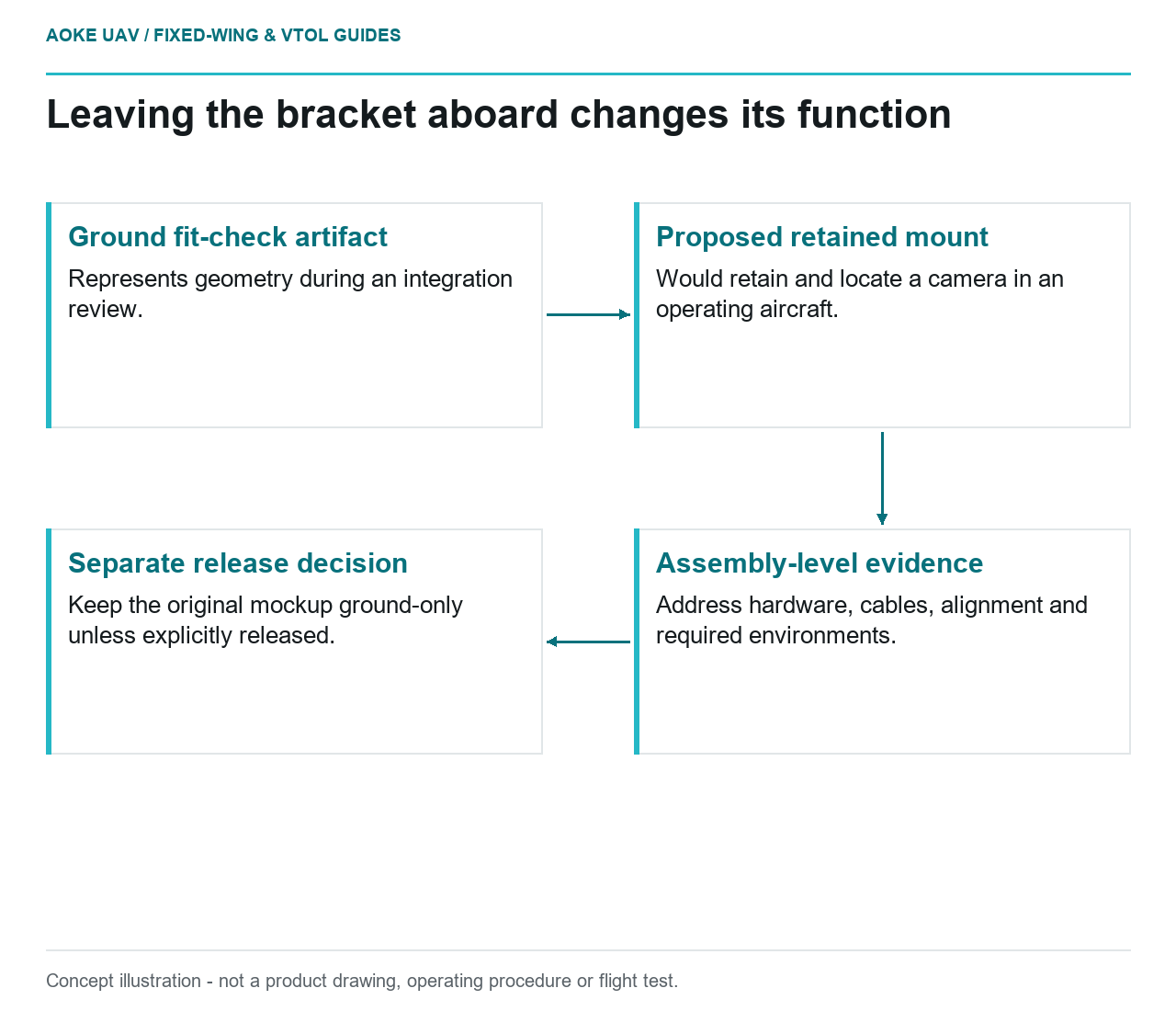
- Ground fit-check artifact: Represents geometry during an integration review.
- Proposed retained mount: Would retain and locate a camera in an operating aircraft.
- Assembly-level evidence: Address hardware, cables, alignment and required environments.
- Separate release decision: Keep the original mockup ground-only unless explicitly released.
A camera bracket that proved useful during a ground fit check is not automatically a candidate for flight. In this hypothetical large civil fixed-wing mapping aircraft, the proposed change is deceptively small: leave the printed bracket installed. The important change is functional. An artifact used to represent geometry would now retain a payload within an operating aircraft, creating a different engineering and release decision.
Failure consequence and retention
Begin with the actual proposed function. Which camera and attachment revision would the bracket retain? Where could movement, detachment, or loose fragments affect the aircraft? Which interfaces carry loads, locate the sensor, or preserve clearance? These are questions for the responsible design authority. Describing the item as a sensor accessory or non-primary structure does not answer them.
NASA-STD-6030 places AM part purpose, operating environment, material definition, production process, and qualification planning within part-specific documentation for its spaceflight applications. That organization illustrates why a fit model cannot stand in for a defined retained component. It does not classify this UAV bracket, establish its required tests, or grant permission to install it. [5]
Process qualification and traceability
The bracket proposal should identify the complete manufacturing state, not just the polymer name. Request machine identity, feedstock specification and lot, build orientation, build-file revision, and relevant post-processing definition. NASA distinguishes feedstock, build control factors, and post-AM processing when defining a candidate material process. Those controls have a specific spaceflight context; here they inform evidence questions rather than a borrowed qualification claim. [5]
For this fixed-wing review, make the configuration discrepancy visible. The ground mockup may lack a production drawing, traceable batch, controlled support removal, or inspection of attachment features. Do not reconstruct those records from assumptions after the event. The design authority can choose a new controlled article for evaluation rather than pretend an undocumented mockup was manufactured to requirements that did not yet exist.
Thermal and vibration interfaces
Define an installation evidence plan around the assembly, including fasteners, inserts, cable restraints, surrounding structures, and sensor alignment requirements. Ask which temperatures, vibration environments, handling conditions, and service exposures the aircraft program requires the mount to address. This article supplies neither environmental limits nor a bracket test recipe. A desktop fit check contains no evidence about an unspecified installed exposure.
A useful review distinguishes sensor survival from aircraft retention and data quality. The camera might remain powered while its orientation changes, or the bracket might remain attached while another interface becomes unacceptable. Those are hypothetical failure questions, not reported events. Assign an owner to each verification question and identify the controlled configuration to which any future evidence would apply.
Assembly-level substantiation requirements
Request acceptance criteria before selecting evidence. The authority should decide which analyses, specimens, representative features, and assembly evaluations are necessary for this particular mounting function. NASA treats establishment and modification of a qualified part process as controlled decisions, with changes linked to written approval and requalification methodology in its own framework. That is a process-control example, not a direct requirement imposed here on a UAV. [5]
End the review with separate dispositions: the original artifact remains a ground fit-check aid; the proposed flight mount remains a design under evaluation unless released by the applicable aircraft authority. A large fixed-wing integration team gains nothing by calling the same object qualified simply because it fitted once. Keep the evidence package identifiable to the camera, bracket, attachment hardware, aircraft interface, and manufacturing configuration actually reviewed. This preserves a usable boundary when any one of those inputs later changes.
Related reading
- Removable Payload Trays Without Hidden Structural Assumptions
- Lever Arms in Fixed-Wing Payload Integration