Concept illustration
Read diagram notes
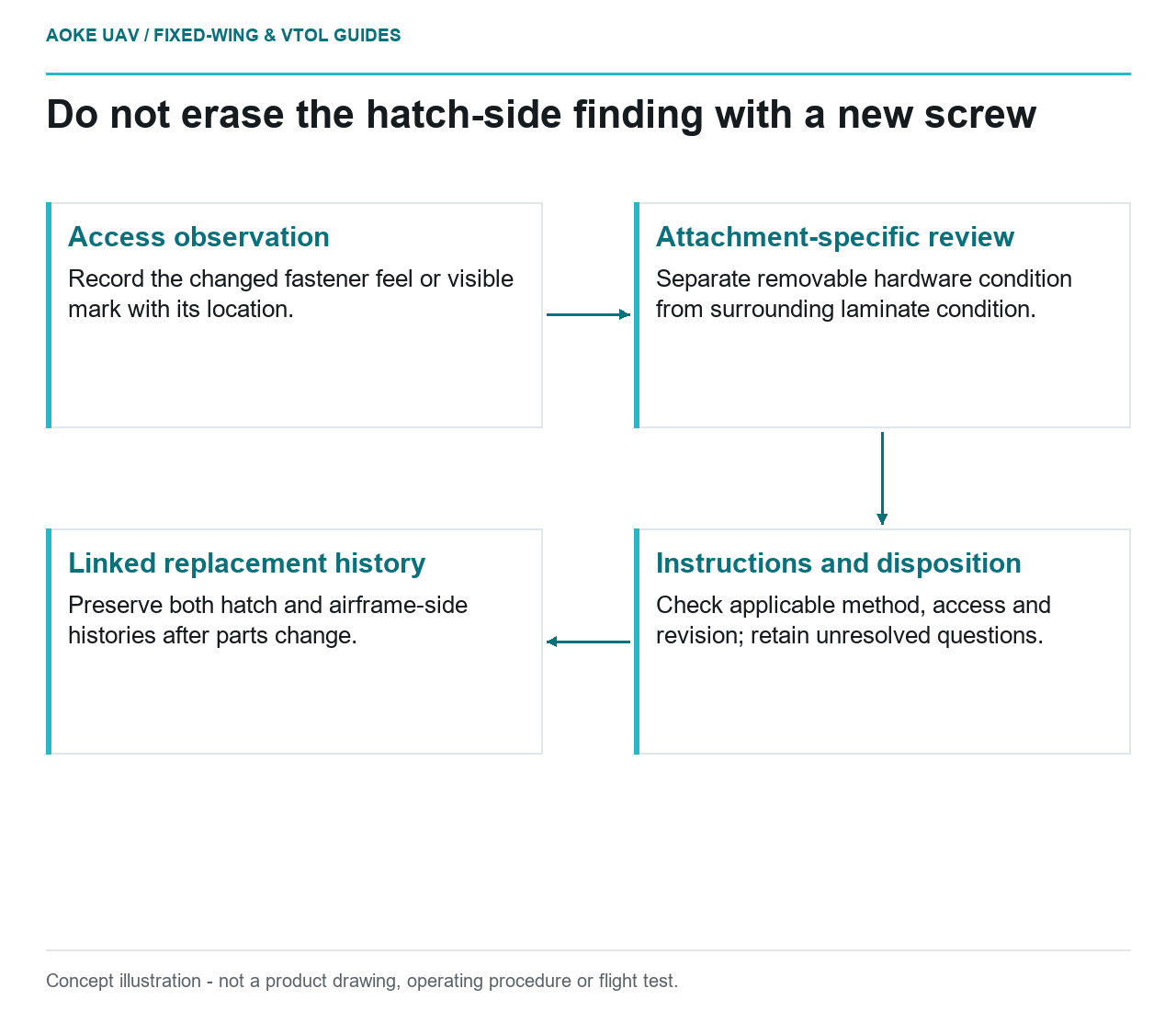
- Access observation: Record the changed fastener feel or visible mark with its location.
- Attachment-specific review: Separate removable hardware condition from surrounding laminate condition.
- Instructions and disposition: Check applicable method, access and revision; retain unresolved questions.
- Linked replacement history: Preserve both hatch and airframe-side histories after parts change.
Between sorties in a hypothetical large fixed-wing survey campaign, a crew repeatedly opens a payload hatch to exchange equipment. Someone notices that one fastener no longer feels like its neighbours. The useful question is not how many openings every composite hatch should survive. It is what the applicable instructions say about this attachment, its surrounding laminate and the history of prior replacements. This review proposes a record structure and supplier questions; it does not authorize tightening, insert replacement or a new reuse limit.
Retention hardware and local laminate
Identify the hatch, frame, retained hardware and airframe configuration. Ask the supplier to show which pieces provide retention and which surfaces define the intended seating condition. Keep the attachment region in view rather than treating the fastener as an isolated commodity. For this hypothetical fixed-wing installation, the review should distinguish a damaged removable item from an unresolved condition in the structure carrying it.
FAA composite guidance notes that special fasteners and installation procedures require consideration of damage to composites, including delamination and fiber breakage, as well as galvanic issues. This is US certificated-aircraft guidance, not a maintenance procedure for the UAV. [1] Its relevance is the need for attachment-specific instructions and evidence, not a universal rule for interchangeable hardware.
Wear at countersinks and inserts
Ask what the documented inspection covers at the fastener head, countersink, insert and nearby laminate. Record visible changes with location references so that later photographs can be compared. Avoid interpreting a polished contact mark, loose-feeling fastener or surface crack as a complete diagnosis. The responsible maintainer needs the exact finding and applicable acceptance criteria.
FAA guidance distinguishes visual detection from the additional procedures needed to characterize hidden damage. [1] For the industrial fixed-wing team, that means a hatch that closes neatly has not necessarily answered the structural question. Nor should an improvised field test be used to infer insert strength. If the instructions do not address the observed condition, request a disposition instead of substituting a generic fastener inspection threshold.
Tool access and assembly consistency
In the proposed review, observe the documented assembly task without changing it. Can the specified tool reach the fastener directly? Is the intended hardware identifiable after a payload exchange? Does the work package show the same hatch and attachment revision as the installed assembly? These questions expose configuration and access gaps without prescribing a new tightening method.
Keep any numerical assembly requirements attached to their actual controlled source. No torque, preload, lubrication or cycle-count recommendation is established by this explainer. FAA guidance calls for appropriate maintenance procedures, equipment and training for the particular composite detail. [1] A different tool or replacement fastener may require supplier review even if it appears easier to use. Convenience during a short fixed-wing turnaround is not evidence of equivalence.
Recording replacement history
Create a local history that links the hatch serial or part identity to attachment findings, replacements and unresolved discrepancies. Record the reason for replacement as well as the replacement part identity. A new screw should not erase the earlier observation about the surrounding structure. If the hatch moves to another fuselage, preserve the distinction between the removable hatch history and the airframe-side attachment history.
FAA maintenance discussion calls for repair documentation associated with the specific part and feedback on service damage. [1] For this hypothetical large fixed-wing operation, use that principle to ask whether the supplier has a defined reporting route and replacement policy. Do not invent a reusable-cycle limit from the number of entries in a log. The goal is a traceable response to an actual condition, not an unsupported claim that routine access is harmless indefinitely.