Concept illustration
Read diagram notes
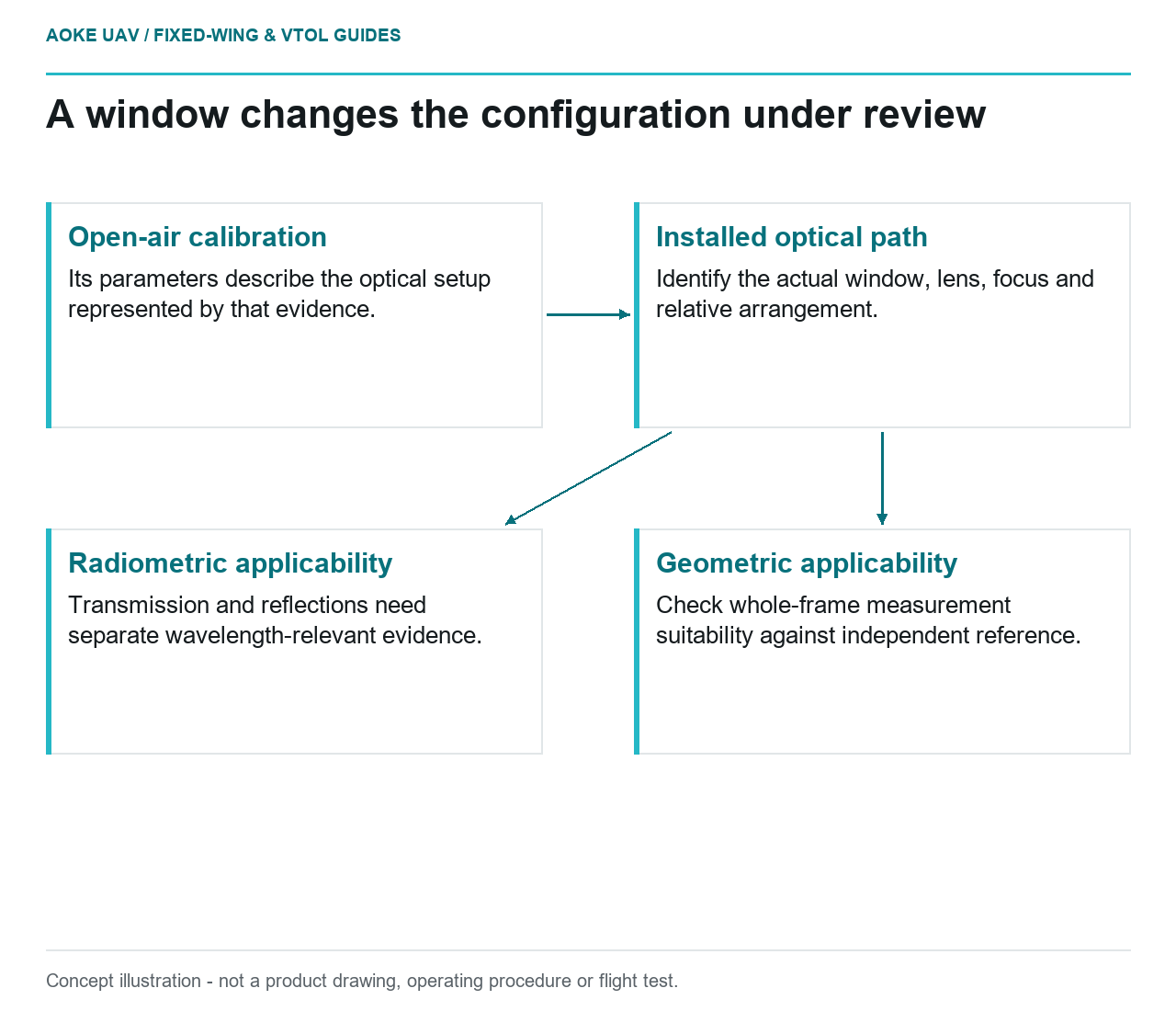
- Open-air calibration: Its parameters describe the optical setup represented by that evidence.
- Installed optical path: Identify the actual window, lens, focus and relative arrangement.
- Geometric applicability: Check whole-frame measurement suitability against independent reference.
- Radiometric applicability: Transmission and reflections need separate wavelength-relevant evidence.
A camera calibration describes a measurement configuration, not every future installation surrounding that camera. In a hypothetical large fixed-wing survey aircraft, a camera calibrated without a belly window is later placed behind one. The engineering question is whether the existing calibration and radiometric corrections remain applicable to the installed optical path. This article defines that evidence review; it does not certify any window.
Optical path through the installed window
USGS describes geometric camera calibration as characterizing the light path through interior-orientation parameters and distortion terms. It also explains why calibration obtained in one setting may need refinement in operational data. That supports asking whether the calibration configuration represents the installed system, but the report does not supply a window-specific correction model. [6]
For the hypothetical fixed-wing payload, the installation record would identify the window, lens, camera body, focus configuration and their relative arrangement. The team would ask the camera supplier which optical configurations its calibration covers. If the existing certificate does not mention the installed window, applicability would remain an unresolved question rather than an assumed equivalence.
A proposed evaluation would preserve observations made with the actual installation and connect them to an independent reference. It would test an agreed measurement objective, not merely demonstrate that recognizable photographs pass through the opening. Neither an unchanged image size nor a visually sharp central feature would establish whole-frame geometric suitability.
Reflections and spectral transmission
The RedEdge-MX integration guide specifically advises against a lens cover during flight because it may filter the wavelengths being measured. This is model-specific guidance and a useful warning against assuming that every transparent protective element is spectrally neutral. It does not establish the transmission or reflection behavior of an aircraft belly window. [20]
The hypothetical review would therefore request wavelength-dependent supplier information for the actual window assembly, including relevant coatings and the intended viewing conditions. A visible-light description alone would not answer a multispectral suitability question. Claims concerning reflections or throughput would need the appropriate supplier data or a defined characterization, neither of which is provided here.
The analyst would also separate geometric and radiometric evidence. A correction that helps align coordinates would not, by itself, establish valid reflectance. Conversely, a plausible panel response would not prove that the entire image geometry is correct. USGS treats these two calibration domains separately. [6]
Geometry and mounting stability
The proposed configuration review would document how the optical assembly is identified after maintenance. Window replacement, camera removal or a change in their relative arrangement would trigger an applicability check against the established evidence. Whether a particular change requires recalibration is an aircraft-and-sensor question; no universal interval or tolerance can be set from the sources here.
For a large fixed-wing campaign, the reviewer would retain image samples and installation records from the acquisition configuration. If an anomaly appears after servicing, those records would allow a controlled comparison rather than an unsupported conclusion that the new window caused it. Structural retention, sealing and aperture design remain separate engineering subjects.
Evidence required from camera and window suppliers
USGS recommends preserving equipment settings, calibration coefficients and documented processing methods with the imagery. It also warns that GSD does not directly establish positional accuracy. Fine output pixels therefore do not close an unanswered installed-window calibration question. [6]
The evidence package for this example would need supplier applicability statements, the installed optical definition, a project-specific evaluation method and independent quality results. Missing transmission data or an unspecified window would be recorded as blockers to a suitability claim, not replaced with a generic statement about optical glass.
The defensible conclusion is conditional: the existing open-air calibration may be used only to the extent justified for the installed configuration. Until that relationship is demonstrated, the project can describe its review plan and limitations, but it cannot claim calibrated performance behind the aircraft window.
Related reading
- Structural Retention and Sealing of UAV Payload Windows
- Payload Power Transients and Survey Sensor Integration