Concept illustration
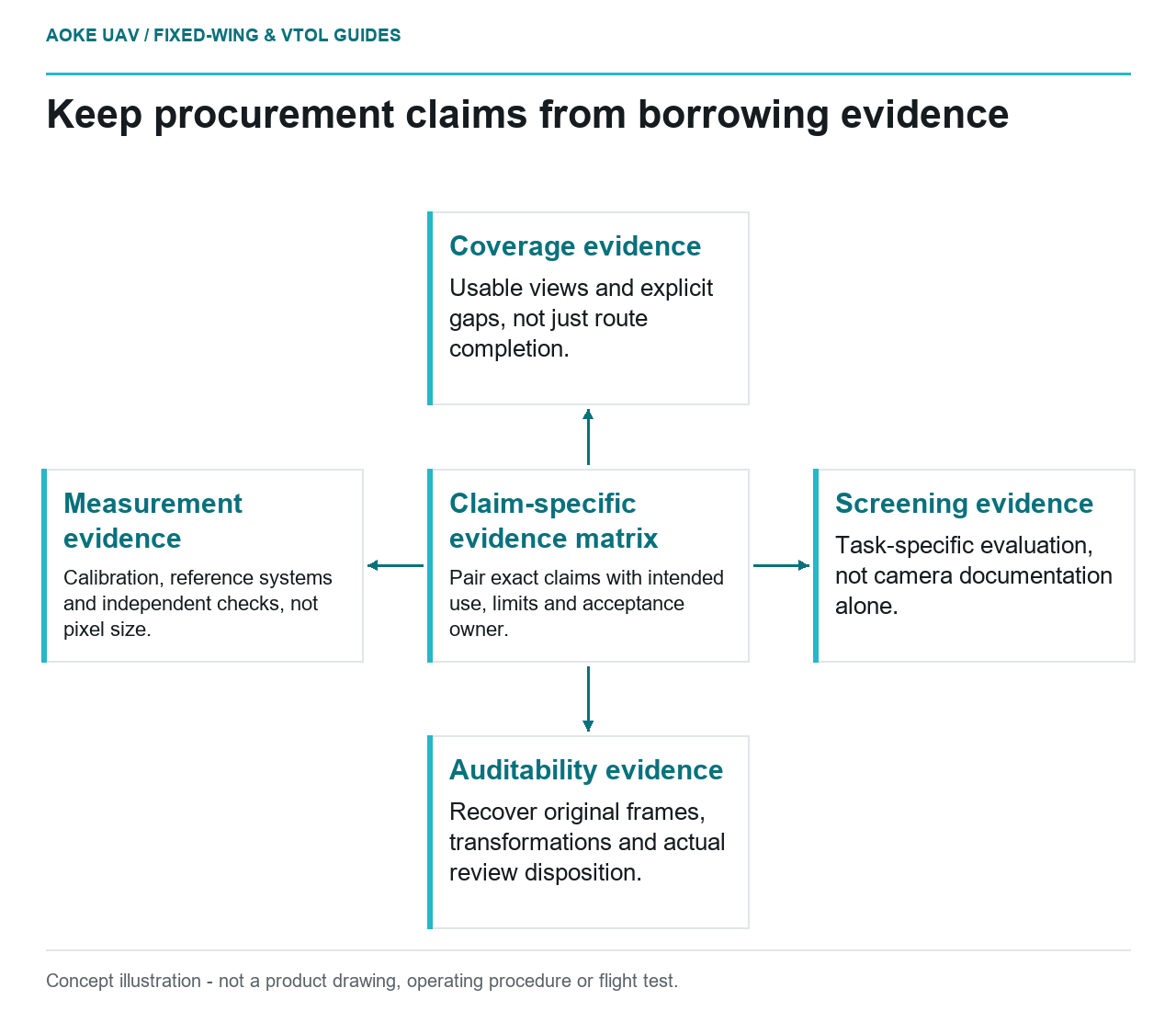
Read diagram notes
- Claim-specific evidence matrix: Pair exact claims with intended use, limits and acceptance owner.
- Coverage evidence: Usable views and explicit gaps, not just route completion.
- Measurement evidence: Calibration, reference systems and independent checks, not pixel size.
- Screening evidence: Task-specific evaluation, not camera documentation alone.
- Auditability evidence: Recover original frames, transformations and actual review disposition.
Build rows around claims the buyer can test
A hypothetical civil asset owner is comparing proposals for large industrial fixed-wing corridor monitoring. One proposal promises complete coverage, accurate mapping, thermal fault detection and an auditable report. Rather than accept or reject the package as a whole, the owner needs a matrix that makes each claim answerable. This is an editorial procurement exercise, not an GAUTEN service offer, a supplier assessment or a completed acceptance test.
For every row, record the supplier’s exact claim, intended asset question, required evidence, applicability limits and acceptance owner. Add a status that distinguishes evidence requested, evidence received and claim accepted for a stated use. The matrix should expose unresolved items before procurement; it should not manufacture a favorable rating from polished examples or a common aircraft label.
Row one: complete coverage of the requested evidence
Translate complete coverage into an owner-defined observation unit and required view. In the hypothetical corridor, a photographed asset roof and a concealed side face are different observation requirements. Request an actual coverage record and usable-view examples for the proposed large fixed-wing configuration. A planned route, nominal footprint or flight duration belongs to collection planning, not proof that every required surface has been observed.
The row’s acceptance question is whether the provider can document usable observations and explicit gaps against the agreed scope. Ask how inaccessible or unsuitable views are reported and what alternative-method disposition is proposed. Keep aircraft capability evidence separate from sensor output evidence: an endurance demonstration does not, by itself, validate the required image or observation.
Row two: accurate coordinates and dimensions
USGS imagery guidance distinguishes ground sample distance from geometric accuracy and links data quality to calibration, control and independent checking. It also emphasizes metadata that explain processing and uncertainty. These are appropriate principles for requesting map-quality evidence, not a universal accuracy threshold for the owner’s corridor. [1]
Write the desired measurement, reference system and acceptance method in the matrix before comparing supplier numbers. Request results from representative checks with their uncertainty and configuration context. If a proposal supplies only pixel size, record that the claimed coordinate or dimensional quality remains unverified. The acceptance decision should identify the actual use supported, such as contextual mapping rather than a more demanding measurement.
Row three: thermal or automated defect screening
FLIR’s guidance describes emissivity, reflected surroundings and atmospheric contributions to infrared measurement. It does not supply an industrial asset fault criterion. A buyer should therefore request measurement-context evidence separately from the asset-specific method used to interpret a thermal observation. Do not treat a camera manual as validation of a fault-detection service. [2]
For an automated screening claim, ask for target definitions, evaluation independence, tested conditions and the exact deployed model version. Require applicable primary performance evidence rather than inventing a detection rate or importing a result from an unrelated task. If it is unavailable, the row remains unresolved or the purchase scope is narrowed to exploratory flags requiring review, not diagnosed defects.
Row four: auditability of the delivered finding
Request a sample finding that links to the original frame, displayed crop, asset association, processing history and actual reviewer disposition. Ask a buyer-side reviewer to follow the evidence path without assistance from the proposal author. Record whether that exercise was performed and what it found. This is a proposed acceptance test, not a claim that a supplier’s system has passed.
Keep output-evidence acceptance distinct from qualification of physical flight hardware or legal operating authorization. The matrix concerns whether the proposed service can support the client’s observation and reporting decisions; those other questions require their own documentation. A strong hardware dossier does not resolve an unsupported asset diagnosis.
At contract review, retain every unresolved row with a requested remedy and decision owner. The buyer can then commission a bounded fixed-wing service, seek a task-specific demonstration or choose another method. The matrix succeeds when it prevents unlike claims from borrowing one another’s evidence, not when every cell has been made green.
Related reading
- Survey Tender Questions That Expose Unsupported Claims
- A Propulsion Supplier Evidence Checklist for Industrial UAVs