Concept illustration
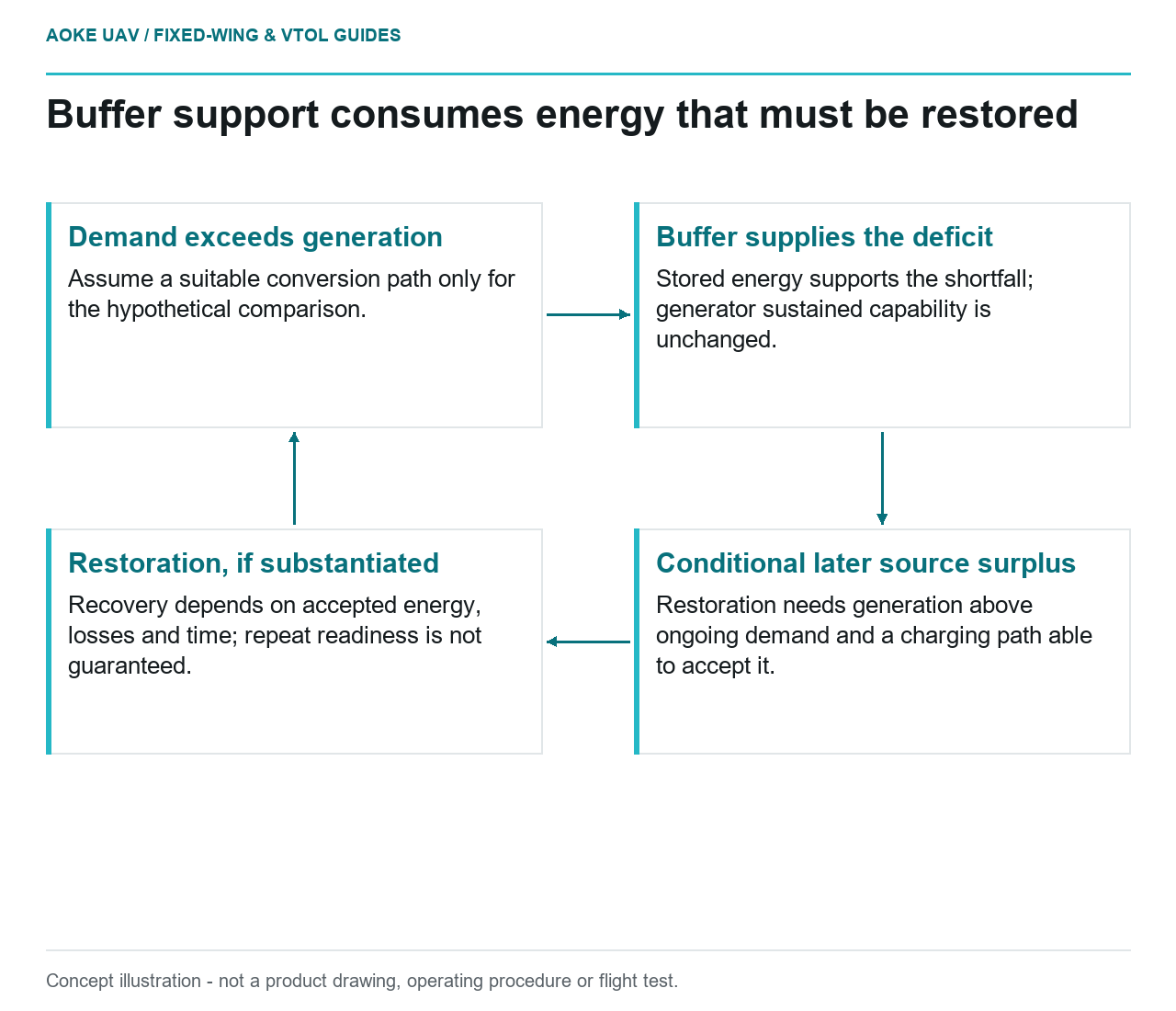
Read diagram notes
- Demand exceeds generation: Assume a suitable conversion path only for the hypothetical comparison.
- Buffer supplies the deficit: Stored energy supports the shortfall; generator sustained capability is unchanged.
- Conditional later source surplus: Restoration needs generation above ongoing demand and a charging path able to accept it.
- Restoration, if substantiated: Recovery depends on accepted energy, losses and time; repeat readiness is not guaranteed.
A generator nameplate does not describe how a hybrid system handles a sudden demand increase or restores energy afterward. Consider a hypothetical large industrial fixed-wing VTOL surveying a civil infrastructure corridor. Its proposed generator and buffer battery must be assessed together, not as two independent capacity labels. The example below uses documented marine equipment to explain a power-flow distinction, not to select aircraft hardware.
Load profile and generator operating range
Victron’s Marine Generator Test 2007, revised January 7, 2008, describes physical generator tests, not an aircraft simulation or flight demonstration. Its hybrid rig used MultiPlus inverter/chargers and an AGM battery bank. In the recorded Kohler 3.5 EFOZ resistive-load case, a 5.4 kW load was supplied with about 3 kW from the generator and 2.4 kW from the MultiPlus; battery discharge was recorded separately.[1]
The topology matters: this is an AC generator supplying an AC load, with a DC battery-connected inverter/charger operating alongside it. Victron’s MultiPlus description identifies an inverter, charger and transfer switch; its PowerControl function reduces charging demand to leave capacity for other consumers.[2] The hypothetical aircraft’s distribution topology remains unspecified. An AC paralleling example does not establish an aircraft DC-bus design, nor justify adding component nameplates as continuous aircraft output.
Transient support from stored energy
For the MultiPlus arrangement, PowerAssist supplements generator power from the battery when demand exceeds the available input; when demand falls, spare source capacity can recharge the battery. The generator FAQ separately describes dynamic current limiting as using inverter assistance to absorb a load change while giving the generator time to respond.[2][3] These are identified product functions, not a universal hybrid-aircraft control law.
Now make an explicitly hypothetical comparison: the survey aircraft encounters a brief interval in which lift propulsion and forward thrust require more electrical power than generation supplies. Assume, solely for this thought experiment, that its actual conversion path and battery can deliver the difference. The buffer then supplies a deficit; it does not raise the generator’s sustained capability. Extending that same deficit consumes more stored energy. A successful short support event therefore cannot establish support for a longer transition.
Compare two subsequent cruise intervals. In one, generation only meets ongoing consumption: there is no assumed surplus for restoring the buffer. In the other, generation exceeds consumption and the documented charging path can accept some surplus. Only the second case even offers a recharge opportunity. Repeating the high-demand interval before sufficient restoration would begin from a different energy state. This is qualitative energy reasoning, not a charge schedule or an endurance prediction.
Conversion losses and thermal limits
The report’s later illustrative battery calculation includes AC-to-DC, DC-to-AC and battery cycling losses, with lost energy becoming heat; that calculation is not a measured aircraft efficiency.[1] In our hypothetical comparison, energy drawn during assistance and energy restored later must therefore be evaluated at compatible boundaries. Crediting all surplus generation as recovered battery energy would erase the intervening conversion and storage processes.
Victron’s generator FAQ also distinguishes peak marketing ratings from sustained duty and flags charging load and ventilation as integration concerns.[3] No marine efficiency, cooling arrangement, rating or operating setting transfers here. For a large fixed-wing installation, the unanswered issue is whether the actual generator, converter and battery retain the required capability throughout the proposed support-and-restoration sequence, including its thermal history.
Evidence for integrated controls and failure cases
The marine tests also recorded a compressor-start case where generator voltage fell enough for the MultiPlus to disconnect and carry the load independently. Assistance did not simply preserve parallel sharing through the disturbance.[1] This observed mode change is more informative than assuming that a running generator must still be contributing electrically.
For the hypothetical fixed-wing VTOL, distinguish a planned deficit with both sources contributing from loss of the generation path. The latter would ask storage and conversion to carry a different burden. Neither the resistive-load result nor the compressor observation establishes aircraft failure tolerance. What remains after nominal output is known is a bounded explanation of who supplies each changing demand, how long storage is used, and whether energy can actually be restored before the next demand—not another telemetry checklist.
Related reading
- Concurrent Power Demand During Fixed-Wing VTOL Transition
- Reviewing Structural Load Cases Across VTOL Transition