Concept illustration
Read diagram notes
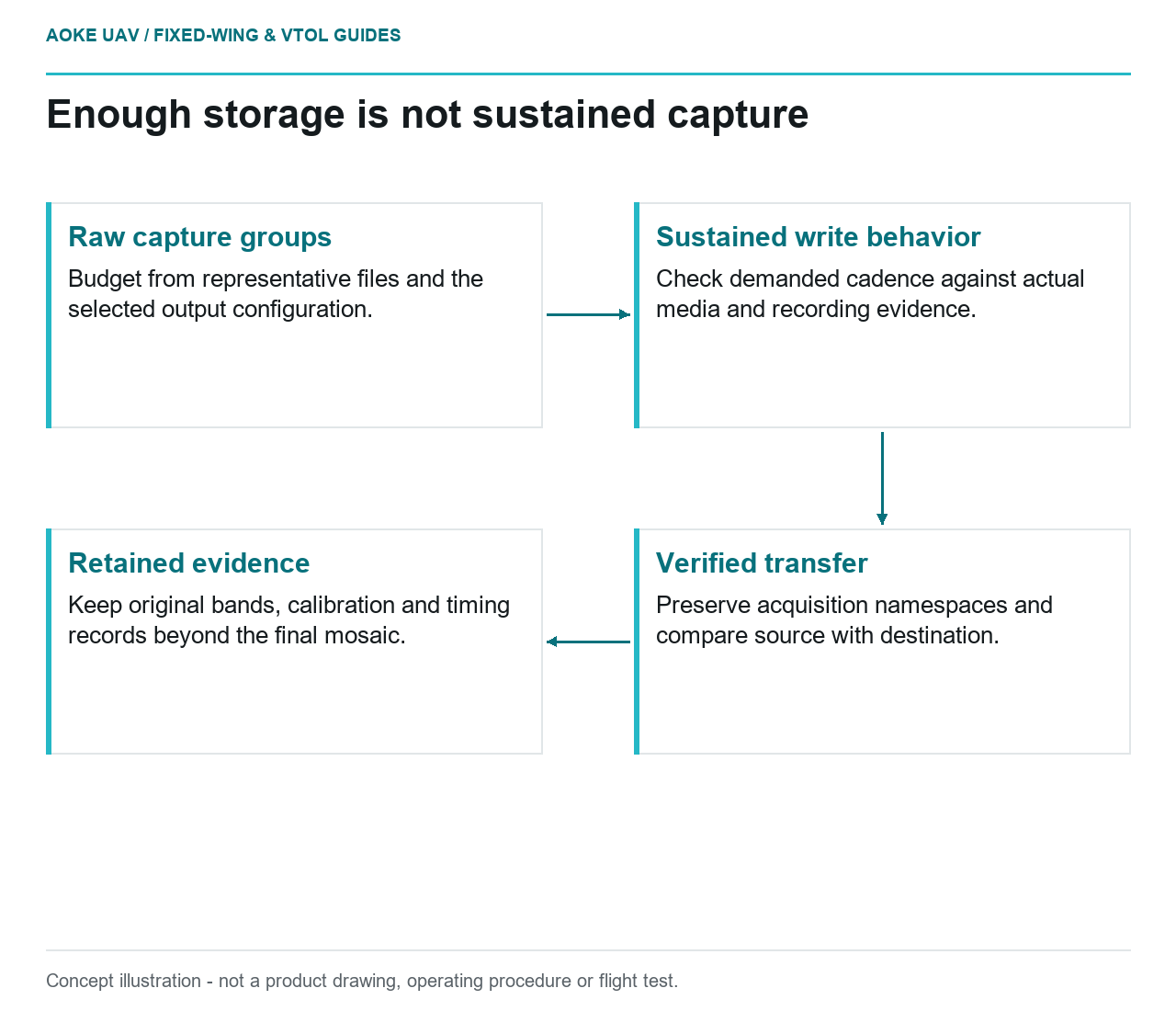
- Raw capture groups: Budget from representative files and the selected output configuration.
- Sustained write behavior: Check demanded cadence against actual media and recording evidence.
- Verified transfer: Preserve acquisition namespaces and compare source with destination.
- Retained evidence: Keep original bands, calibration and timing records beyond the final mosaic.
A storage card can have enough free space and still be unsuitable for the intended acquisition. In a hypothetical sustained large fixed-wing survey, the field team must plan not only what fits on the camera but what can be recorded, copied, checked and retained before the next collection. Capacity, throughput and preservation are separate questions with different evidence.
Capture rate and mission dataset size
The RedEdge-MX integration guide describes a multispectral camera with separate band outputs and states that capture rate depends heavily on the storage device. It connects mission planning with capture interval, altitude, overlap and speed. These statements concern that documented model and configuration; they are not a universal rate for survey cameras. [20]
For the hypothetical fixed-wing mission, the storage budget would start with representative files from the selected configuration. The inventory would distinguish an individual band file, a complete capture group, calibration observations and supporting records. Compression or export assumptions would not be substituted for the sensor’s actual raw output.
The team would estimate planned capture groups from the acquisition plan, then account separately for calibration, commissioning and repeated observations. This article supplies no invented file sizes or dataset totals. The budgeting method is to make every assumption visible and replace estimates with measured configuration-specific values before committing to acquisition.
Write performance and buffer behavior
The model-specific guide warns that timer requests faster than storage can write can produce inconsistent capture intervals. Nominal card capacity therefore cannot stand in for evidence of sustained recording behavior. Trigger configuration and actual recorded sequence need to be reviewed together. [20]
The proposed evaluation would exercise the chosen media, sensor firmware and output configuration over a representative acquisition period. The question would be whether intended capture groups are present and readable, not merely whether the camera accepts a start command. Buffer behavior and recovery from interruptions would be established from applicable documentation and recorded observations, not assumed from a storage label.
For long fixed-wing strips, the planning record would identify how the demanded capture cadence relates to the measured recording capability. If the evidence is incomplete, the team would retain that as a planning constraint rather than asserting that a larger card solves the problem.
Copy verification and project organisation
A proposed field workflow would inventory original files before transfer, copy them into a clearly identified acquisition folder and compare the destination with the source. File identity, size and a content-integrity check would be recorded as separate from image suitability. Matching copies can establish transfer consistency; they do not establish that every intended exposure was acquired.
The example team would keep each sortie and sensor configuration identifiable. Duplicate filenames from separate media would remain in distinct acquisition namespaces instead of being overwritten during consolidation. Any renaming scheme would preserve a mapping to original names and capture groups. These are editorial workflow recommendations, not a vendor-defined storage format.
Media reuse would be a controlled project decision after retained copies and required checks are confirmed. A transfer progress bar reaching its end would not be sufficient evidence of complete, usable acquisition. The record would name who checked which copy and where unresolved errors remain.
Retain raw data and calibration records
USGS recommends storing equipment descriptions, settings, calibration information and acquisition context with raw data, including README documentation that helps other users interpret the collection. Its metadata guidance connects those records to reproducibility and later suitability assessment. [6]
The hypothetical retention package would therefore include original bands, panel images, timing or navigation records supplied by the system, processing inputs and the inventory linking them. Working products and temporary caches would be budgeted separately from preserved evidence. Keeping only the final mosaic would prevent later review of important acquisition questions.
The final storage decision is end-to-end: demonstrated capture capability, sufficient space, accountable transfers and an agreed preservation plan. None alone proves the others. A large fixed-wing survey needs this data workflow defined before collection rather than improvised when the aircraft returns with the only copy.
Related reading
- Detecting Capture Throughput Problems Before Processing
- Payload Power Transients and Survey Sensor Integration