Concept illustration
Read diagram notes
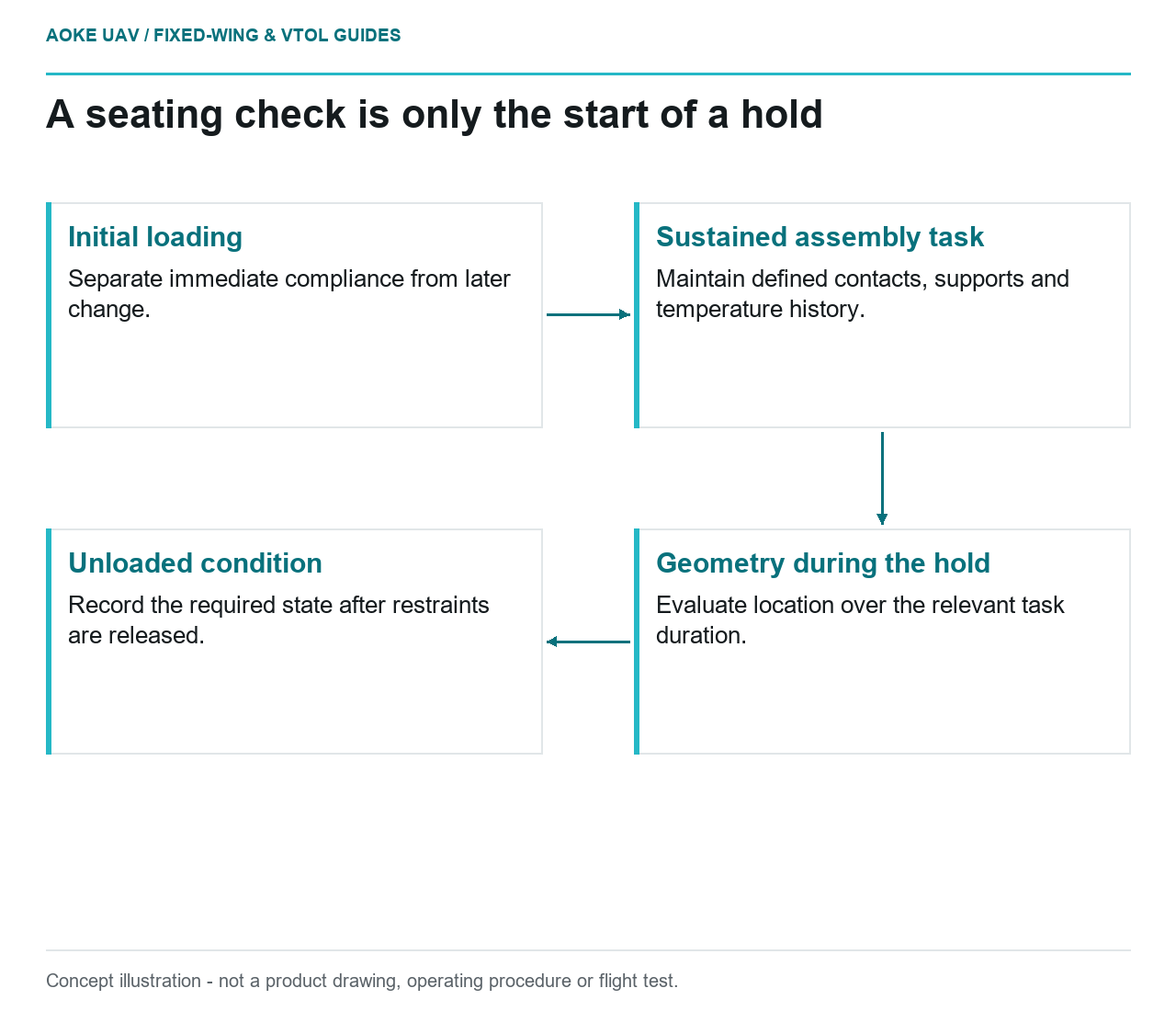
- Initial loading: Separate immediate compliance from later change.
- Sustained assembly task: Maintain defined contacts, supports and temperature history.
- Geometry during the hold: Evaluate location over the relevant task duration.
- Unloaded condition: Record the required state after restraints are released.
The jig locates a long wing assembly correctly when the clamps are first applied. Hours later, the manufacturing task is still under way. Those two moments are not automatically equivalent. In this hypothetical large fixed-wing bonding operation, the proposed printed fixture must preserve the process-defined geometry for the relevant duration. The review therefore needs time and temperature questions, not just a quick demonstration that the jig feels rigid.
Time-dependent deformation concept
Creep concerns deformation that develops with time under sustained loading. Formlabs warns that SLA printed parts may experience creep when continuously loaded and advises relieving bolts and clamping forces after secondary operations. That is a material/process caution for manufacturing aids, not a prediction of how much this particular wing jig will move or a statement that every printed polymer behaves identically. [4]
Separate immediate compliance from later change in the review record. Ask what happened at loading, what must remain controlled during the hold, and what condition is required after unloading. A single before-use dimension does not answer every question. This article proposes an evidence framework rather than an actual creep test, measured displacement, or constitutive material model for an unidentified fixture.
Contact pressure and unsupported spans
Map the proposed clamp loads, fixture supports, locating surfaces, and workpiece contacts for engineering review. Ask whether the jig carries the intended reactions through its controlled construction or through an overlooked unsupported feature. Formlabs recommends reinforcing ribs and fillets where appropriate and cautions against thin features or unsupported arms without validation. Those suggestions do not supply dimensions or allowable clamp forces for this installation. [4]
For the fixed-wing example, distinguish holding the assembly against defined datums from forcing it into shape. The responsible process authority needs to decide how the workpiece is supported throughout the bonding task. Do not increase clamp load simply to conceal movement in the fixture. Record any unresolved load path and seek the applicable engineering definition instead of treating more restraint as an automatic improvement.
Temperature during the task
Establish the relevant temperature history from the actual assembly instructions, including any processing exposure the fixture is intended to experience. A room-temperature demonstration cannot by itself represent an unspecified heated operation. Request long-duration evidence for the chosen material and finished construction under relevant conditions rather than substitute a short strength value or a generic heat-resistance label.
Stratasys discusses creep-related tool-life assessment using elevated-temperature flexural specimens and explains the connection between loading mode, temperature, and interpretation. The work concerns its stated ULTEM 1010 tooling context. [3] It provides an example of why conditions matter, not a direct prediction for an SLA jig, another thermoplastic, a different support arrangement, or a complete wing assembly.
Verification over relevant hold time
Define the required geometry, reference setup, duration, environment, and acceptance criteria before evaluating the fixture. The plan should be set by the responsible tooling and manufacturing authorities. Include the actual contacts, inserts, base, and clamps that influence the proposed use, and distinguish fixture movement from workpiece or reference-system movement. No hold time or permissible displacement is invented here.
A defensible large fixed-wing review ends with a bounded conclusion: the specific jig is accepted for a defined task on identified evidence, or the necessary evidence remains incomplete. Record restrictions on sustained loading and storage separately from aircraft acceptance. Passing a quick seating check may still be useful, but it cannot close a question that only exists over the full duration of the manufacturing operation.
Related reading
- Monitoring Dimensional Drift in Reused Printed Tools
- Bondline Thickness Control Without a Universal Recipe