Define the evidence expected from the zoom view
Consider a hypothetical civil power corridor with broad overview imagery and occasional pointed views of service compounds. The proposed large industrial fixed-wing payload has a zoom function, and the client expects every narrow view to provide both fine detail and complete compound coverage. Before accepting that expectation, the team should define the required observation and the actual optical configuration. This is an integration example, not an GAUTEN payload specification or a demonstrated imaging result.
Separate an overview requirement from a detail requirement. In this example, the overview identifies the compound and surrounding access, while a pointed view is intended to show a particular visible component. Specify both in the acquisition brief. Do not count an entire compound as adequately inspected merely because a narrow image intersects one part of its mapped boundary.
Keep optical state attached to each observation
USGS describes focal length, principal point and lens distortion among the interior parameters that characterize camera geometry. It also identifies viewing geometry, sensor information and processing schemes as useful metadata. These principles explain why a reported view needs configuration context, but the guide does not supply a calibration model for an unspecified zoom payload. [1]
Request the exact sensor and lens documentation, supported zoom states, metadata definitions and applicable calibration evidence. Ask how the system distinguishes optical configuration from display cropping or digital enlargement. If a displayed magnification cannot be linked to the actual acquisition state, leave its measurement implications unresolved. An enlarged presentation should not be advertised as independently demonstrated detail.
For the illustrative fixed-wing report, retain the original frame dimensions and the unedited image along with the crop. Record the zoom value as the payload reports it, including units or mode names, rather than normalizing undocumented values into a guessed focal length. Preserve configuration changes between images so later processing can use a justified model or reject unsupported measurement use.
Evaluate usable coverage at the chosen setting
Compare the requested asset view with the actual recorded footprint and image sequence. Ask whether the intended feature is present, distinguishable and unobscured, and whether its surrounding context supports asset association. This is a proposed acceptance review, not a claim that a particular zoom setting provides a guaranteed observation distance or feature size. No universal standoff or magnification value can be derived from the available source.
The USGS guide separates ground sample distance from positional accuracy and connects geometric quality to calibration, acquisition configuration and control. Accordingly, a detail view should not inherit a map-accuracy claim merely because a feature occupies more display pixels. Any measured position or dimension needs evidence appropriate to the actual image and processing method. [1]
In this scenario, review the moving aircraft’s image sequence rather than a single selected still. Ask which acquisition intervals yield usable views and whether pointing or configuration changes leave uncovered sections. Maintain a coverage layer for the fixed-wing overview and a separate layer for accepted detail views. Their union should not conceal that each answers a different observation question.
Accept detail and overview as separate outputs
Propose a delivery record containing the compound identifier, requested feature, source frame, optical state, applicable calibration reference and view-quality disposition. If the detail requirement is unmet, state the gap and propose another acquisition method for owner review. Do not imply that the aircraft should simply move closer; any flight change requires the actual platform and site limitations.
Use sample outputs to test the proposed configuration before treating an entire route as covered by a marketing zoom ratio. A useful demonstration should preserve rejected views and their reasons, not only a favorable selected image. It must also identify whether any claimed dimensions or coordinates were independently checked.
The final decision is therefore task-specific: can the documented fixed-wing configuration produce the required observation with a defensible evidence record? Until the actual optics and calibration are supplied, this remains a method-selection question. Keeping that limit explicit avoids promising hover-like inspection, added detail from enlargement or universal measurement performance from an unspecified zoom feature.
Related reading
- Focus and Lens Changes in Survey Camera Calibration
- Payload Power Transients and Survey Sensor Integration
Sources
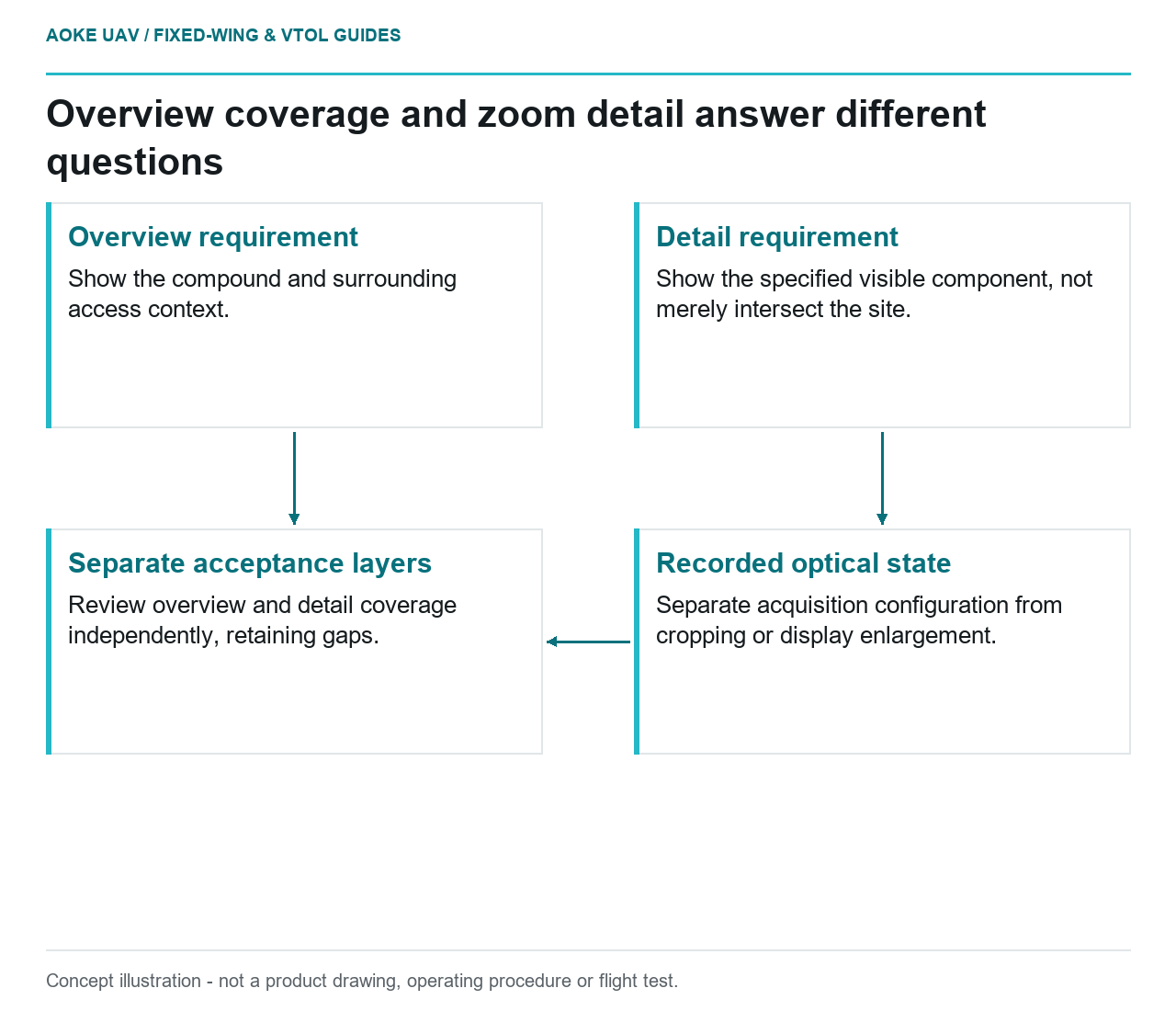
Visual summary
Concept illustration
Read diagram notes
- Overview requirement: Show the compound and surrounding access context.
- Detail requirement: Show the specified visible component, not merely intersect the site.
- Recorded optical state: Separate acquisition configuration from cropping or display enlargement.
- Separate acceptance layers: Review overview and detail coverage independently, retaining gaps.