Concept illustration
Read diagram notes
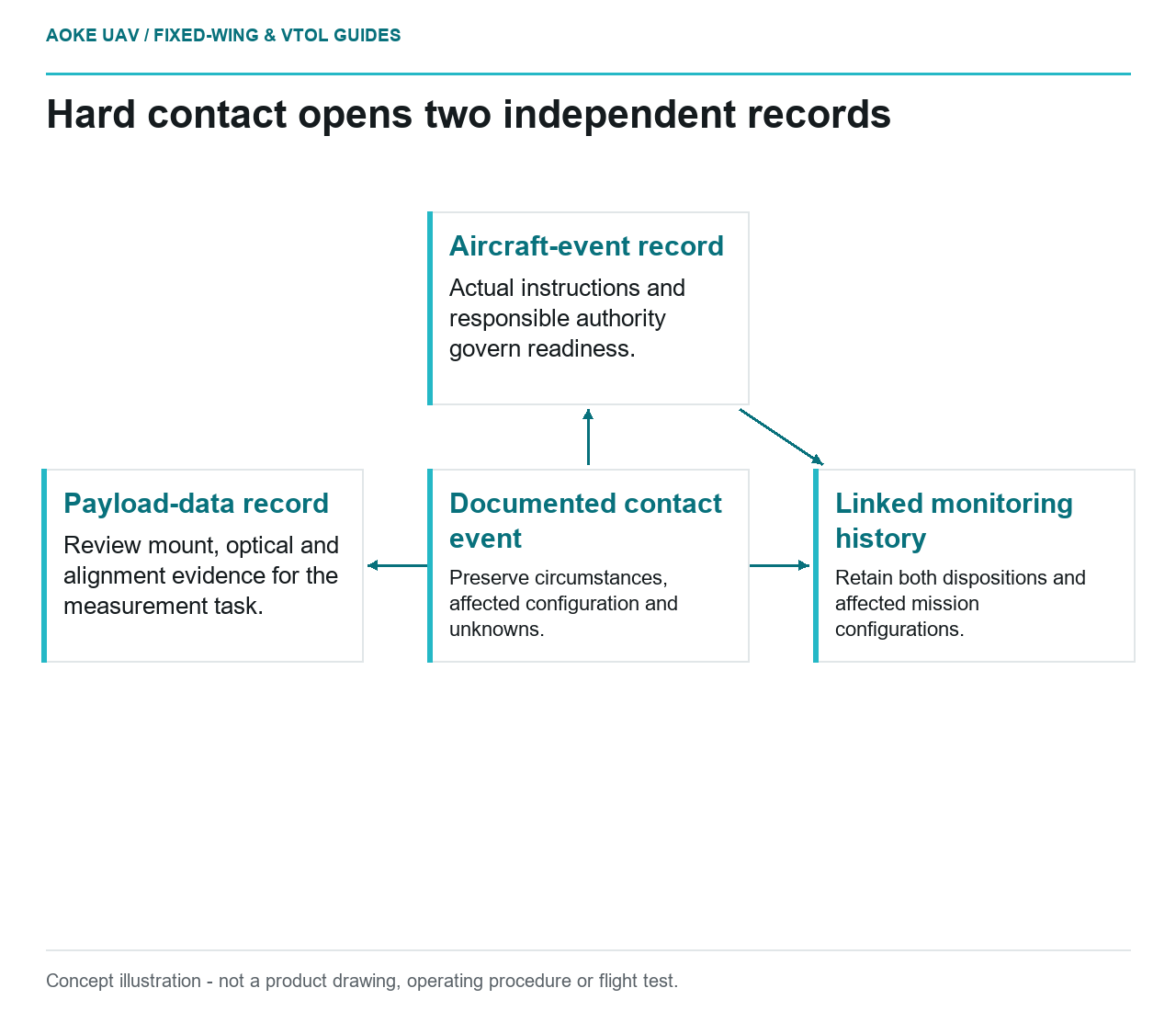
- Documented contact event: Preserve circumstances, affected configuration and unknowns.
- Aircraft-event record: Actual instructions and responsible authority govern readiness.
- Payload-data record: Review mount, optical and alignment evidence for the measurement task.
- Linked monitoring history: Retain both dispositions and affected mission configurations.
Open two records after the event
Consider a hypothetical large industrial fixed-wing monitoring aircraft whose wing contacts an obstacle during ground handling after a civil corridor mission. The camera still produces sharp pictures, and the schedule calls for another acquisition. The team faces two different questions: what assessment the aircraft requires and whether the payload configuration remains suitable for the intended measurement. This is a bounded editorial scenario, not an GAUTEN event or an aircraft return-to-service procedure.
Open an aircraft-event record and a linked payload-data record rather than combining them into one pass or fail field. Neither record should be closed solely because the other looks satisfactory. The relevant aircraft instructions, authorized maintenance process and actual payload documentation must determine the assessment; no universal inspection checklist or structural limit is supplied here.
Do not substitute appearance for structural disposition
FAA composite-aircraft guidance explains that visual indications give limited details about hidden damage and that further characterization may use different inspection procedures. It also emphasizes documented maintenance methods and inspection access. That guidance addresses certificated aircraft structures and supplies conceptual background only; it is not approval or a specific maintenance instruction for the hypothetical UAV. [1]
For the scenario, preserve an accurate account of the contact location, known circumstances, affected configuration and available observations. Distinguish what witnesses reported from what was later inspected. Route the event to the responsible aircraft maintenance authority using the actual instructions. Do not improvise tap tests, load tests, repair methods or a fly-to-check exercise from a general article.
The inspection camera’s output is not a structural assessment of the aircraft carrying it. A report intended to describe a civil asset also should not become evidence that an aircraft is ready for further operation. Keep the maintenance disposition and its supporting documentation outside the asset-imagery quality review, while linking the records where configuration changes are relevant.
Review the measurement configuration independently
USGS imagery guidance describes camera calibration in terms of focal length, principal point and distortion, together with exterior sensor position and orientation. It connects geometric data quality to control, acquisition and verification. These concepts explain what a measurement review must document, without establishing that any particular contact altered the payload. [2]
Ask whether the event, subsequent handling or maintenance affected a mount, optical window, lens state or a recorded alignment. If that cannot be established, mark the calibration applicability question unresolved. Identify the configuration used for the completed mission separately from the configuration proposed for a later mission. Do not assume that a calibration certificate attached to the camera serial number covers every installation state.
In the illustrative fixed-wing program, the payload reviewer should define what evidence would demonstrate fitness for the next measurement task. That might involve documented configuration checks or independent reference observations under the applicable method, but this article does not claim that either has occurred. The aircraft’s maintenance process remains a separate prerequisite, not something an imagery trial can replace.
Preserve both decisions in the monitoring history
The proposed event bundle should link the aircraft record, payload configuration versions, affected mission files and the actual dispositions when issued. Preserve unknowns instead of assigning a clean status to keep the acquisition calendar moving. If an assessment later establishes that earlier data need review, retain the original product and document the revised data-use decision.
For the civil client, distinguish scheduling information from data acceptance. Explain which delivery is under quality review and which evidence is being requested without claiming that damage occurred or that the aircraft has been cleared. A fixed-wing monitoring series can acknowledge a configuration interruption without inventing a continuous, unchanged measurement history.
The central outcome is two traceable answers from appropriate evidence: the aircraft’s documented readiness disposition and the payload’s documented data-use disposition. Good-looking pictures alone answer neither. Keeping the records separate protects both the aviation decision and the integrity of the civil monitoring evidence.