Concept illustration
Read diagram notes
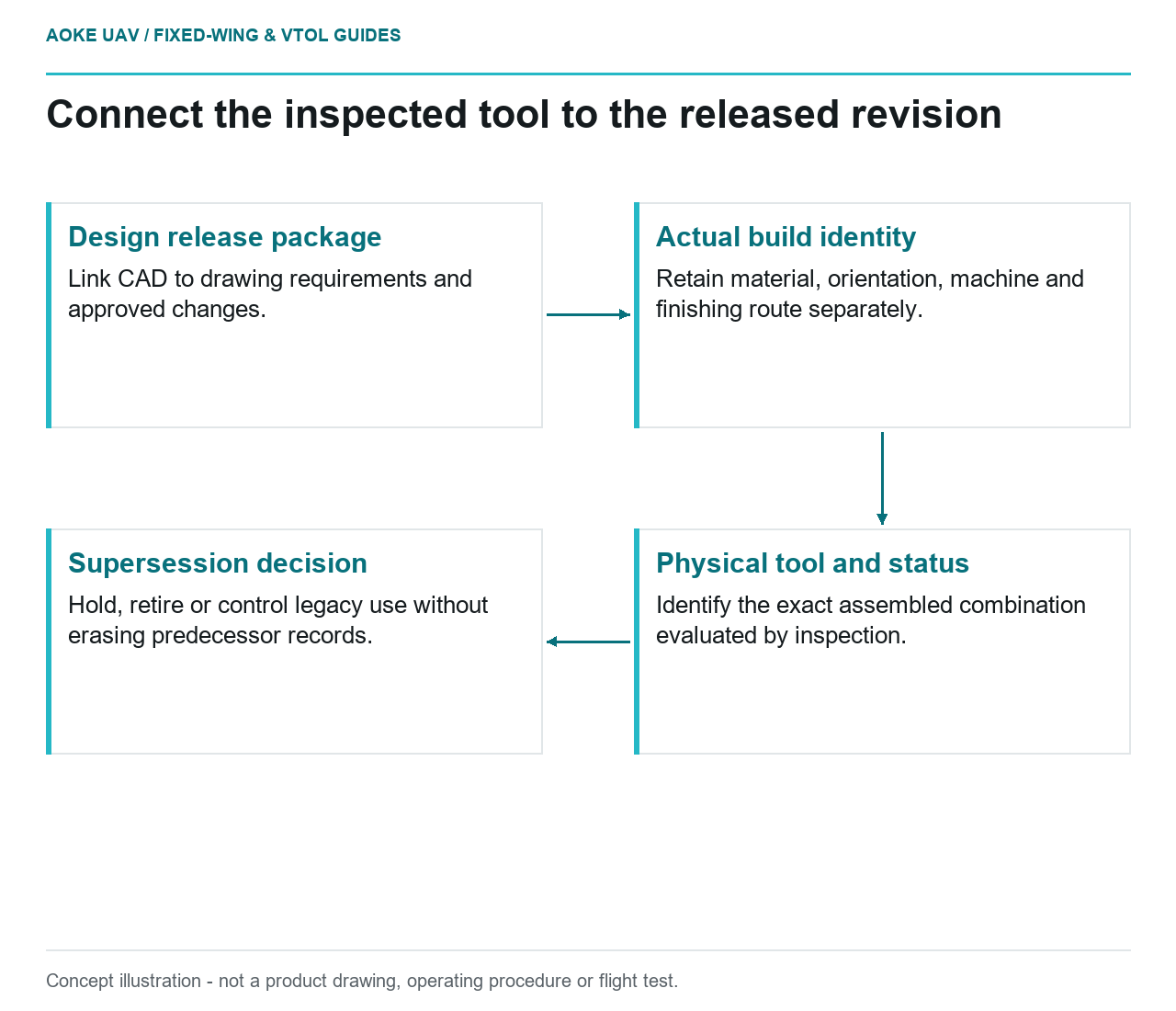
- Design release package: Link CAD to drawing requirements and approved changes.
- Actual build identity: Retain material, orientation, machine and finishing route separately.
- Physical tool and status: Identify the exact assembled combination evaluated by inspection.
- Supersession decision: Hold, retire or control legacy use without erasing predecessor records.
Two printed wing fixtures sit on the same bench. One was made before a payload-bay drawing change; the other came from the revised model. Without a clear identity, their similar appearance creates an avoidable review problem. This hypothetical large fixed-wing manufacturing workflow concerns the connection between controlled digital definitions and physical tools, rather than assuming that the newest file in a folder automatically identifies the correct fixture.
CAD and drawing revision identity
Define the governing geometry and the requirements that are not contained in it. A mesh may represent shape while a drawing defines datums, tolerances, hardware, and use restrictions. In the proposed workflow, a tool identity points to a controlled release package rather than to an informal folder path. Changes to that package retain an approval record explaining what changed and which physical tools are affected.
NASA-STD-6030 describes configuration control of material processes and preservation of the digital thread for spaceflight AM production. [5] That framework provides a context for maintaining the relationship among files and manufacturing decisions. It does not require a particular software platform for this UAV workshop or establish that using a document-management system makes an otherwise unverified fixture acceptable.
Build-file and process records
Keep the design revision distinct from the build identity. The same geometry may be manufactured under different orientations, parameter definitions, machines, materials, and finishing routes. Record the definition actually used for each physical article. NASA’s digital-product discussion includes the data and manually set processing parameters needed to reproduce a build, with file identities and hashes used to maintain traceability. [5]
For the fixed-wing example, a proposed traveler can link the controlled design package, build package, material record, and finishing instruction to the fixture serial or local identifier. File hashes can help distinguish exact digital content, but they do not establish manufacturing quality or dimensional agreement. A matching build file cannot by itself prove that the printed object completed every required downstream operation.
Physical labels and inspection status
Give the assembled fixture a readable identity that survives its intended ground use under the applicable tooling instructions. Include a way to find its current revision and status without guessing from color, handwritten notes, or resemblance. Where an assembly uses interchangeable components, make the accepted combination understandable rather than allowing unmarked parts from different revisions to accumulate in the same storage tray.
Formlabs recommends inspecting printed aids against CAD and checking functional seating. [4] In this workflow, the inspection record should name the exact tool configuration evaluated. A pass attached to an old identifier is not evidence for a revised contact geometry. Likewise, marking a tool with a new revision does not demonstrate that its physical surfaces were actually changed or rechecked.
Retire obsolete fixtures from the workflow
Define what happens to superseded tooling when a new configuration is released. The proposed options are controlled storage for a documented legacy task, explicit hold pending assessment, or retirement according to the workshop’s process. Choose an approach that prevents casual reuse while preserving the history needed to understand earlier work. Do not erase the predecessor’s records simply because its successor exists.
A large fixed-wing team should be able to answer which fixture revision supported a given assembly decision and whether later changes affect that earlier work. That is the useful output of revision control. It is not a claim of aircraft certification, manufacturing capability, or semantic approval of the design. The physical tool, controlled definition, and inspection evidence must remain linked for the process to be understandable.
Related reading
- Serialised Assembly Records for Large UAV Structures
- Distributed Printing of Spare Fixtures: What Must Travel With the File?