Concept illustration
Read diagram notes
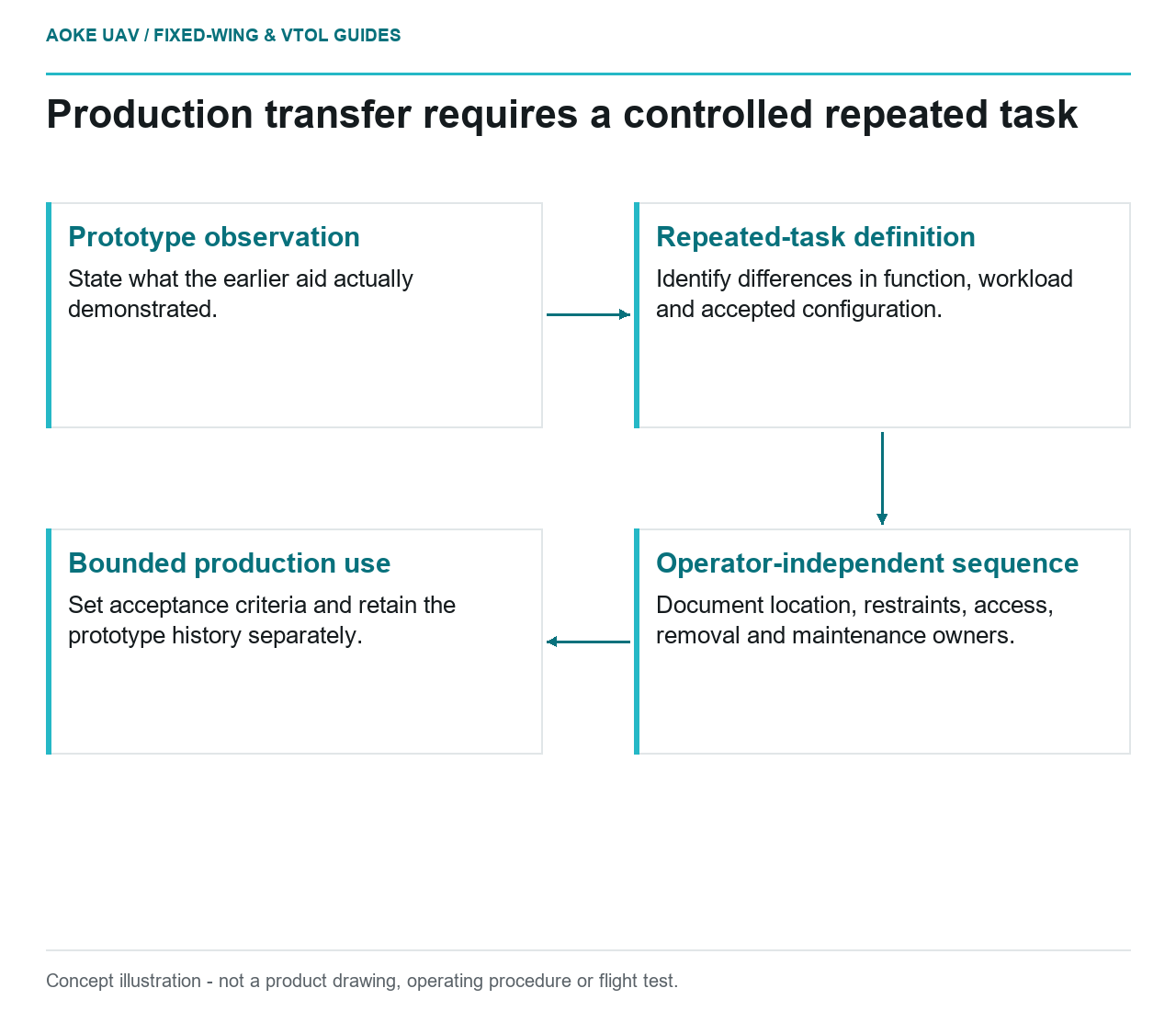
- Prototype observation: State what the earlier aid actually demonstrated.
- Repeated-task definition: Identify differences in function, workload and accepted configuration.
- Operator-independent sequence: Document location, restraints, access, removal and maintenance owners.
- Bounded production use: Set acceptance criteria and retain the prototype history separately.
An improvised fixture helped a team assemble a prototype payload bay. Now the same fixture is proposed for repeated work on a large civil fixed-wing airframe. The earlier success is useful experience, but it does not fully define a manufacturing process. In this hypothetical transfer review, the task is to convert what the team learned into a controlled tool and work sequence, not to rename the prototype production-ready.
Proven function versus controlled definition
Begin by identifying what the prototype actually demonstrated. Perhaps it made a connector accessible or helped hold a panel for a ground review. Record those limited observations without claiming repeated accuracy, durability, or production capability. Then define the intended repeated task and its requirements. Any gap between the original function and the proposed production role belongs on the review list.
NASA-STD-6030 distinguishes controlled material and part-production processes and documents readiness-review outcomes within its spaceflight framework. [5] That is contextual support for an explicit transfer decision, not a UAV production approval scheme. The civil workshop still needs its own responsible authority to define which evidence supports the fixture’s intended manufacturing role and which conditions remain outside the proposed release.
Inspection and maintenance responsibilities
Create a complete tool definition that includes relevant geometry, materials, hardware, process instructions, and finished condition. Assign who verifies the fixture before use, who maintains it, and who can disposition damage or change. An informal understanding held by the original builder should not be the only way another operator can discover which contact is a datum or which part is replaceable.
Formlabs recommends inspecting printed aids against CAD and checking their functional seating, and notes creep and high-wear limitations that can affect the use of some printed tools. [4] These considerations help establish review topics for maintenance planning. They do not provide a universal inspection interval or prove that the prototype material is suitable for the proposed repeated workload.
Operator access and repeatability
Write the proposed assembly sequence in terms another operator can follow, using the actual aircraft and fixture revisions. Identify installation, workpiece location, restraints, tool access, and removal steps. Ask whether the sequence relies on an undocumented adjustment or a particular operator’s judgment. Where the prototype needed hand-fitting, record that condition and decide whether the production definition needs revision or additional verification.
For this fixed-wing payload-bay example, review the complete fixture assembly with its base and accessories rather than only the printed piece. Determine how the accepted configuration is recognized and how mixed revisions will be prevented. These are original workflow recommendations, not claims that a repeatability study has been performed or that any specific operator arrangement guarantees dimensional consistency.
Release criteria for production use
Have the manufacturing and tooling authorities set acceptance criteria before treating the fixture as a normal production asset. Identify which evidence covers geometry, functional use, processing compatibility, and planned reuse. NASA’s qualified-part-process discussion illustrates the importance of preserving the approved configuration and controlling later changes in its own application. [5] It does not certify this fixture or prescribe its production acceptance tests.
Close the transfer with a visible status, controlled package, named responsibilities, and unresolved restrictions where necessary. Retain the prototype history separately so that observations are not rewritten as formal qualification results. A large fixed-wing team can then use the jig within its evidenced purpose while keeping aircraft acceptance independent. The decisive change is an understandable, maintainable manufacturing definition, not a new label attached to an old print.