Concept illustration
Read diagram notes
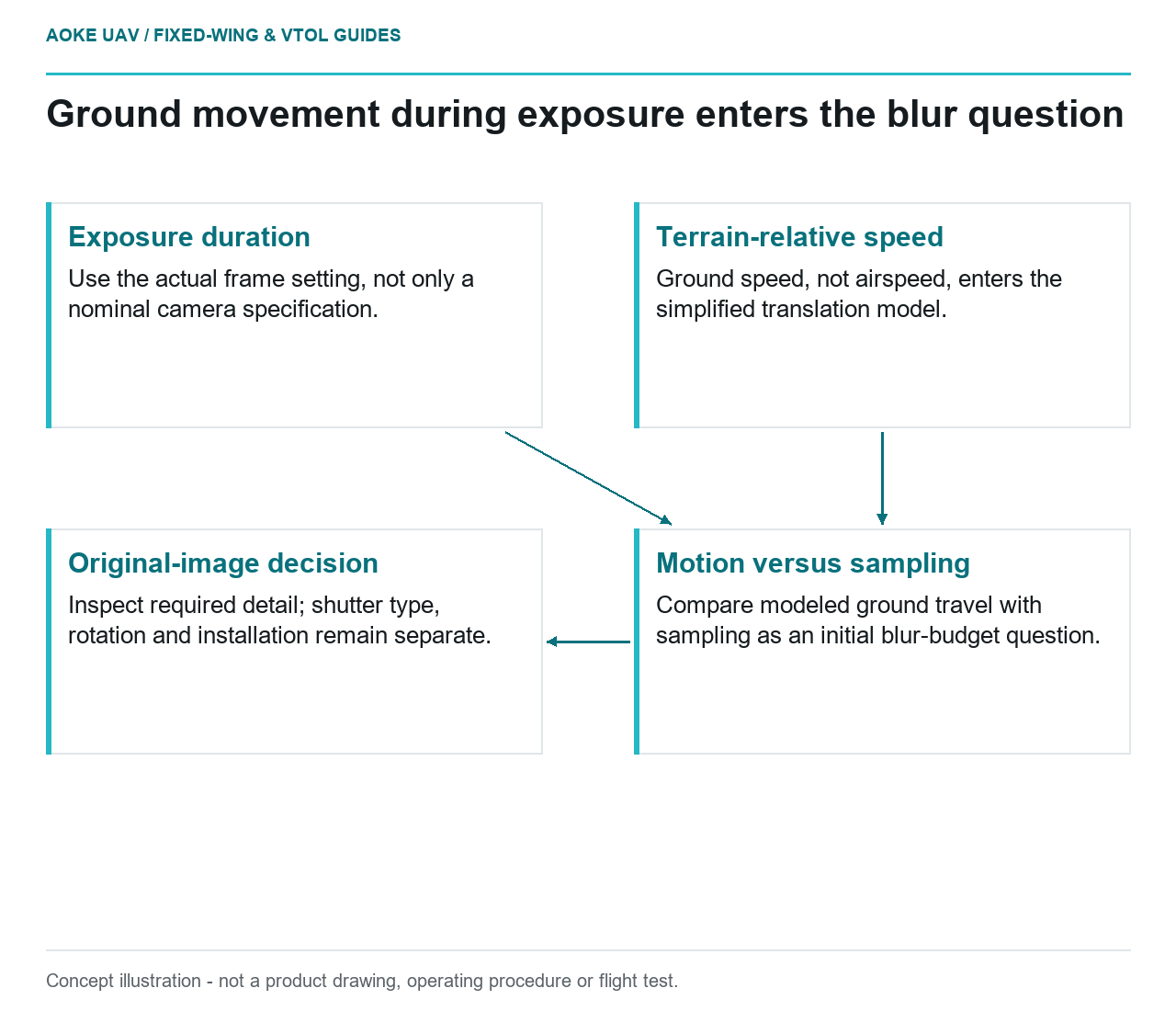
- Exposure duration: Use the actual frame setting, not only a nominal camera specification.
- Terrain-relative speed: Ground speed, not airspeed, enters the simplified translation model.
- Motion versus sampling: Compare modeled ground travel with sampling as an initial blur-budget question.
- Original-image decision: Inspect required detail; shutter type, rotation and installation remain separate.
Image motion during exposure
A hypothetical large industrial fixed-wing UAV carries a survey camera across a civil earthworks site in sustained cruise. The integration question is whether the images will retain useful detail while the aircraft moves, not whether the camera has enough nominal pixels. Treat the following as a simplified editorial image-motion model, not a validated aircraft performance prediction: during one exposure, terrain-relative translation is the distance travelled along the ground over that exposure time.
In that simplified model, increasing ground speed or leaving the shutter open longer increases the translational contribution to image motion. Comparing that distance with the proposed ground sampling gives an initial blur-budget question. It is not a complete camera model: the team must also investigate orientation changes, installation behaviour and the applicable shutter implementation. Do not assign a universal acceptable fraction of a pixel without identifying what detail the project actually needs to measure.
Ground speed versus airspeed
The acquisition review should label its speed inputs explicitly. Official ArduPilot Plane documentation discusses airspeed calibration and compares airspeed readings with GPS ground speed when considering sensor behaviour; they are not interchangeable fields. [2] In this hypothetical fixed-wing survey, request ground-speed records for image-spacing and translational-motion analysis, while leaving safe flight-speed selection to the aircraft documentation and responsible flight team.
Do not solve an image-quality problem by casually instructing a large fixed-wing aircraft to fly slower. Instead, ask the integration team to compare documented acquisition options: exposure choices supported by the camera, acquisition conditions, optical configuration or a different mission design. Any change must remain within the actual aircraft and payload constraints. This article supplies no minimum airspeed, wind limit or safe operating setting, and the example is not a flight instruction.
Sensor shutter and exposure constraints
Identify the exact camera and revision before assigning a shutter assumption. The November 2020 RedEdge-MX integration guide describes a global shutter for that model and recommends attention to vibration isolation. [3] That is a useful example of why installation and shutter type deserve separate review; it does not establish the shutter behaviour, timing precision or vibration tolerance of another survey camera installed in a large aircraft.
USGS discusses selecting camera gain and shutter speed and retaining the settings when automatic acquisition is used. [1] For our scenario, request exposure metadata alongside each original image and identify whether the intended settings can be sustained under the expected illumination. Avoid treating a short nominal exposure as sufficient evidence. Ask the payload specialist which applicable manual, configuration record and image test will establish that the installed system produces usable data.
Verify image quality before processing
Build an original-image review into the hypothetical acquisition acceptance process. Select candidate frames from different strip directions and parts of the site, including periods that raise questions in the aircraft or camera logs. Inspect the actual measurement features, not only a reduced preview. Record the frame identifier, exposure information and the reason a frame is accepted, rejected or referred for further investigation. This is a proposed review workflow, not a report of observed sharpness.
Distinguish the source image from the processed display. In this scenario, require the reviewer to preserve access to the originals so a visually attractive mosaic is not the only evidence available. If one strip appears weaker, compare its ground-speed and exposure records with adjacent strips before choosing an explanation. The practical deliverable is a documented connection between the mission’s movement, camera behaviour and usable imagery. No universal shutter speed or guaranteed survey accuracy follows from the simplified budget.
For example, the hypothetical review sheet could place the frame identifier beside the exposure setting, ground-speed source, strip direction and inspection decision. Keep the proposed blur model in a separate column from the observed image judgement. If those disagree, retain the disagreement as an investigation item. That separation is particularly useful when a large fixed-wing installation changes: the previous camera-only assumption should not silently become a finding about the new airborne configuration.
Related reading
- Along-Track Overlap and Camera Trigger Capacity
- Exposure and the Visibility of Small Inspection Features