Concept illustration
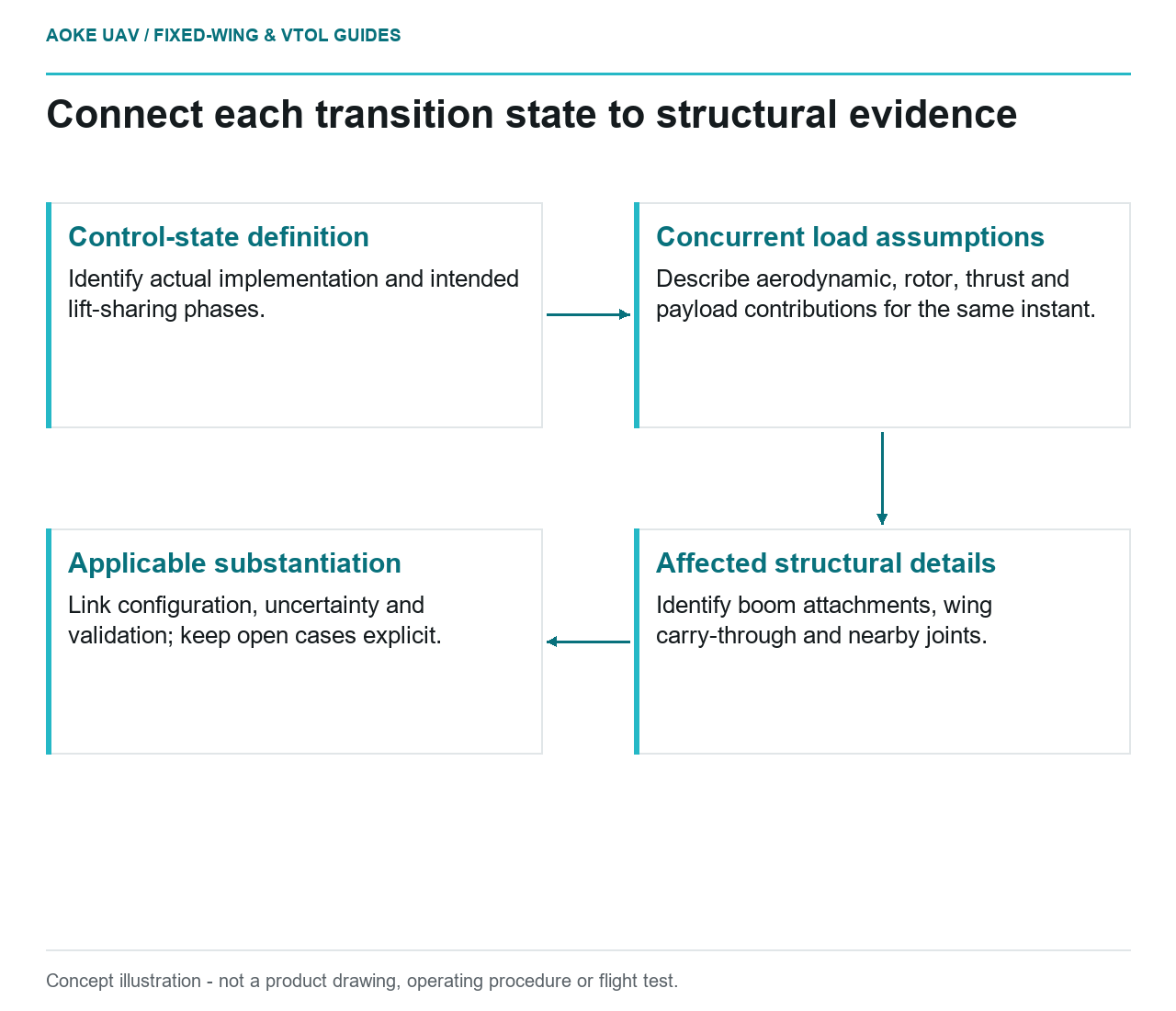
Read diagram notes
- Control-state definition: Identify actual implementation and intended lift-sharing phases.
- Concurrent load assumptions: Describe aerodynamic, rotor, thrust and payload contributions for the same instant.
- Affected structural details: Identify boom attachments, wing carry-through and nearby joints.
- Applicable substantiation: Link configuration, uncertainty and validation; keep open cases explicit.
Consider a hypothetical large fixed-wing VTOL aircraft departing on a civil mapping mission. Its structural review needs to describe the interval between rotor-supported flight and wing-supported flight, not merely the two endpoints. The discussion below proposes an evidence-review framework, not a transition procedure or an account of an GAUTEN aircraft. A transition label identifies an architecture; it does not establish which combination of forces a particular wing, boom, or attachment has been shown to withstand.
Changing sources of lift and thrust
ArduPilot describes QuadPlane transition as a change between primarily VTOL and conventional fixed-wing flight. Its documentation distinguishes configurations and flight modes; in relevant transitions, vertical motors continue providing lift and stability while forward speed develops. Tailsitters are treated separately. Those distinctions make software documentation useful for identifying candidate structural questions, but not for establishing structural capability. [4]
For the hypothetical mapping departure, request a phase diagram showing intended lift sharing, thrust directions, aircraft attitude, and the mass configuration used in the analysis. Treat each interval as an integration question: which attachment introduces each force, and where does the opposing reaction enter the airframe? A cruise-only wing diagram would leave the departure question unanswered.
Concurrent aerodynamic and motor loads
FAA composite guidance says static substantiation should address critical load cases and their associated failure modes, including environmental and manufacturing influences. Its building-block discussion includes structural details and combined loading rather than treating a material coupon as a complete-aircraft demonstration. This is certificated-aircraft guidance used here as engineering context, not a claim of UAV approval. [1]
A useful proposed review table would place wing aerodynamic loading beside rotor, forward-thrust, and payload-inertia assumptions for the same instant. Ask whether boom attachments, wing carry-through structure, and nearby joints are included in the model. Do not simply add separate maximum numbers without explaining whether they can occur together. Conversely, do not omit a concurrent contribution solely because another subsystem is designated the main source of lift.
Uncertainty in transition assumptions
The ArduPilot description includes an airspeed-wait phase and a later reduction of vertical-motor contribution. It also describes mode-dependent exceptions and transition-failure behavior. These are reasons to identify the actual control implementation rather than borrow a timeline from a different configuration. No parameter value in that page is a structural limit for the proposed airframe. [4]
For this illustrative review, list uncertainty alongside each assumed phase: payload variant, mass distribution, airspeed information, commanded climb, and the possible response to an incomplete transition. Request the responsible engineers to explain which cases are covered and which remain open. A nominal smooth transition is a scenario to substantiate, not evidence that off-nominal combinations have already been considered.
Evidence linking controls and structure
Build a proposed evidence chain from control-state definition to loads analysis, structural detail identification, and the analysis or test supporting that detail. FAA guidance describes progressively more representative specimens and components for validating analysis and addressing variability, damage, and discontinuities. It does not permit software configuration alone to replace structural substantiation. [1]
For a large fixed-wing civil platform, the requested package could cross-reference the control version, payload configuration, relevant attachment drawings, model assumptions, and applicable test reports. When a configuration changes, ask which links require review. A flight log may help describe an event, but the reviewer still needs to connect the recorded quantities to the loads and structural response being claimed. This article deliberately leaves electrical sizing to the related power-demand discussion.
Decision boundary
The practical question is whether the transition load cases are defined and connected to evidence for this fixed-wing configuration. Do not copy another aircraft’s transition envelope, infer allowable loads from a successful departure video, or turn generic guidance into a release decision. Without model-specific substantiation, the honest outcome is an identified review gap rather than a numerical operating limit.
Related reading
- Structural Interfaces for Fixed-Wing VTOL Lift Booms
- Concurrent Power Demand During Fixed-Wing VTOL Transition