Concept illustration
Read diagram notes
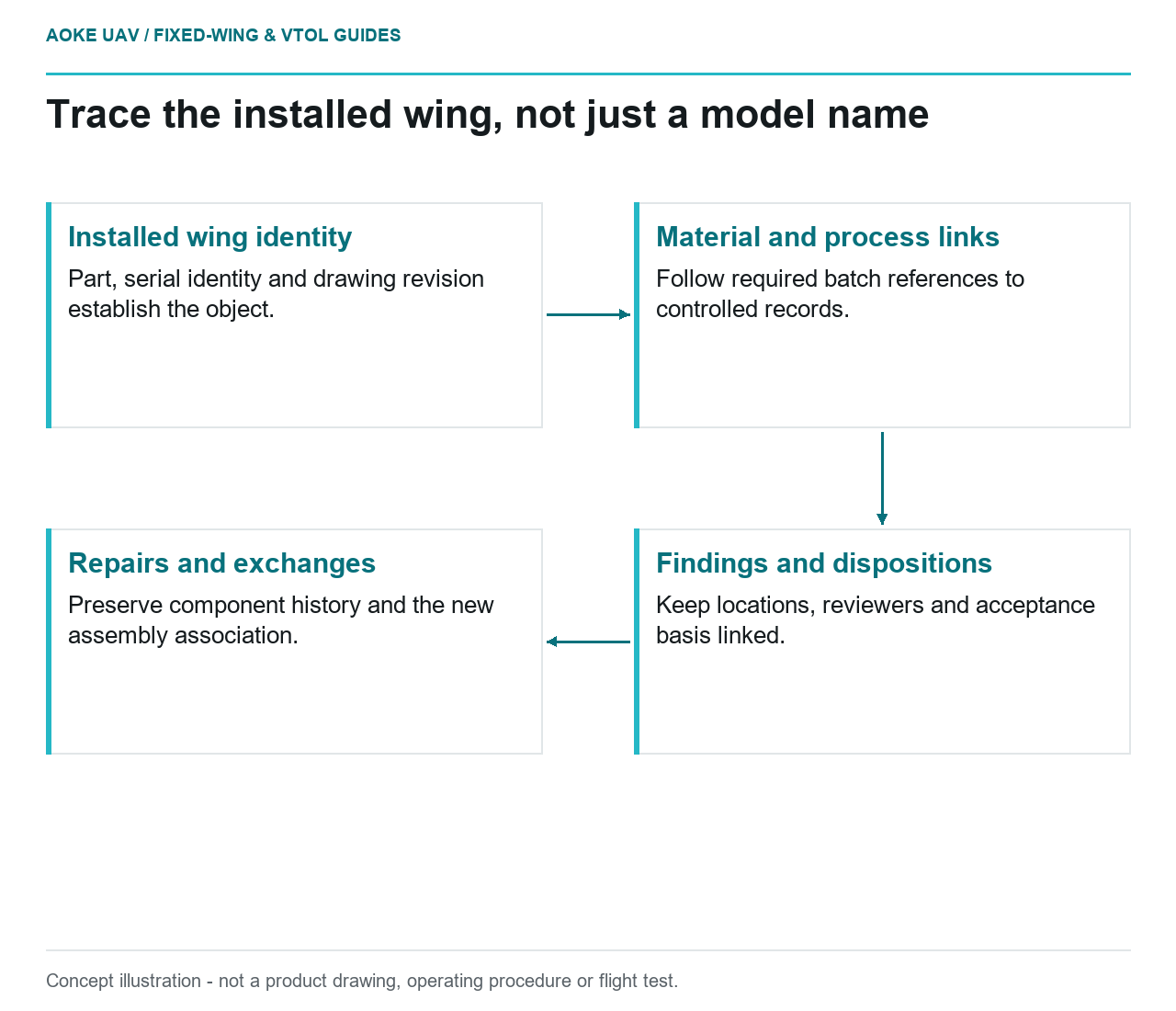
- Installed wing identity: Part, serial identity and drawing revision establish the object.
- Material and process links: Follow required batch references to controlled records.
- Findings and dispositions: Keep locations, reviewers and acceptance basis linked.
- Repairs and exchanges: Preserve component history and the new assembly association.
A civil survey operator receives a replacement wing for a hypothetical large fixed-wing aircraft. The physical panel has a serial number, but the accompanying inspection file identifies only a model family. The issue is not the appearance of the label; it is whether the records describe the installed assembly. This article proposes a traceability review connecting identities, configurations and dispositions. It does not treat possession of a serial number, a certificate or a complete-looking folder as proof that the structure is approved or airworthy.
Assembly identity and configuration
Start with the installed wing’s part number, serial identity and drawing revision. Ask how the record identifies detachable subassemblies and which changes affect the top-level configuration. If a root fitting or control surface has its own identity, the assembly record should explain its relationship to the wing rather than leave the reviewer to infer it from storage labels.
FAA composite guidance calls for manufacturing documentation to control fabrication and assembly and for records supporting part acceptance. [1] This US certificated-aircraft context is useful background for the hypothetical fixed-wing operator, not evidence that the supplier meets a particular approval scheme. The practical question is whether an independent reviewer can trace this installed object through the record without guessing which similarly named assembly a document describes.
Material and bond batch links
Request links from the assembly to the material and adhesive batches that its applicable process requires. A batch identifier should lead to the corresponding controlled record, not merely to a spreadsheet with the same word in a column. Keep material identity, supplier documentation and process evidence distinguishable so that the purpose of each reference is clear.
The FAA connects material requirements with qualification and expects controls over raw and ancillary materials, fabrication and bonding. [1] For the large industrial fixed-wing review, that supports asking which batch-to-part relationships are required and how the supplier preserves them. Do not demand a fabricated level of detail merely to fill a template. If a requested link was never recorded, identify the evidence gap honestly and ask the responsible authority how it affects acceptance.
Inspection findings and dispositions
Tie each inspection report to the assembly identity, inspection revision and relevant configuration. Preserve finding locations and their dispositions together. A finding should not disappear because a later cover sheet says accepted. Ask who made the disposition and which supporting record establishes its applicability to the part now offered.
FAA guidance states that manufacturing records support acceptance and allowable discrepancies, and that defects or anomalies left without rework or repair need substantiating data. [1] This is not a requirement invented for the hypothetical fixed-wing transaction; it is the reasoning behind asking for a complete chain rather than an isolated pass mark. Keep unresolved deviations visible in the handoff. A report describing a different serial number should remain an applicability problem until reconciled, not be silently relabelled.
Repairs and component exchanges
When components move between aircraft, preserve both the component history and the assembly association. Ask how repairs, replacement fittings and revised inspection requirements are carried into the new installation record. The proposed review should distinguish a component exchange from a repair and retain the document authorizing each relevant change.
FAA maintenance guidance calls for repair documentation in records for the specific part and for feedback on damage and degradation. [1] For this hypothetical large fixed-wing operation, the closing evidence pack should let a reviewer follow the installed wing from identity through material/process history, inspection and later changes. Provenance explains where records and hardware came from; it does not independently confer certification. State any missing links and their disposition instead of allowing a well-formatted serialised log to imply an approval that has not been established.