Concept illustration
Read diagram notes
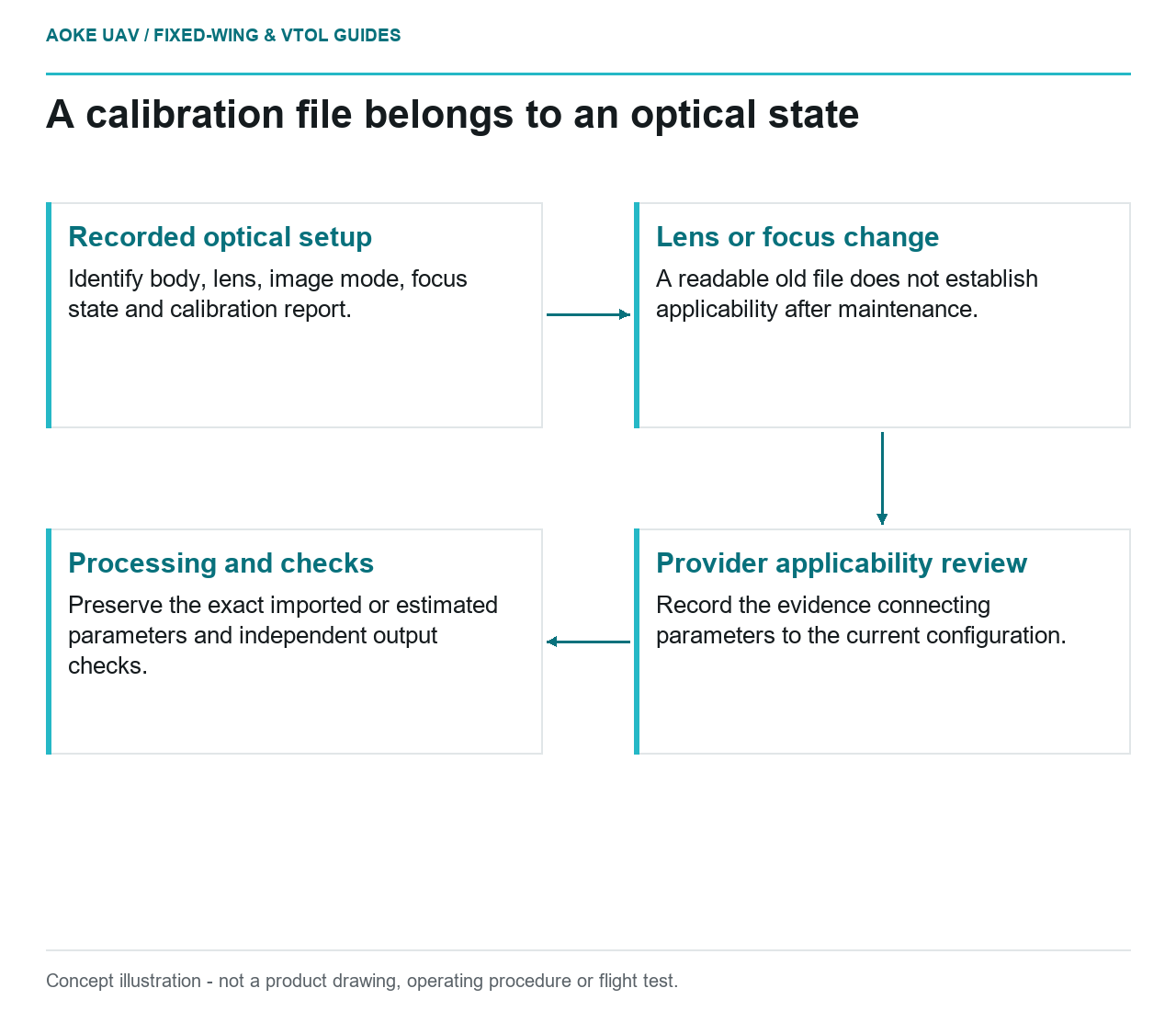
- Recorded optical setup: Identify body, lens, image mode, focus state and calibration report.
- Lens or focus change: A readable old file does not establish applicability after maintenance.
- Provider applicability review: Record the evidence connecting parameters to the current configuration.
- Processing and checks: Preserve the exact imported or estimated parameters and independent output checks.
The camera’s name is not a complete calibration identity. In a hypothetical large fixed-wing civil mapping program, a familiar survey camera returns from maintenance with a replacement lens and an adjusted focus setting. The old calibration file still opens, but that does not establish its applicability. The task is to connect the file to the actual optical configuration before treating it as measurement evidence.
Camera parameters belong to a configuration
USGS describes geometric camera calibration in terms of interior orientation: focal length, principal-point location and lens-distortion parameters. These describe the imaging geometry, rather than simply identifying the camera manufacturer. Its report presents particular calibration approaches, not a universal maintenance interval or a certificate for another installation. [1]
For the fixed-wing example, begin with a configuration sheet containing the camera and lens identifiers, image mode, focus state, calibration date and report reference. Identify how the processing software selects that calibration. If a file is named only after the aircraft, ask which payload installation it represents. Keep a readable summary beside the machine-readable parameters so the relationship can be reviewed without opening specialist software.
Focus changes and lens replacement
The USGS laboratory example explicitly fixes focus at infinity during its described calibration procedure. That detail illustrates that the calibration observations have an optical setup; it should not be reinterpreted as an instruction to set every survey lens to infinity regardless of its own documentation. [1]
For the hypothetical replacement, ask the camera or calibration provider whether the previous parameter set applies to the new lens and focus state. Record the answer and its basis. Avoid both extremes: automatically declaring the old calibration valid because the camera body is unchanged, or asserting that every small intervention demands an identical recalibration procedure. The relevant decision depends on the actual equipment and calibration method.
Before the next large fixed-wing acquisition, the proposed review would verify how focus is set, whether it can change during the mission and how that state is recorded. If the setting cannot be reconstructed, state that uncertainty. Do not select an unknown calibration file merely because it produces an attractive orthomosaic.
Temperature and mounting context
Extend the review to installation changes without inventing a generic thermal correction. For this example, ask whether the calibration provider specified an operating context and whether the camera is now used behind a different window, in a different housing or with a revised restraint. Record any temperature-related evidence that actually exists. No source here establishes a universal temperature coefficient or an allowable mechanical stress for a survey lens.
A fixed-wing payload bay review should distinguish optical calibration from mount-to-navigation alignment. A new bracket might leave a laboratory camera file readable while changing the installation relationship that another part of the workflow uses. Treat this as a configuration question to resolve with the selected sensor’s documentation, not proof that one calibration operation covers both problems.
Preserve calibration identity in project records
USGS recommends retaining calibration parameters and their uncertainties as metadata, and explains that ground control and tie-point quality contribute to geometric accuracy independently of GSD. Therefore, neither a reused calibration file nor a smaller planned pixel footprint can stand alone as an accuracy guarantee for this civil survey. [1]
The proposed handover would preserve the original calibration report, the exact parameter file supplied to processing, the camera configuration and the processing revision. A change log should explain whether a file was imported, estimated during adjustment, constrained or replaced. Keep independent product checks separate from observations used to estimate parameters, and have the project team define acceptance against the intended measurement use.
If documentation cannot connect the calibration to the replacement configuration, classify the camera as awaiting applicability review for that deliverable. It may still make photographs, but that is a different claim from demonstrating dependable mapping geometry. Closing the review means obtaining the necessary provider guidance and product evidence, not simply renaming the old calibration after the new lens.