Concept illustration
Read diagram notes
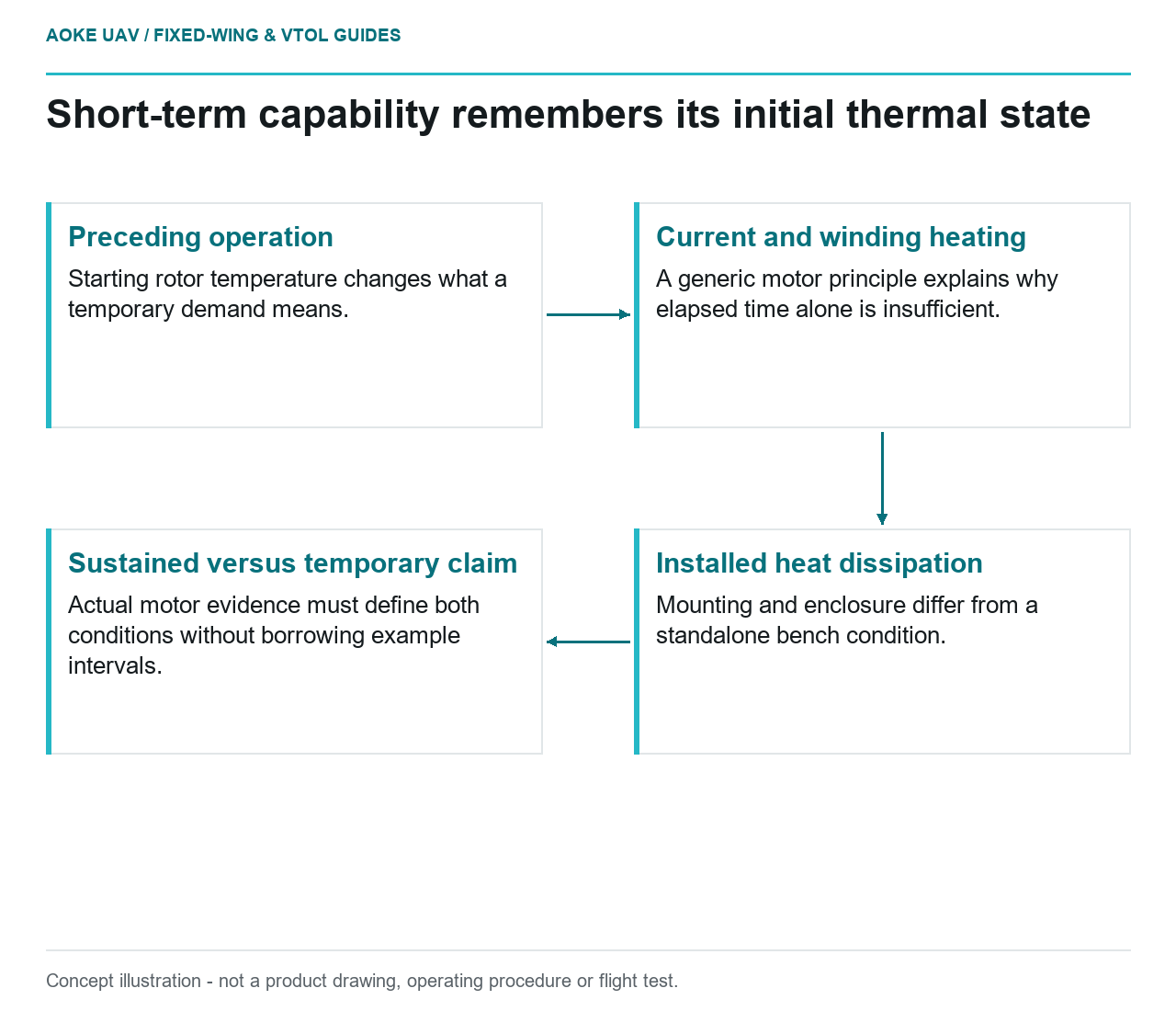
- Preceding operation: Starting rotor temperature changes what a temporary demand means.
- Current and winding heating: A generic motor principle explains why elapsed time alone is insufficient.
- Installed heat dissipation: Mounting and enclosure differ from a standalone bench condition.
- Sustained versus temporary claim: Actual motor evidence must define both conditions without borrowing example intervals.
A rating needs its conditions attached
Consider a hypothetical large fixed-wing aircraft performing extended civil mapping runs. Its proposed motor sits within a fuselage, while the supplier’s brief presentation emphasizes a short-duration output claim. The review question is whether the available evidence describes the aircraft’s sustained demand, not whether the largest advertised number exceeds a proposed requirement.
The maxon reference distinguishes a continuous operating region from temporary overload. It describes maximum continuous torque and permissible speed as boundaries of the continuous region, while explaining that higher temporary current depends on thermal conditions. These are generic motor concepts, not transferable ratings for the aircraft in this example. [1]
Ask the supplier to preserve the complete rating statement: exact motor and winding, quantity being rated, duration, initial state and test conditions. Do not reduce that statement to watts or amperes in a comparison sheet. If a term such as peak lacks a defined duration, the duration remains an unanswered specification question.
Understand why elapsed time is not the only variable
In its temporary-operation discussion, maxon ties overload duration to motor current and starting rotor temperature, and introduces the winding thermal time constant. The reference’s examples concern its own motor range; their durations are not settings for a large UAV. The supported lesson is that a short-term capability is conditional, not that another installation may copy the example interval. [1]
For the hypothetical fixed-wing mission, ask how the proposed evidence represents preceding operation. A demonstration beginning from a documented thermal state answers a more specific question than one with no initial-state record. A sequence of repeated demands should be described as a sequence in the project’s evidence request, rather than as unrelated isolated events.
Likewise, separate current, shaft power and speed claims. A peak value of one quantity should not silently become a sustained limit for another. This is a documentation discipline for the proposed review, not an aircraft-specific rating interpretation supplied by the generic source.
Bring the cooling assumptions into the installation review
Maxon explains continuous current through winding heat generation and dissipation. Its catalog discussion states particular standard conditions and notes that thermal behavior can change with heat dissipation through the mounting arrangement. Those conditions belong to the source’s own motor context, not to an arbitrary enclosed propulsion installation. [1]
In the illustrative large survey aircraft, request a description of the actual motor mounting, cooling path and environmental assumptions. Ask whether the supplied thermal record represents that installation or a different bench arrangement. If the evidence concerns an exposed motor while the proposal places it inside a fuselage, retain that difference as a validation need rather than assigning an unsupported derating.
For a fixed-wing VTOL derivative, ask which operating states and durations the record covers for each propulsion unit. The question is not answered by giving every motor the same label or assuming that a brief lift segment validates prolonged forward propulsion. No cooling coefficient or temperature threshold is established here.
Make the review outcome narrower than the claim
A useful proposed evidence sheet separates continuous capability, defined short-term capability and unresolved advertising language. Beside each entry, retain the source revision and the conditions actually documented. Then show which intended mission demand it is being compared with. This keeps a brief demonstration from quietly becoming a sustained-capability assertion.
The maxon reference also notes that its basic motor diagrams omit tolerances and temperature influences. A point that appears acceptable in a generic diagram therefore does not settle the installation-specific thermal question. The actual motor, controller and cooling arrangement require applicable evidence. [1]
For the hypothetical civil fixed-wing aircraft, the defensible decision may be to request installed thermal characterization before treating the proposed continuous output as demonstrated. That is different from declaring the motor unsuitable, and different from inventing a universal margin. Keep peak capability, sustained capability and aircraft performance as separate claims until the documentation connects them under the intended conditions.
Related reading
- Motor Efficiency Claims and the Mission Operating Range
- Hot-Wet Exposure and Composite Airframe Evidence