Concept illustration
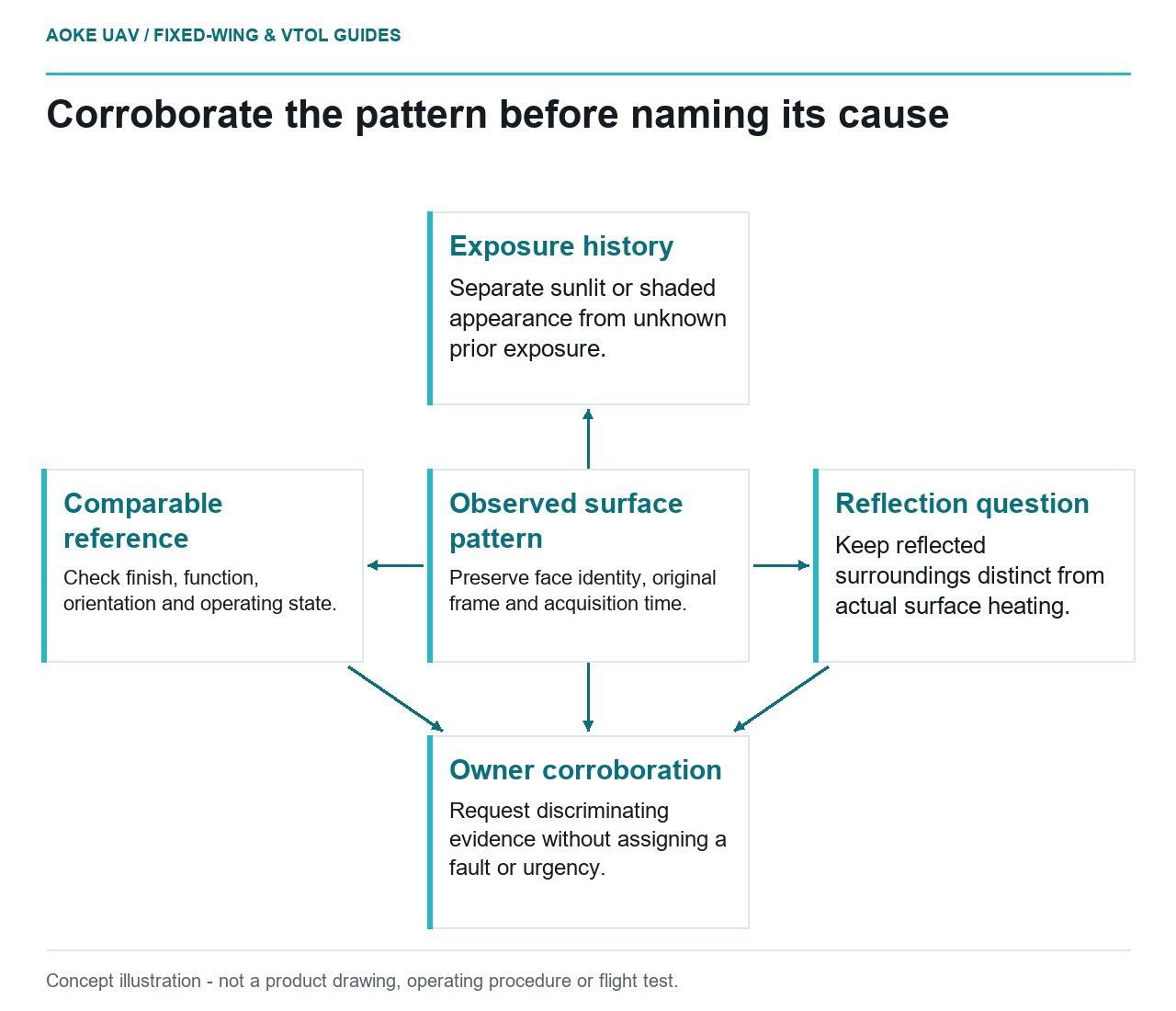
Read diagram notes
- Observed surface pattern: Preserve face identity, original frame and acquisition time.
- Exposure history: Separate sunlit or shaded appearance from unknown prior exposure.
- Comparable reference: Check finish, function, orientation and operating state.
- Reflection question: Keep reflected surroundings distinct from actual surface heating.
- Owner corroboration: Request discriminating evidence without assigning a fault or urgency.
A warm region in an industrial overview needs an explanation, not just a label. In this hypothetical civil survey, a large fixed-wing aircraft records a row of outdoor enclosures. One exposed face appears different from a shaded neighboring face. The example is not an GAUTEN customer result. It frames a useful question: which evidence could distinguish environmental heating from an asset-related condition requiring further investigation?
Sun exposure and surface orientation
An InfraMation application paper hosted by the Infrared Training Center examined solar and wind effects on switchyard equipment. Its study considered target orientation relative to the sun, wind near the surface, target material and emissivity. [5] These are reasons to examine environmental context, not universal corrections for every industrial asset.
For the proposed fixed-wing handover, retain enough context to describe which surface is observed and whether it was sunlit or shaded at acquisition. Ask the asset team for a diagram or register if orientation cannot be resolved from the images. A location marker alone does not tell the later reviewer which face generated the observation.
Distinguish the acquisition instant from the surface’s preceding exposure history. In the investigation brief, ask whether a recent shadow or cloud transition might be relevant and whether any record is available. Do not manufacture an exposure history from a single frame. If the history is unknown, keep that uncertainty visible.
Material finish and local shadows
The same study reported different behavior in its equipment examples, including an example involving cooling fins. Its findings should remain in that study’s context rather than becoming a promise that solar loading always preserves a diagnostic pattern. [5] The appropriate lesson for this overview is to investigate differences, not assume they cancel.
In the hypothetical scenario, construct a comparison that does not silently mix different surfaces. Ask whether the neighboring reference has the same function, coating, exposure and operating condition. If those characteristics cannot be established, explain why the comparison is tentative. Similar shapes in an overview are not sufficient evidence of equivalent thermal behavior.
Also distinguish actual surface heating from reflected surroundings. FLIR treats reflected radiation as a separate contribution in thermal measurement. [1] A reflective face therefore needs a different evidence question from a surface whose temperature changed through exposure. Do not use solar heating as a blanket explanation for every bright region.
Operating state and acquisition time
Request the owner’s available operating records for the observation period. The analyst’s proposed log should separate confirmed information, owner estimates and missing data. If an enclosure was idle while its neighbor was operating, leave the comparison open until the owner explains whether it is meaningful for the asset’s function.
For a large fixed-wing campaign, connect each finding to its own acquisition time rather than only a mission start date. A proposed review can then ask which site events or environmental observations overlap that finding. Do not imply a detailed reconstruction when the available logs cover only broad periods.
Record any decision to exclude a reference area. For example, if a reviewer rejects a shaded neighbor as unsuitable, retain the reason instead of silently substituting another convenient comparison. This makes the analytical chain reviewable and prevents the reference from being selected solely because it supports a preferred diagnosis.
Plan corroboration rather than a diagnosis
The overview should end with a testable question for the asset team. Which observation would help distinguish exposure effects, reflection, normal operation and a maintenance concern? The exact follow-up method and acceptance criteria need the applicable asset documentation; neither the switchyard study nor FLIR’s general measurement chapter supplies them for the hypothetical installation.
Propose separate report fields for the observed pattern, environmental context, alternative explanations and requested corroboration. Avoid assigning a fault-temperature threshold, repair urgency or power-loss value. A useful record can remain unresolved while still directing an appropriate investigation to the right place.
Keep the fixed-wing role proportionate: broad, traceable observation from the planned acquisition geometry. Do not assume a large aircraft can provide an unplanned stationary close view. Where the necessary evidence lies outside that scope, say what remains unseen and hand the question to the responsible asset specialist.