Concept illustration
Read diagram notes
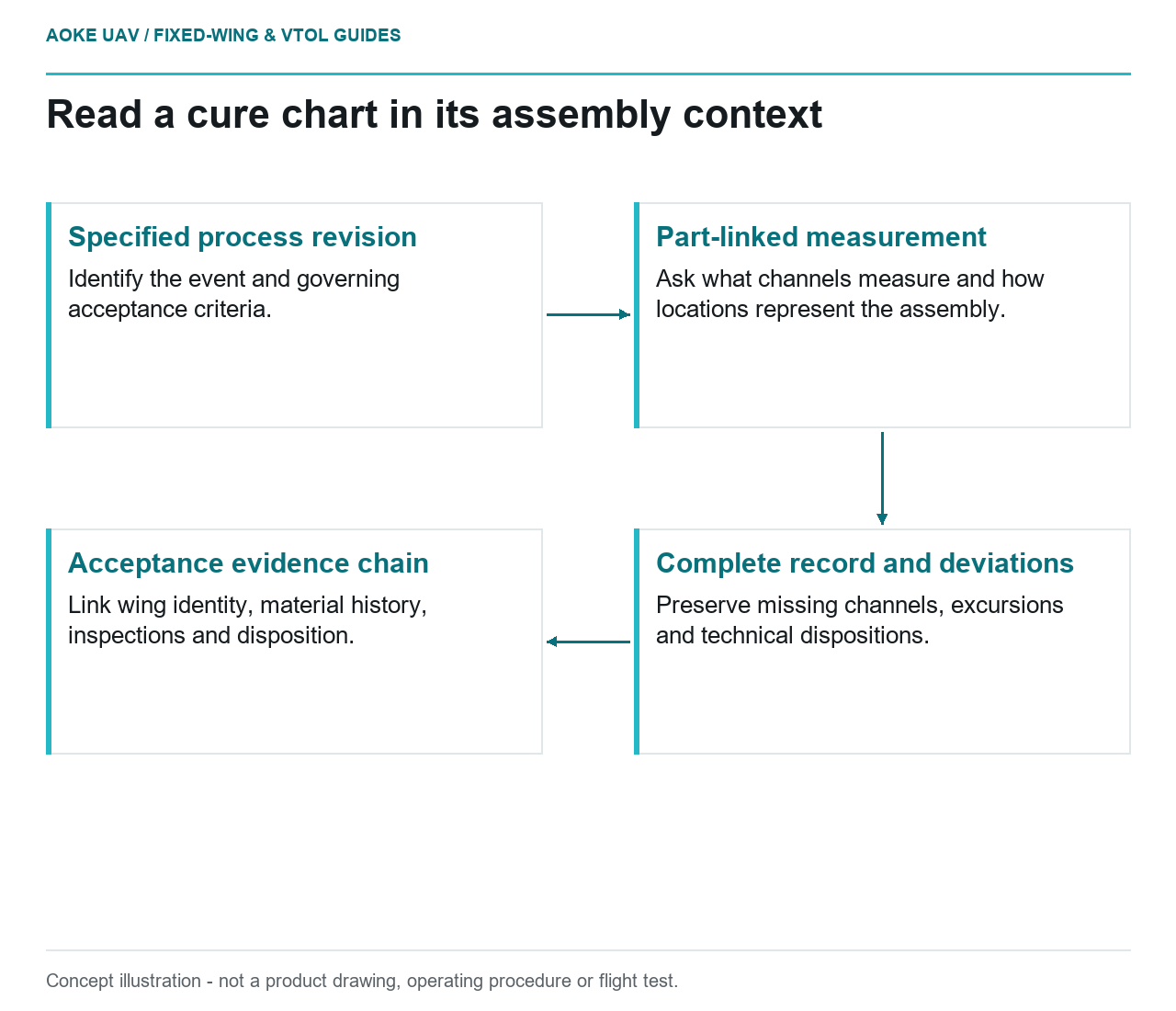
- Specified process revision: Identify the event and governing acceptance criteria.
- Part-linked measurement: Ask what channels measure and how locations represent the assembly.
- Complete record and deviations: Preserve missing channels, excursions and technical dispositions.
- Acceptance evidence chain: Link wing identity, material history, inspections and disposition.
A temperature plot can be genuine and still answer less than a buyer assumes. In this hypothetical procurement review, cure records are offered for a large composite wing intended for civil fixed-wing surveying. The question is how to read those records without mistaking evidence of a processing event for proof of the finished wing’s structural acceptability. This example is not an GAUTEN manufacturing record or a report of an actual production result.
Specified cycle versus recorded cycle
Begin by requesting the specified process and its revision, then compare that reference with the record offered for the actual wing. FAA composite guidance explains that final mechanical behavior depends on processing and that repeatable materials and fabrication controls support the design evidence. A chart therefore needs a defined specification before its significance can be assessed. This is certification-context guidance, not a cure instruction for the hypothetical UAV. [1]
Ask what the record is intended to demonstrate: an equipment cycle, a particular assembly cure, a post-cure, or something else. Do not silently merge those events. Request the applicable acceptance criteria and the process record’s complete context rather than selecting only its smoothest interval. This article gives no cure temperature, duration, pressure, or tolerance; those belong to the actual material and process documentation.
Sensor locations and part representation
For the proposed review, ask where the measurements were taken and how they represent the material being processed. Is the graph an equipment readout, a part-linked measurement, or a summary assembled from several channels? Request the sensor identification and arrangement used by the governing process, together with the required equipment and measurement controls. These are questions to resolve, not an assertion that a particular wing needs a specified sensor count.
NASA’s JSC sandwich assembly specification illustrates the distinction between a named cure schedule and its governing data: cure and post-cure are controlled by material data, drawing, model, or contractual documentation. The specification is a JSC process example, not a standard cure cycle for fixed-wing UAV wings. [2] A supplier should explain the applicable process basis rather than rely on a generic oven capability statement.
Deviations and engineering disposition
If a record shows a deviation, ask what occurred, which specification limit was involved, and who made the technical disposition. If channels are missing, ask whether the remaining record satisfies the actual acceptance basis. Do not invent an allowed excursion from the graph or accept an undocumented verbal statement that the cycle was close enough. These are proposed purchasing-review boundaries for the scenario.
FAA guidance calls for thorough manufacturing records supporting acceptance and allowable discrepancies, with substantiating data for anomalies allowed to remain. It also identifies curing-cycle changes among processing changes that may require technical evaluation. [1] Distinguish accepting a documented deviation on one assembly from changing the production process for future assemblies. Neither conclusion should be inferred merely because the finished fixed-wing wing looks normal.
Trace records to serialised assemblies
The record must identify the hardware it describes. NASA’s JSC specification provides an explicit example of part-number and serial-number identification, verification of cure operations, and traceable mandatory-inspection records in its Level 1 process. It also distinguishes separately specified nondestructive evaluation from the assembly process specification itself. [2] Those distinctions help frame a document request without adopting NASA’s process as UAV qualification.
For the hypothetical large fixed-wing wing, propose a traceability chain linking assembly identity, material history, specified cycle, actual process record, required inspections, deviations, and acceptance disposition. Ask whether later assembly or repair operations have their own relevant records. A completed cure chart should be described as evidence for the processing claim it actually supports. It is not, alone, a measurement of laminate properties, proof of all internal bond quality, or a complete structural substantiation package.
Decision boundary
A useful buyer’s review separates conformance to a defined process from acceptance of the finished component and from structural capability. When the offered record cannot be linked to the wing or its governing requirements, state that limitation. No oven trace in this article establishes a fixed-wing flight limit, a material allowable, or approval of a production process.