Concept illustration
Read diagram notes
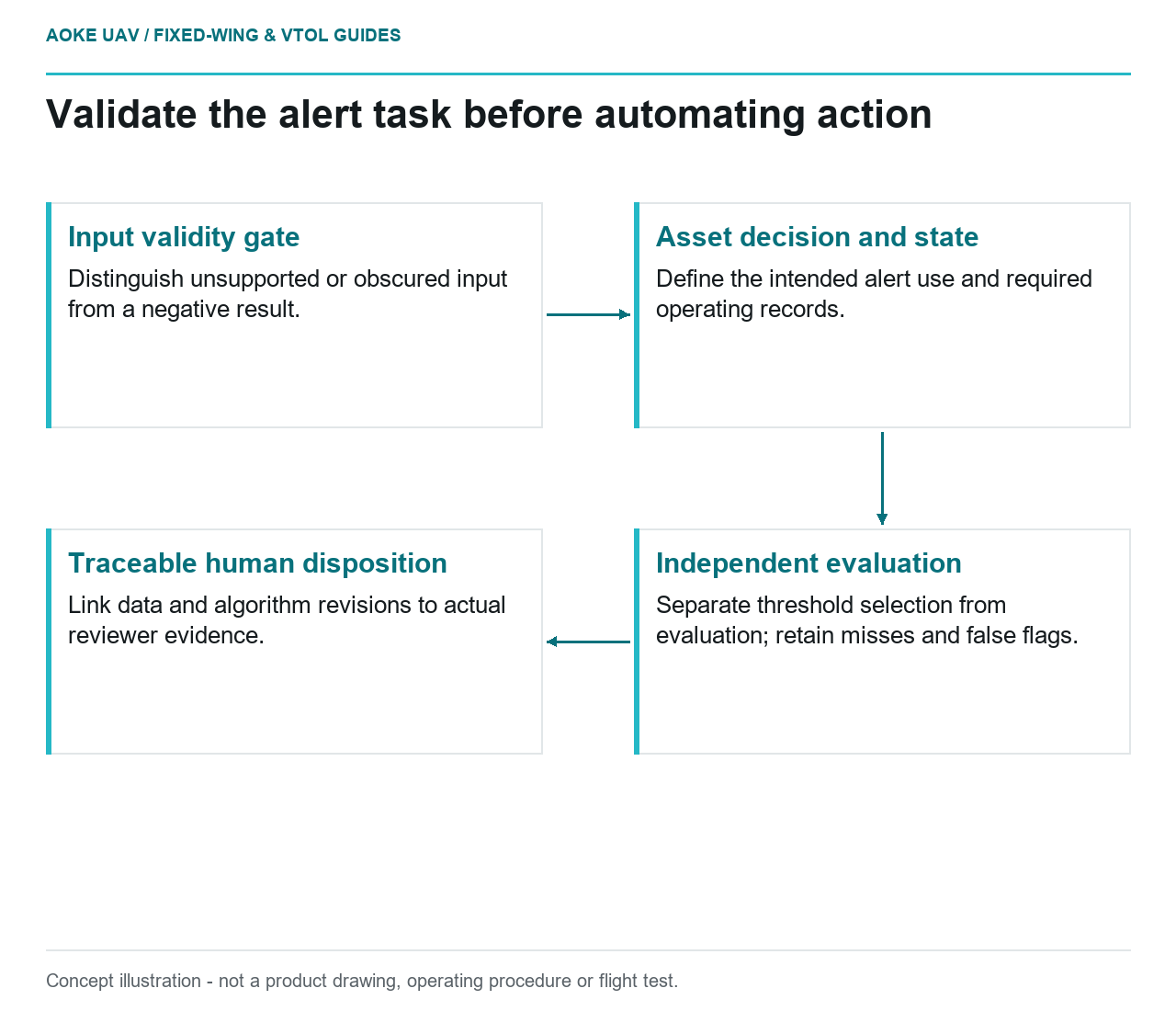
- Input validity gate: Distinguish unsupported or obscured input from a negative result.
- Asset decision and state: Define the intended alert use and required operating records.
- Independent evaluation: Separate threshold selection from evaluation; retain misses and false flags.
- Traceable human disposition: Link data and algorithm revisions to actual reviewer evidence.
A software flag can organize work without establishing a defect. Imagine a hypothetical industrial monitoring program in which a large fixed-wing UAV records thermal imagery and software marks candidate regions for review. The owner wants to know which flags justify maintenance action. This is a civil validation problem, not an GAUTEN detection system or a demonstrated performance claim. The article offers validation questions because no applicable asset-specific alert method has been established here.
Measurement assumptions before thresholds
FLIR identifies object and environmental parameters needed for thermal measurement compensation, including emissivity and reflected apparent temperature. [1] Before evaluating an alert threshold, the proposed review must establish what the software’s input actually represents and which assumptions were used to produce it.
Ask whether the flag operates on a calibrated measurement, a derived statistic or a rendered image. Request the original data, input-region definition and processing configuration. Do not let a user-interface temperature readout conceal uncertainty about surface identity, measurement parameters or whether the feature was observed adequately.
For the proposed fixed-wing workflow, define an invalid-input outcome separately from a negative result. If the asset is obscured, unidentifiable or unsupported by the measurement evidence, the system should not silently record that no concern exists. The exact criteria for valid input need agreement with the intended asset method.
Asset operating-state context
Require the owner to define the asset population and the decision the alert is meant to support. A location for further investigation is a different objective from confirmed fault classification or automatic work-order generation. Keep those purposes separate in the test plan and report.
Ask which operating records are necessary to interpret each candidate and how missing context is handled. If a threshold is intended for a particular state, the validation evidence should identify that state rather than pooling unrelated observations into one success claim. This is a proposed review principle, not an asset-specific threshold recommendation.
Broad fixed-wing coverage should not erase per-asset uncertainty. A software pipeline may create a marker at every mapped asset, but the validation record still needs to distinguish observed, unresolved and unobserved cases. Do not infer condition from the existence of a database row or from a blank alert layer.
Reference observations and false alerts
Ask the owner what independent evidence can establish the relevant condition and who is qualified to adjudicate it. The reference needs an applicable asset procedure and a known relationship to the airborne observation. A second reviewer agreeing with the same thermal screenshot is not automatically independent confirmation.
USGS’s imagery guidelines emphasize calibration, quality control and uncertainty metadata for evaluating datasets. [2] That supports checking the underlying data chain, but it supplies neither industrial fault temperatures nor a validated defect-classification benchmark.
Propose an evaluation set that includes confirmed concerns, appropriate comparison cases and the conditions in which interpretation is difficult. Keep evidence used to choose a threshold distinct from evidence used to evaluate the chosen version. Record unresolved reference cases rather than forcing them into whichever label improves the apparent result.
Require the review to account for both flags that were not confirmed and concerns that the process failed to flag. Define the evaluation population and exclusions before reporting performance. Do not publish a detection rate from a convenient collection of selected examples or call the absence of a confirmed fault proof that an observation was useless.
Human review and traceable disposition
For each proposed alert, preserve the source file, asset association, measurement configuration, algorithm revision and threshold revision. Add the reviewer’s disposition and the evidence supporting it. A later software change should create a traceable interpretation revision, not overwrite the only account of an earlier decision.
Assign authority explicitly. The monitoring pipeline may propose a review candidate while the asset team decides the appropriate investigation or action under its applicable procedures. Do not convert that workflow into a legal inspection equivalence or a guarantee of safe condition.
The useful endpoint is a validated scope, not necessarily unattended automation. A large fixed-wing program can begin with supervised screening, preserve its evidence and leave unsupported classifications unresolved. Stronger decisions require the missing asset-specific primary method and validation data, not an invented temperature limit or a confident software label.
Related reading
- Emissivity in Industrial Thermal UAV Imagery
- A Propulsion Supplier Evidence Checklist for Industrial UAVs