Concept illustration
Read diagram notes
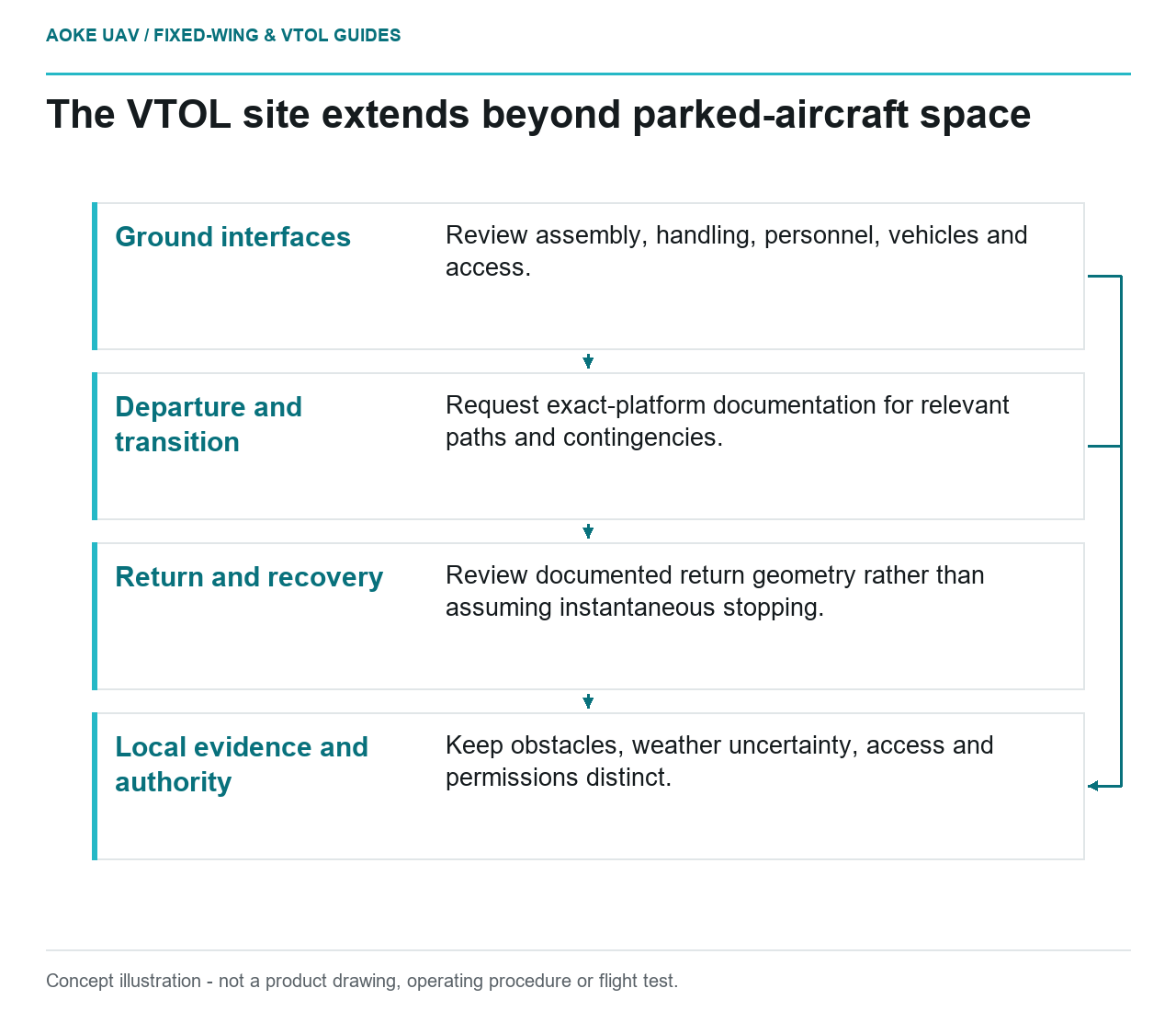
- Ground interfaces: Review assembly, handling, personnel, vehicles and access.
- Departure and transition: Request exact-platform documentation for relevant paths and contingencies.
- Return and recovery: Review documented return geometry rather than assuming instantaneous stopping.
- Local evidence and authority: Keep obstacles, weather uncertainty, access and permissions distinct.
Ground setup and personnel interfaces
A clearing that accommodates a parked aircraft does not by itself establish a usable departure site. In this hypothetical civil inspection project, a team is considering a large fixed-wing VTOL aircraft for broad corridor imagery. The site review must include the whole operation rather than only a point marked takeoff. Start with ground assembly, personnel positions, equipment access and the routes by which the team reaches and leaves the work area.
ArduPilot’s QuadPlane overview distinguishes combined fixed-wing and multicopter operation and describes a variety of configurations. [1] That architecture explains why the label VTOL does not uniquely specify a ground footprint. In the proposed site checklist, request the actual aircraft’s documentation for assembly, handling and operating-site requirements. Do not infer required space from another platform’s photograph, or convert the controller overview into approval to operate a multi-metre wing from a small clearing.
Transition requires a different flight condition
The site question extends beyond vertical lift. ArduPilot describes transition between VTOL and conventional fixed-wing flight as a change in the way the aircraft is supported and controlled. Its detailed behaviour varies with configuration and mode, and the documentation discusses airspeed-dependent transition phases. [2] These are controller-specific explanations, not a site-sizing method. This article deliberately provides no transition distance, height, speed target or parameter recommendation for the hypothetical aircraft.
Ask the responsible integrator to explain which departure, transition, return and contingency paths must be considered under the exact platform procedures. Include a question about what happens if the intended transition cannot be completed. Record the answer by reference to the actual documentation rather than improvising a recovery instruction. For a large fixed-wing civil monitoring mission, the intended benefit of wingborne corridor coverage does not erase these site interfaces at the beginning and end of the flight.
Return deserves its own review. The ArduPilot transition documentation describes deceleration when moving from fixed-wing flight toward VTOL position holding, rather than instantaneous stopping at a map point. [2] The proposed planning implication is simply to ask for the documented return geometry and its assumptions. A narrow arrival opening should not be accepted because the aircraft can eventually hover. No stopping performance is calculated or assured here.
Wind and local obstacles
WMO identifies terrain roughness, wind strength and atmospheric stability as influences on mechanical turbulence and describes complex local airflow around terrain. [3] Use that context to ask whether the available weather information represents the candidate site and its departure and arrival surroundings. Do not treat a windsock at one position as a complete local-flow assessment or draw an invented safe boundary around a structure. The actual weather decision belongs to the authorised operating team.
In this proposed site review, record obstacles, uncertain local conditions and unresolved documentation separately from the dimensions of the open ground. The review should also identify where personnel, vehicles or other site users interface with the aircraft operation. These are questions for a controlled planning process, not a claim that a generic exclusion zone is sufficient. If a site requirement is unavailable, retain it as a blocker for the operational plan rather than inserting an assumed clearance.
Separate site access from authorisation
A landowner’s invitation and an aircraft’s vertical-takeoff capability answer different questions. For this hypothetical project, maintain distinct records for property access, the actual operator’s permissions and the platform-specific site assessment. This article makes no legal determination about any of them. The cited ArduPilot material explains software architecture and transition behaviour; it is not evidence that a particular aircraft, site or inspection mission has been approved. [1] [2]
Finish with a site dossier that points to the exact aircraft documents, identifies the responsible reviewers and lists unresolved departure, return and contingency questions. Where the site cannot support the documented operation, reconsider the site or observation method through the responsible team’s process. Large fixed-wing VTOL can have a role in corridor monitoring without a promise of operation from any clearing, close-structure hovering or an inspection-quality outcome based solely on vertical takeoff.
Related reading
- Reviewing Structural Load Cases Across VTOL Transition
- Concurrent Power Demand During Fixed-Wing VTOL Transition