Begin with the defect question, not the aircraft
Imagine a hypothetical owner of a civil utility campus asking a large industrial fixed-wing survey to certify that covered structures contain no internal material defects. The proposed acquisition is ordinary RGB imagery of visible exterior surfaces. Before selecting an aircraft or interpreting a map, the owner must separate an appearance record from the material question it actually wants answered. This is an illustrative method-selection exercise, not an GAUTEN inspection capability or a certification claim.
Ask what physical evidence would answer the owner’s question and which parts of the asset must be accessible to the chosen method. State whether the request concerns surface appearance, dimensions, internal condition or a combination. Do not label all of these nondestructive testing and then assume a visual overflight satisfies the entire scope. The applicable asset documentation must define the assessment method.
Distinguish initial detection from characterization
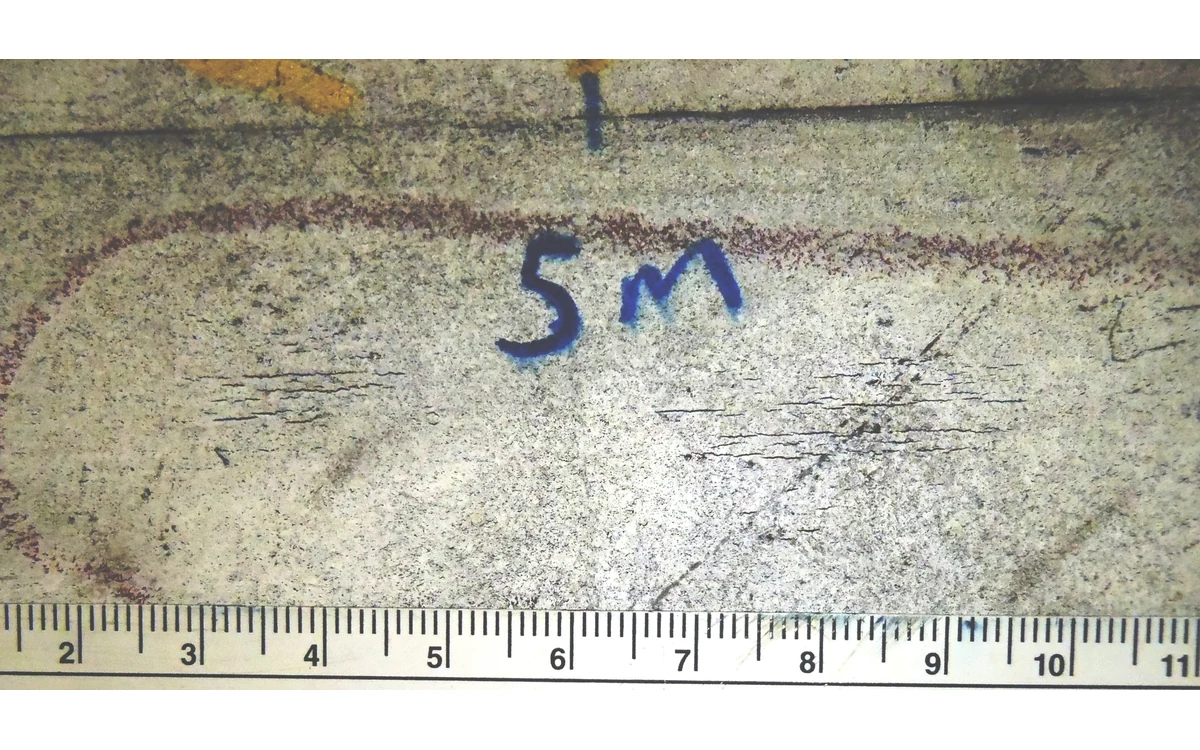
FAA composite-aircraft guidance explains that visual indications reveal limited information about hidden damage and that more complete characterization generally uses different procedures. It also recognizes that some processing defects, including weak bonds in its discussion, are not reliably detected at repair completion. These points concern composite aircraft maintenance, not the condition of the campus assets or a universal detection rule. [1]
The useful methodological lesson is to avoid treating one visible indication as a complete account of an internal state. In the hypothetical campus, a surface patch might prompt a qualified review, while an ordinary-looking surface might still leave the requested internal question unanswered. Neither observation establishes the presence or absence of a specific hidden defect without applicable supporting evidence.
Keep detection, characterization and engineering disposition as distinct fields in the request. The first asks whether a particular indication was observed. The second asks what it represents and how far it extends. The third asks what action is justified. A fixed-wing image can contribute to the first stage within its documented visibility limits without completing the other stages.
Match collection geometry to the evidence request
For the scenario, map the exterior surfaces the owner wants recorded and mark those excluded from the proposed view. Ask for evidence that the actual aircraft and payload configuration can obtain the intended observation. Do not transfer close-access or contact-testing capability from an unrelated platform to a large fixed-wing mission because both are called UAV inspection.
The FAA guidance discusses access, prescribed lighting and surface conditions for visual inspection in its aircraft context. That supports asking how a visual procedure is implemented and validated, not assuming that any photograph is equivalent to a documented inspection. The actual campus method and acceptance criteria remain an evidence gap for the owner to resolve. [1]
If the required observation involves a hidden interface, an inaccessible face or a contact measurement, identify it as an alternative-method question. The owner and qualified assessor should specify the suitable access and equipment. This article supplies no ultrasonic settings, material thresholds, pass criteria or permission to operate near an asset. The correct procurement response may be to divide the job among complementary methods.
Deliver a method-bound report
Propose a scope table that pairs each owner question with the intended observation, selected method, applicable documentation, coverage limitation and decision authority. Where the method has not been established, leave the row unresolved instead of filling it with a generic image-quality claim. This lets the client see precisely why a broad overview is useful yet insufficient for another task.
For the fixed-wing component, retain original images and clear statements of what surfaces were adequately observed. Report visible indications as observations pending interpretation where appropriate. Do not turn an unobserved region into a no-finding result or describe the mission as a comprehensive material examination.
A defensible handover can therefore combine valuable exterior context with an explicit request for further assessment. Its strength lies in matching claims to evidence, not in using a broad testing label. The client receives a clearer route toward the required asset decision without being told that ordinary aerial imagery has ruled out every class of internal damage.
Related reading
- Tap Testing: Useful Questions and Important Limits
- Vertical Faces and the Blind Spots of Nadir Mapping
Sources
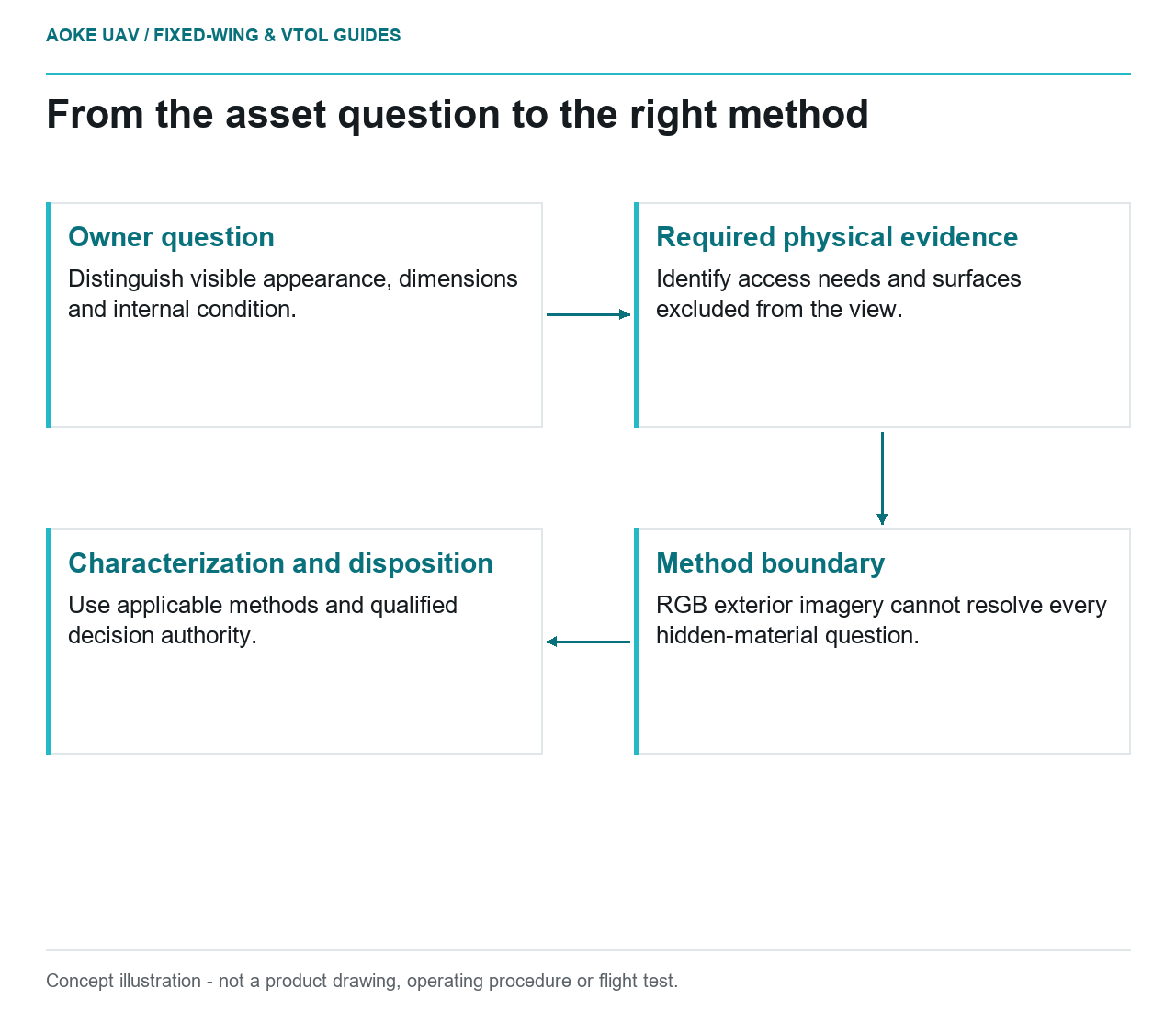
Visual summary
Concept illustration
Read diagram notes
- Owner question: Distinguish visible appearance, dimensions and internal condition.
- Required physical evidence: Identify access needs and surfaces excluded from the view.
- Method boundary: RGB exterior imagery cannot resolve every hidden-material question.
- Characterization and disposition: Use applicable methods and qualified decision authority.