Concept illustration
Read diagram notes
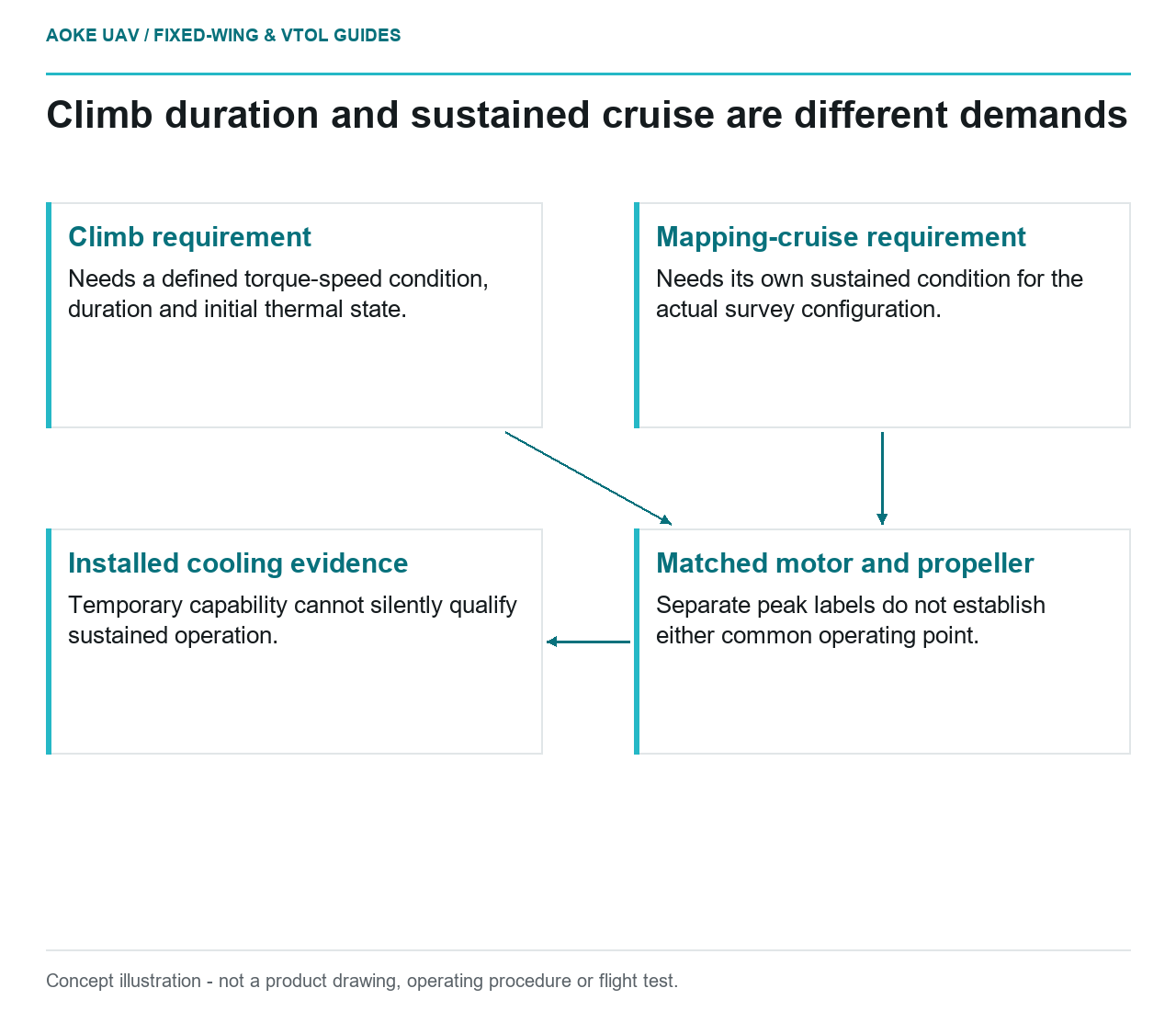
- Climb requirement: Needs a defined torque-speed condition, duration and initial thermal state.
- Mapping-cruise requirement: Needs its own sustained condition for the actual survey configuration.
- Matched motor and propeller: Separate peak labels do not establish either common operating point.
- Installed cooling evidence: Temporary capability cannot silently qualify sustained operation.
A maximum-power figure answers a narrow question about a stated component condition. It does not by itself describe the propulsion task throughout a civil survey flight. A large fixed-wing aircraft needs a comparison that preserves both the operating point and the time spent there. The distinction matters before ranking motors, because the most demanding short interval and the longest interval are different review problems.
Define mission operating points
Imagine a hypothetical industrial mapping aircraft climbing to its survey area, then spending a sustained period on mapping lines. This is an original integration scenario, not an observed product or flight result. Ask the aircraft designer to specify the propulsion evidence needed for each state. Record aircraft mass, configuration, intended airspeed, required trajectory and atmosphere as assumptions awaiting substantiation, not as facts supplied by a motor brochure.
Prepare separate rows for climb, mapping cruise and any return condition. Each row should distinguish the mechanical demand being requested from the electrical demand predicted at the supply. maxon’s guide explains electrical-to-mechanical conversion and motor operating ranges; it is general motor background, not a propulsion map for this large fixed-wing airframe.[1] Use that distinction to formulate supplier questions rather than importing its catalogue examples into aircraft sizing.
Match motor and propeller at the same point
Request motor speed, torque, electrical input and the corresponding propeller condition together. An isolated motor efficiency figure and an unrelated propeller thrust figure do not establish a demonstrated combination. In the hypothetical comparison, reject a proposal that labels both cruise and climb with the same peak catalogue number but provides no operating-point explanation. Keep the candidate open for further evidence rather than interpreting missing data as failure or success.
APC explicitly describes its propeller performance data as analytical and states a sea-level standard-atmosphere basis for its calculations.[4] That makes such data useful as an example of a defined prediction, not an installed large-aircraft result. If a supplier uses a calculated propeller map, request the exact geometry, calculation version and applicability statement. Do not call the calculation a measured climb demonstration.
Duration and thermal conditions change the question
The maxon document distinguishes continuous and short-term motor operation, with thermal conditions relevant to the permissible loading.[1] It does not establish an overload duration for an unrelated aircraft motor. For the hypothetical climb, ask what applicable documentation permits the requested operating point for the required duration and initial condition. For cruise, ask what supports sustained operation in the actual installation, rather than copying a convenient transient capability into the continuous row.
As an original review practice, attach cooling and enclosure assumptions to each row. Identify whether supporting evidence used an exposed bench motor or the proposed installed configuration. Record any uncertainty about airflow or temperature as a request for engineering substantiation. This keeps a thermal question from disappearing behind an electrical power label and avoids inventing a universal headroom percentage.
Require aircraft-specific performance evidence
A defensible climb claim must be tied to the aircraft configuration and relevant operating conditions. In this scenario, request the airframe performance basis and its relationship to the proposed propulsion combination. Static thrust alone leaves that relationship unresolved. Do not calculate or promise a climb capability from a zero-advance thrust result without the missing aircraft and forward-flight evidence.
For cruise, ask how the claimed operating point relates to the survey configuration rather than a clean airframe or a different payload. The review deliverable should state which demands are predicted, which have supporting component data and which have installed evidence. A prediction can be useful while remaining a prediction; the error is relabelling it as an aircraft result.
The decision can then be expressed precisely: one candidate has documented sustained operation relevant to the proposed cruise condition, another has only an unexplained peak rating, and climb substantiation remains outstanding. That is a comparison of evidence quality, not a declaration that either system is suitable. Large fixed-wing propulsion selection should preserve those distinctions until the actual configuration closes them.
Related reading
- A Mission-First Power Architecture for Large Fixed-Wing UAVs
- Reading the Load Paths in a Large Composite UAV Wing