Concept illustration
Read diagram notes
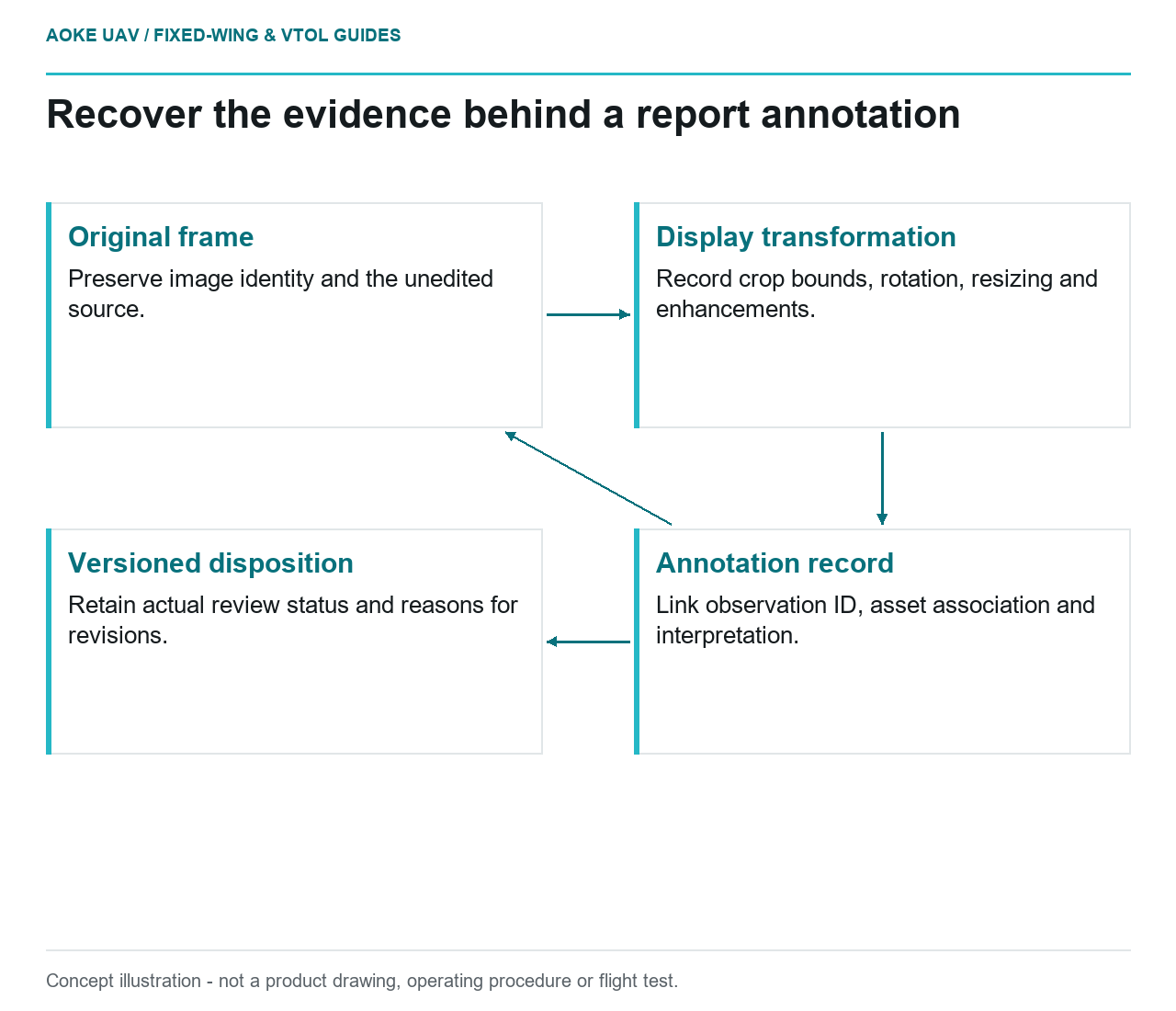
- Original frame: Preserve image identity and the unedited source.
- Display transformation: Record crop bounds, rotation, resizing and enhancements.
- Annotation record: Link observation ID, asset association and interpretation.
- Versioned disposition: Retain actual review status and reasons for revisions.
Keep the annotation attached to an original frame
A hypothetical corridor owner receives a report with an arrow pointing at a patch on a service-yard surface. The picture is a cropped, contrast-adjusted image from a large industrial fixed-wing campaign, but the original filename is absent. A second reviewer cannot determine where the crop came from or whether it depicts the correct yard. This is an illustrative provenance problem, not an GAUTEN finding or a record of a real inspection error.
Assign a durable observation identifier and retain the original image identity independently of the report filename. Link the annotation to the source frame, not only to the page on which it appears. A presentation may be regenerated or rearranged; the relationship between the observation and its original evidence should remain recoverable through those changes.
Describe the path from original to displayed crop
For this fixed-wing example, propose a record of crop bounds in the original image, any resizing or rotation and any enhancement applied for display. Preserve the unedited original beside the displayed view. Distinguish an analyst’s markup from source image content so an arrow, mask or outline cannot later be mistaken for a feature captured by the camera.
USGS imagery guidance discusses metadata that include processing schemes, sensor configuration, viewing geometry and calibration information. It treats such documentation as important for judging data quality and enabling comparison. This grounds the need for processing context, but the particular annotation-record design here is an editorial proposal, not a USGS inspection-report standard. [1]
If a crop is taken from a mosaic rather than a single frame, identify that product and its processing version. Where possible, retain the constituent-image link needed to examine an ambiguous region. Do not relabel a mosaic crop as an original camera exposure. A reviewer needs to know which transformations stand between the photographed scene and the displayed evidence.
Separate asset association and interpretation
In the hypothetical yard, retain the candidate asset ID and how that association was made. If a reviewer selected the yard from surrounding context, state that method. If a geospatial product was used, record its coordinate reference and version. Avoid assigning a component identity solely because its inventory point happens to be nearest to the image tag.
USGS separates image sampling from geometric accuracy and discusses the roles of camera geometry, control and verification. Those principles support asking what positional evidence underlies a map-linked annotation; they do not prove that a particular mark has exact defect coordinates. Keep any approximate or disputed association explicit. [1]
Store the descriptive observation separately from the interpretation. An annotation may initially describe a dark region while a later qualified review supplies a different explanation. Preserve both versions with their actual status. Do not make a proposed follow-up look like a completed specialist assessment, and do not attribute human review to an algorithm-generated label.
Make revisions testable rather than invisible
Propose a versioned record containing creator type, creation time, source evidence, transformation history, interpretation and review disposition. When an observation is corrected, retain the earlier label and the reason for change. This allows earlier field notes or maintenance discussions to remain understandable without requiring the owner to reconstruct which report version was circulating.
For a practical acceptance exercise, ask a reviewer unfamiliar with the campaign to follow one annotation back to its original fixed-wing frame. Have the reviewer identify the same region, recover the display transformations and determine whether the interpretation is pending or confirmed. This is a suggested audit test, not a claim that any system has passed it.
If the path cannot be followed, repair the provenance before treating the finding as a reusable asset record. A polished crop can help communication, but it should remain a view of evidence rather than a substitute for evidence. The durable deliverable is the traceable relationship among image, annotation, asset and actual review decision.