Concept illustration
Read diagram notes
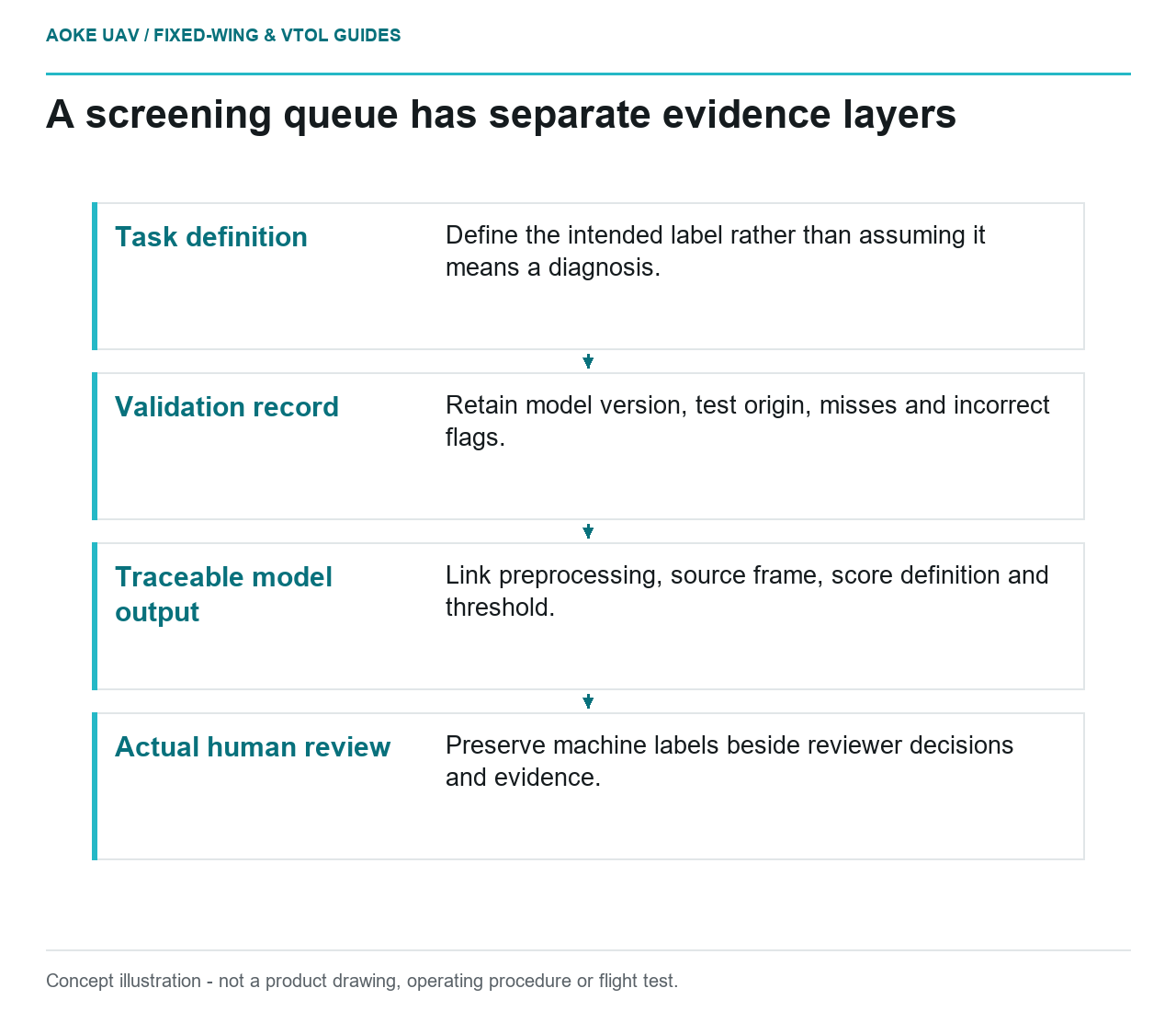
- Task definition: Define the intended label rather than assuming it means a diagnosis.
- Validation record: Retain model version, test origin, misses and incorrect flags.
- Traceable model output: Link preprocessing, source frame, score definition and threshold.
- Actual human review: Preserve machine labels beside reviewer decisions and evidence.
A screening flag is a claim to investigate
A hypothetical industrial estate owner receives a set of automated flags from a large fixed-wing image campaign. The model was demonstrated on a different image collection, and the delivery does not explain whether its evaluation covered the estate’s surfaces or acquisition geometry. The owner needs an evidence request, not an invented detection rate. This scenario is not an GAUTEN algorithm, a benchmark result or a claim of certified defect detection.
Define the target of the screening task before interpreting confidence values. Ask whether the model marks an image pattern, assigns an asset category or predicts a diagnosed defect. Record the intended label and the required human or specialist follow-up. A score in an exported table does not establish that the owner and developer mean the same thing by the word defect.
Request a validation record tied to this task
For the illustrative fixed-wing deployment, ask for the evaluated model version, label definitions, test-data origin and independence of the evaluation set. Request results broken down by conditions relevant to the intended use, including the types of image and asset actually represented. These are proposed review questions, not findings that the system performs poorly or well under any particular condition.
Ask how both missed targets and incorrect flags were assessed and how uncertain reference labels were handled. A demonstration containing only selected successful images cannot answer those questions. If the provider cannot supply primary evaluation evidence, keep performance unverified and limit the output to exploratory screening for review. No numerical accuracy, recall or confidence threshold is supplied by this article.
USGS imagery guidance explains why acquisition, calibration and data-quality documentation matter when combining data from different sensors and processes. It does not validate a defect algorithm. Its role here is limited to the image-quality evidence that must accompany an evaluation or deployment record. [1]
Preserve the input conditions and model configuration
Record the image products supplied to the algorithm, including crops, resizing, enhancements and preprocessing versions. Link each flag to the actual input and its original source frame. In this scenario, ask whether a model evaluated on close images was tested on the proposed large fixed-wing views rather than assuming the same label implies the same demonstrated task.
USGS identifies sensor configuration, viewing geometry, illumination and processing schemes among useful metadata for assessing imagery. Those categories offer a starting point for describing the input collection, not a complete machine-learning validation standard or evidence of algorithm robustness. [1]
Retain the configured screening threshold and any subsequent change with its reason and date. Do not replace earlier scores silently after updating the model. If the owner wants to compare flags across campaigns, identify changes in both the imagery and the screening configuration before interpreting differences as asset deterioration. The comparison itself needs a justified method, not merely a common spreadsheet column.
Keep review status separate from machine output
Propose a flag record with an immutable observation ID, model version, source image, image-space region, score definition, candidate asset association and review status. Preserve the model’s original label beside any human interpretation. Record the reviewer and supporting evidence only when review occurs; do not imply that every automated item has already been inspected by a specialist.
For a disputed flag in this example, retain both the algorithm output and the reason for the reviewer disposition. A rejected flag can remain valuable evaluation evidence rather than being deleted from the record. Similarly, an owner-reported issue absent from the flags should be investigated through the agreed validation process instead of being omitted from the performance discussion.
The useful fixed-wing product is thus a traceable screening queue with clearly bounded claims. If task-specific evidence is missing, the owner can request a representative evaluation or use another assessment method. The output must not become a diagnosis, a detection guarantee or an approval claim simply because an algorithm generated it.
Related reading
- Validating Thermal Alert Thresholds Before Automation
- Survey Tender Questions That Expose Unsupported Claims