Concept illustration
Read diagram notes
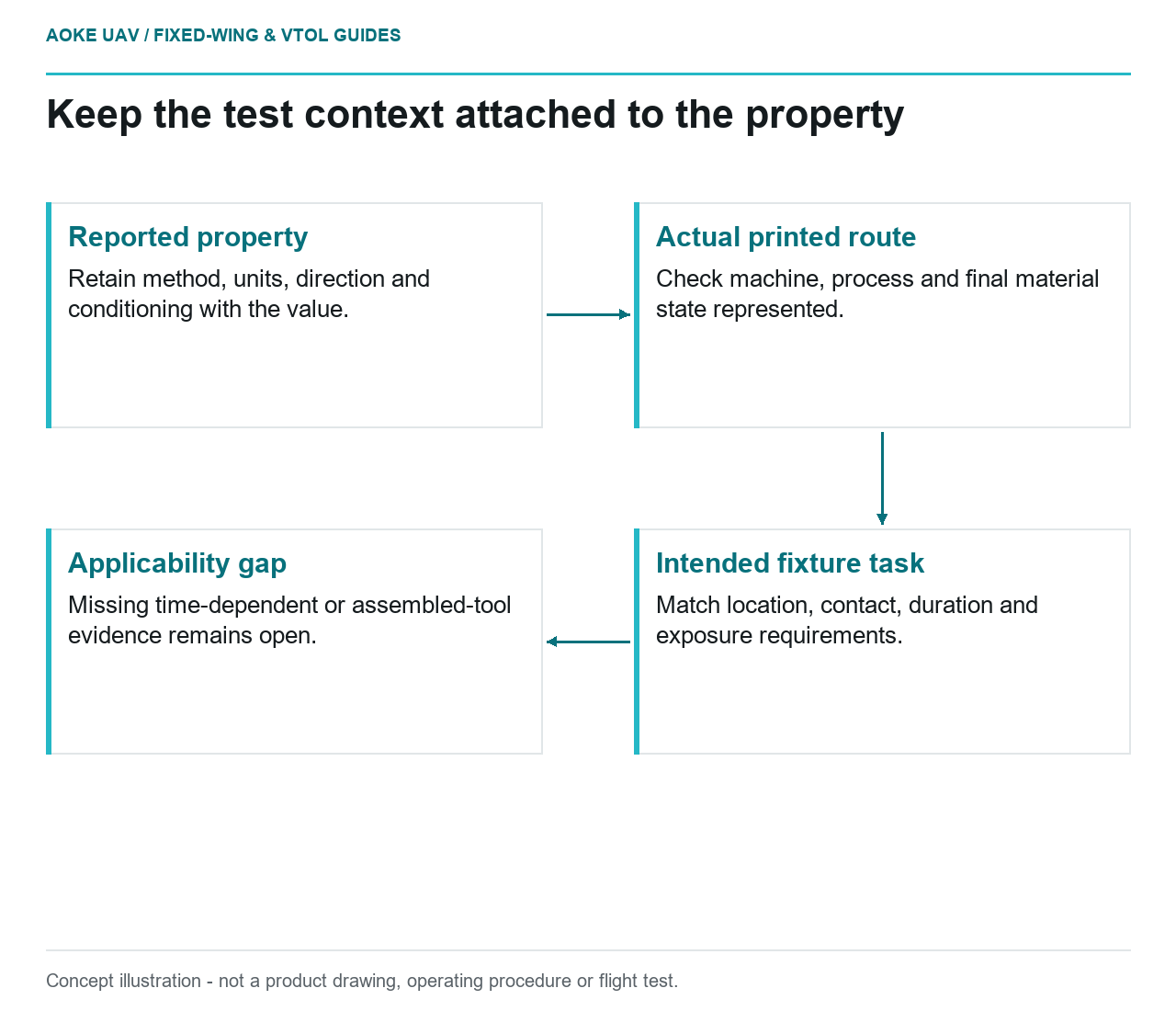
- Reported property: Retain method, units, direction and conditioning with the value.
- Actual printed route: Check machine, process and final material state represented.
- Intended fixture task: Match location, contact, duration and exposure requirements.
- Applicability gap: Missing time-dependent or assembled-tool evidence remains open.
A material table becomes useful when its test context survives the trip into a design review. Consider a hypothetical long-wing assembly fixture for a large civil fixed-wing inspection aircraft. The team is comparing printed polymers using supplier information. The task is not to crown the strongest material from one column, but to decide which reported properties address the proposed tooling requirements and which evidence is still missing.
Preserve specimen direction and condition
Stratasys states that FDM part properties are direction-dependent and discusses both mechanical and thermal behavior in its composite-tooling guide. That OEM discussion does not make a generic polymer name a complete printed-material specification. [1]
For our fixed-wing fixture review, keep the exact material designation, specimen direction, test method and units together in each comparison entry. Add the reported conditioning and test environment where provided. If a field is absent, mark it unknown and request clarification; do not replace it with an assumption that favors the candidate.
Check how direction labels are defined in the actual document. A specimen name or axis label is only useful if the review can connect it to the printed structure being proposed. Avoid comparing an in-plane value from one source with another orientation from a different source as though the two represented the same question.
Identify the process behind the number
The OEM guide connects material selection with tool design, processing exposure and anticipated use. [1] Our recommended worksheet would therefore distinguish raw feedstock identity from the tested printed product. Record the stated machine/process and post-processing context rather than assuming the material trade name defines every resulting property.
A supplier may present several relevant documents, but they should not be blended into a fictional single dataset. Preserve the source revision and mark whether an entry describes the actual proposed build route. When a value comes from a different route, classify it as background information until its applicability is justified.
For the large fixed-wing fixture, list the requirements before selecting comparison columns. Location stability, local contact behavior and the intended workshop exposure are different review questions. A fiber-filled label is not, in this proposed assessment, a substitute for evidence that addresses each question. Nor does a favorable mechanical entry settle dimensional behavior of an assembled long tool.
Separate brief tests from sustained use
Formlabs explicitly warns about continuous-loading creep in SLA tooling. Its guidance is not a lifetime prediction for other printed polymers. [2] The practical review question is whether the available tests address the actual duration and conditions of the proposed fixture task.
Retain loading mode, test temperature and reported conditioning alongside the result. Do not turn a short-term strength entry into an allowable for a sustained fixture load. If time-dependent behavior or moisture exposure matters to the defined requirement and the evidence is missing, make that a development task instead of filling the gap with an unsupported safety factor.
Thermal entries also need their original meaning. Review the property definition and method before treating a number as a permissible process temperature. The hypothetical wing fixture may need an application-specific dimensional demonstration under its intended conditions; this explainer does not select a temperature limit or authorize an adhesive cure.
Turn the comparison into an evidence request
Our suggested output is a decision table with candidate identity, reported test context, requirement addressed and remaining uncertainty. Keep screening information separate from accepted design values. If the same property is expressed in different units, perform and record any conversion rather than comparing bare numbers.
Finish by planning how the selected printed fixture will be checked as an assembled tool. Material data can support that plan without replacing it. For the civil fixed-wing manufacturing scenario, supplier guidance remains process-specific context; it supplies neither UAV approval nor an aircraft material allowable. No GAUTEN tooling result, selected polymer or proven manufacturing capability is claimed.
Related reading
- Reading Hybrid Laminate Claims for Industrial UAVs
- Chopped-Fiber Prints Are Not Continuous-Fiber Wing Laminates