A proposed wing-root cover for a hypothetical large fixed-wing civil survey aircraft is described as carbon-aramid. Another proposal says carbon-glass. The labels sound informative, but neither specifies a complete laminate or a demonstrated performance advantage. This review asks what must sit behind a hybrid description before the integration team can evaluate it. There are no candidate hybrid test data in the offline research pack. No impact immunity, damage tolerance ranking or preferred material combination can therefore be claimed for either proposal.
Fiber name versus laminate architecture
Request the actual architecture rather than expanding the trade name into assumptions. Ask how the reinforcement types are arranged, which directions they represent and what definition controls the manufactured part. If the supplier considers a stacking detail proprietary, ask what controlled summary and substantiation can still establish applicability to the proposed assembly. Do not fill the information gap with a guessed lay-up.
FAA guidance establishes laminate-level design values through testing or test-validated analysis and links them to a representative production process. [1] That US certificated-aircraft guidance does not rank hybrids for this fixed-wing UAV. It explains why a family label is insufficient evidence: the assessed material system and its manufacturing definition must be identifiable before their results can be applied to an actual component.
Resin and manufacturing process
Ask for matrix identity, processing route and the revision of the specifications governing the offered part. Determine whether the evidence concerns the same reinforcement form and fabrication process. A description that names two fibers but omits the matrix leaves the review unable to identify the tested material system. Treat the omission as a supplier question, not an opportunity to assume a familiar resin.
The FAA connects reliable structural properties with qualified materials, repeatable processes and controlled manufacturing implementation. [1] For the hypothetical industrial fixed-wing procurement, ask whether the report represents development samples, a qualified production definition or another clearly described stage. Similar-looking parts may still have different evidence histories. The review should retain those distinctions even if the supplier sells them under the same broad hybrid name.
Directional properties and test conditions
For every property statement, request the specimen definition, orientation, conditioning and test method. Ask whether the comparison uses equivalent conditions and whether any analysis connecting the tests to the part has been validated. Avoid extracting a favourable result from one orientation and presenting it as a property of the complete wing attachment.
FAA environmental guidance emphasizes that the critical exposure can vary with material system and failure mode. [1] Accordingly, an ambient coupon comparison cannot automatically answer the hypothetical fixed-wing aircraft’s service environment question. A claim about impact response needs its own applicable evidence, including the relevant damage and structural detail. The word aramid does not establish that an assembled part is immune to damage, nor does the word carbon establish its remaining strength after an event.
Assembly evidence beyond coupon values
Connect the material dossier to the component drawing, attachments, inspection plan and any known deviations. Ask which results support the assembled structure and which remain material-level context. The FAA building-block approach addresses increasingly complex details and components because geometry, discontinuities and manufacturing variation need representation. [1] No hybrid label removes that applicability requirement.
For this hypothetical large fixed-wing review, the final comparison should identify both supported conclusions and unresolved differences. If one proposal lacks conditioned tests or a clear architecture, say that the evidence is incomplete rather than ranking it below another on invented performance grounds. A useful procurement outcome is a precise request for missing information. It is not an unsupported claim that combining fibers necessarily improves every function, eliminates inspection needs or preserves an existing aircraft approval.
Related reading
Sources
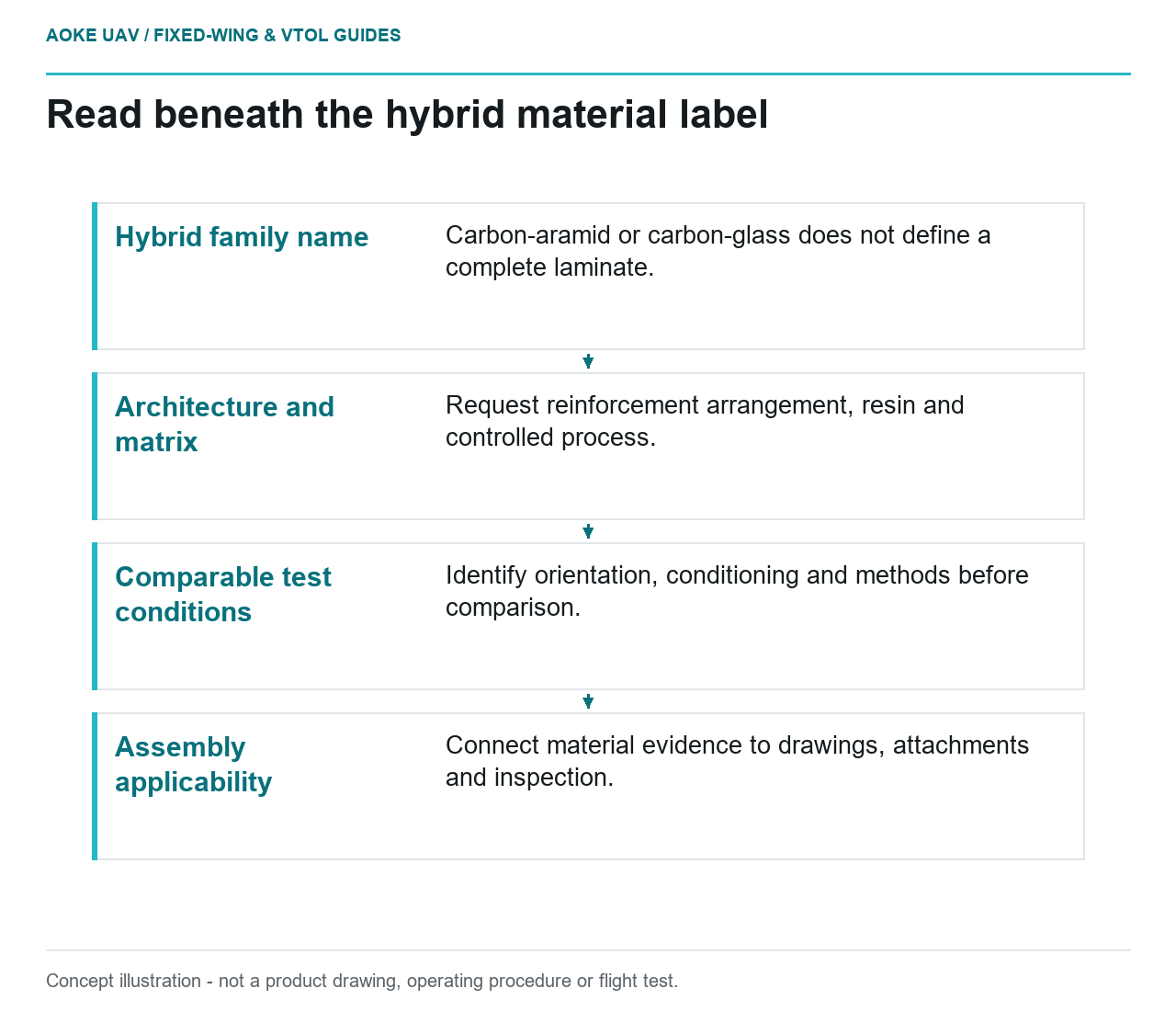
Visual summary
Concept illustration
Read diagram notes
- Hybrid family name: Carbon-aramid or carbon-glass does not define a complete laminate.
- Architecture and matrix: Request reinforcement arrangement, resin and controlled process.
- Comparable test conditions: Identify orientation, conditioning and methods before comparison.
- Assembly applicability: Connect material evidence to drawings, attachments and inspection.