Concept illustration
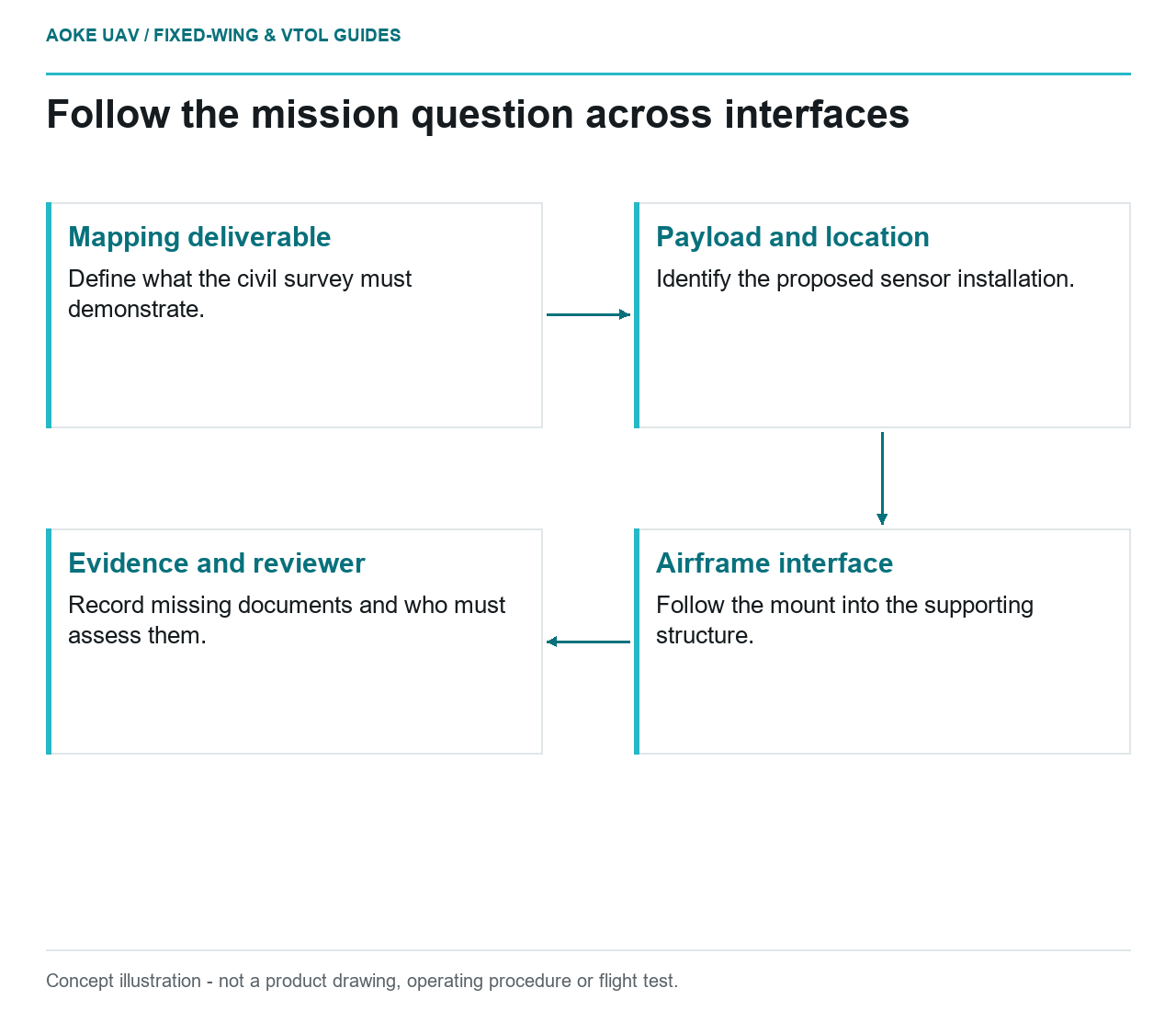
Read diagram notes
- Mapping deliverable: Define what the civil survey must demonstrate.
- Payload and location: Identify the proposed sensor installation.
- Airframe interface: Follow the mount into the supporting structure.
- Evidence and reviewer: Record missing documents and who must assess them.
Begin with a mission question
This GAUTEN UAV reading guide explains how to use a technical library without turning an explainer into a product specification. Consider a hypothetical civil survey team planning large-area mapping with a large industrial fixed-wing aircraft. It must decide what terrain information it needs, how the payload will be installed, and which evidence would justify the chosen configuration. This is an editorial scenario, not an GAUTEN aircraft, customer project or flight result.
Start a reading note with the intended deliverable and an unresolved question. For example: does the proposed payload location remain consistent with the geometry assumed during data processing? Follow that question through several categories rather than treating the longest endurance claim or the most familiar material name as the answer.
Five coverage areas, five boundaries
Airframes and composites articles examine structural interfaces, manufacturing evidence and inspection questions. FAA AC 20-107B discusses design, manufacturing and maintenance for composite certificated aircraft; it is guidance, not a statement that an aircraft described here has approval. Its emphasis on application-specific materials and processes helps explain why a material datasheet cannot stand in for an assembled wing assessment. [1]
Additive manufacturing coverage distinguishes tooling and manufacturing aids from parts intended to carry flight loads. Treat each article as a route to the relevant process evidence, not permission to substitute a printed item. Surveying and mapping coverage asks whether acquisition, calibration and checking support the requested output. USGS distinguishes imagery ground sample distance from achieved data accuracy and discusses the role of ground control. A small pixel size is not, by itself, a survey accuracy guarantee. [3]
Inspection and monitoring coverage separates what an image shows from what an asset owner can diagnose with it. Propulsion and components coverage follows the relationship between mission demand and installed-system documentation. Neither category should be read as a collection of interchangeable ratings or operating permissions. These boundaries are the library’s editorial method, not claimed manufacturing capabilities.
Follow one requirement across interfaces
For the hypothetical fixed-wing survey, first record what the mapping deliverable must demonstrate. Next identify the payload and its proposed location. Then follow the mounting interface into the airframe, and identify the supporting evidence requested from the responsible designer. Keep a separate question for power and another for acquisition timing. This suggested sequence prevents a discussion about one subsystem from silently answering a different question.
If the mission concept includes vertical takeoff, read the architecture before assuming that cruise reasoning covers the whole aircraft. ArduPilot describes QuadPlane as combining fixed-wing and multicopter functions and supporting transitions between those modes. That software overview establishes an architectural distinction; it supplies neither structural qualification nor installed endurance evidence for a large fixed-wing VTOL aircraft. [4]
For this example, create a simple interface register: requirement, assumed configuration, missing document and responsible reviewer. A useful reading outcome is a precise unanswered question. It is not necessary to manufacture a numerical answer when the relevant aircraft information is absent.
Read dates, scopes and uncertainty
Check the article’s publication context separately from the source’s revision. A retrieval date records when material was obtained, not when the underlying engineering was updated. Read the source title and the nearby claim together. A source about composite maintenance does not establish the accuracy of a camera installation merely because both concern the same hypothetical aircraft.
FAA guidance calls for field inspection and repair access and documented methods for structural details. Use that as context for asking whether the proposed wing installation remains accessible, not as an aircraft-specific maintenance instruction. [1] Likewise, USGS calibration guidance belongs to its stated imagery context; it does not provide a universal wing-deflection limit. [3]
Stop before approval or procurement
Before committing to an aircraft or modification, gather the actual configuration documents, applicable limits and responsible engineering assessment. None were supplied for an GAUTEN model here. Keep concepts, hypothetical reasoning and demonstrated performance in different columns. Related reading should broaden the question set; it cannot close an evidence gap simply by repeating a plausible explanation.
Related reading
- Fixed-Wing Mapping Starts With the Deliverable
- A Mission-First Power Architecture for Large Fixed-Wing UAVs