Concept illustration
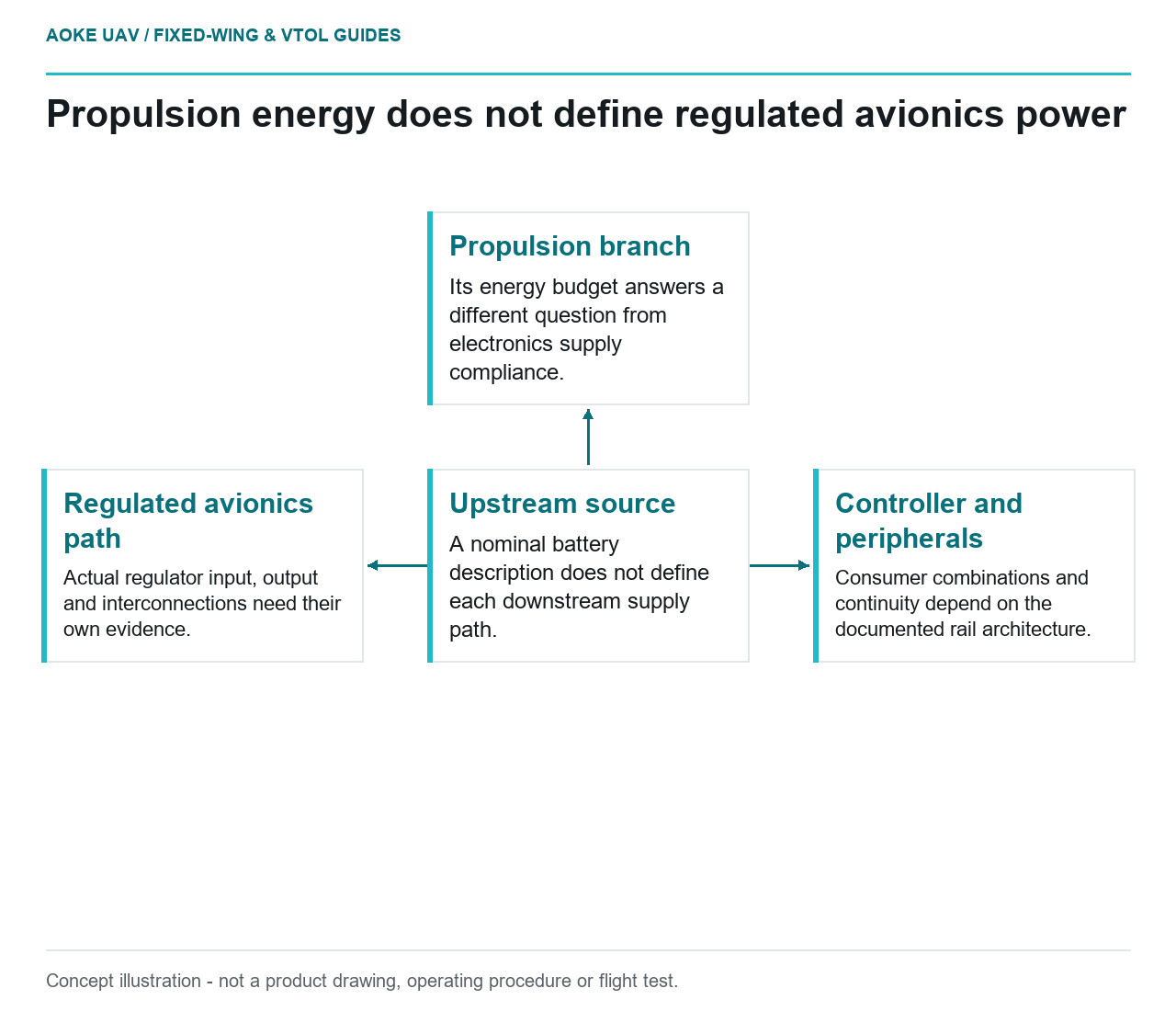
Read diagram notes
- Upstream source: A nominal battery description does not define each downstream supply path.
- Propulsion branch: Its energy budget answers a different question from electronics supply compliance.
- Regulated avionics path: Actual regulator input, output and interconnections need their own evidence.
- Controller and peripherals: Consumer combinations and continuity depend on the documented rail architecture.
A hypothetical large civil fixed-wing aircraft has enough proposed propulsion energy for its survey assignment, yet its flight-controller supply remains poorly documented. The design review contains a battery budget and a wiring sketch, but no clear accounting of the regulated avionics consumers. Those are different deliverables. This article focuses on the controller electronics and its peripherals, not control-surface actuator sizing or the startup behavior of a particular survey camera.
Separate supply rails and consumers
Begin with a functional power map for the fixed-wing installation. Identify the propulsion bus, controller supply, peripheral supplies and actuator supply as separate review items, even where they share an upstream source. Assign each consumer to its documented rail and identify the relevant interface drawing. A component list alone cannot show which path supplies a receiver, navigation device or companion computer.
ArduPilot’s Powering the Pixhawk page explicitly distinguishes its example controller power input from the servo rail, which that controller does not itself power.[1] This is model-specific documentation, not a wiring template for every autopilot. Its transferable lesson is to establish supply boundaries from the exact hardware documentation rather than infer them from the presence of a connector or a functioning controller.
Regulation and input operating range
For each regulated path in the hypothetical aircraft, request the actual regulator identity, input requirements, output capability and supported installation arrangement. Keep the controller’s acceptable supply conditions separate from the propulsion battery’s nominal label. The question is whether the complete path has applicable evidence, including its interconnections, not whether one upstream source is described as powerful enough.
The Common Power Module documentation describes an example supply serving the autopilot and limited low-power peripherals, and warns against assuming that it covers servos or high-current devices.[2] Its legacy module values are not ratings for a large UAV installation. Use the warning to organize an explicit consumer inventory; do not borrow the example’s numerical ratings to size this aircraft’s avionics supply.
Transient demands and failure behavior
Ask the design owner which changes in consumer state are represented in the avionics evidence. For this fixed-wing example, relevant review questions include simultaneous peripheral activity and interaction with other branches of the distribution system. No generic current allowance is proposed. The evidence request should identify the actual combinations assessed and the criteria used, rather than reducing everything to one average load figure.
Also separate observations from guarantees about continuity. A controller that remained powered in one documented configuration does not settle an undocumented interruption or regulator-failure case. Request the defined behavior and responsible assessment for each dependency. The Pixhawk page discusses particular backup paths and power-management behavior, but those arrangements must not be projected onto a different controller board or aircraft architecture.[1]
Board-specific architecture and verification
A useful review artifact is a rail-by-rail matrix: identified consumers, supply hardware, applicable document revisions, measured evidence and open issues. Keep the drawing and the matrix synchronized. If the team changes a peripheral or adds a companion computer, the matrix should reveal which power argument needs revisiting without reopening unrelated propulsion-energy arithmetic. That makes the architecture review both narrower and more auditable.
The hypothetical large fixed-wing decision is complete only to the extent supported by the installed controller, regulator and distribution evidence. A battery budget can remain valid while this avionics question stays open. Do not close the gap with a generic spare-capacity percentage, copied wiring values or a claim of redundancy. The appropriate outcome is a clearly documented supply boundary and an explicit list of missing board-specific substantiation.