Concept illustration
Read diagram notes
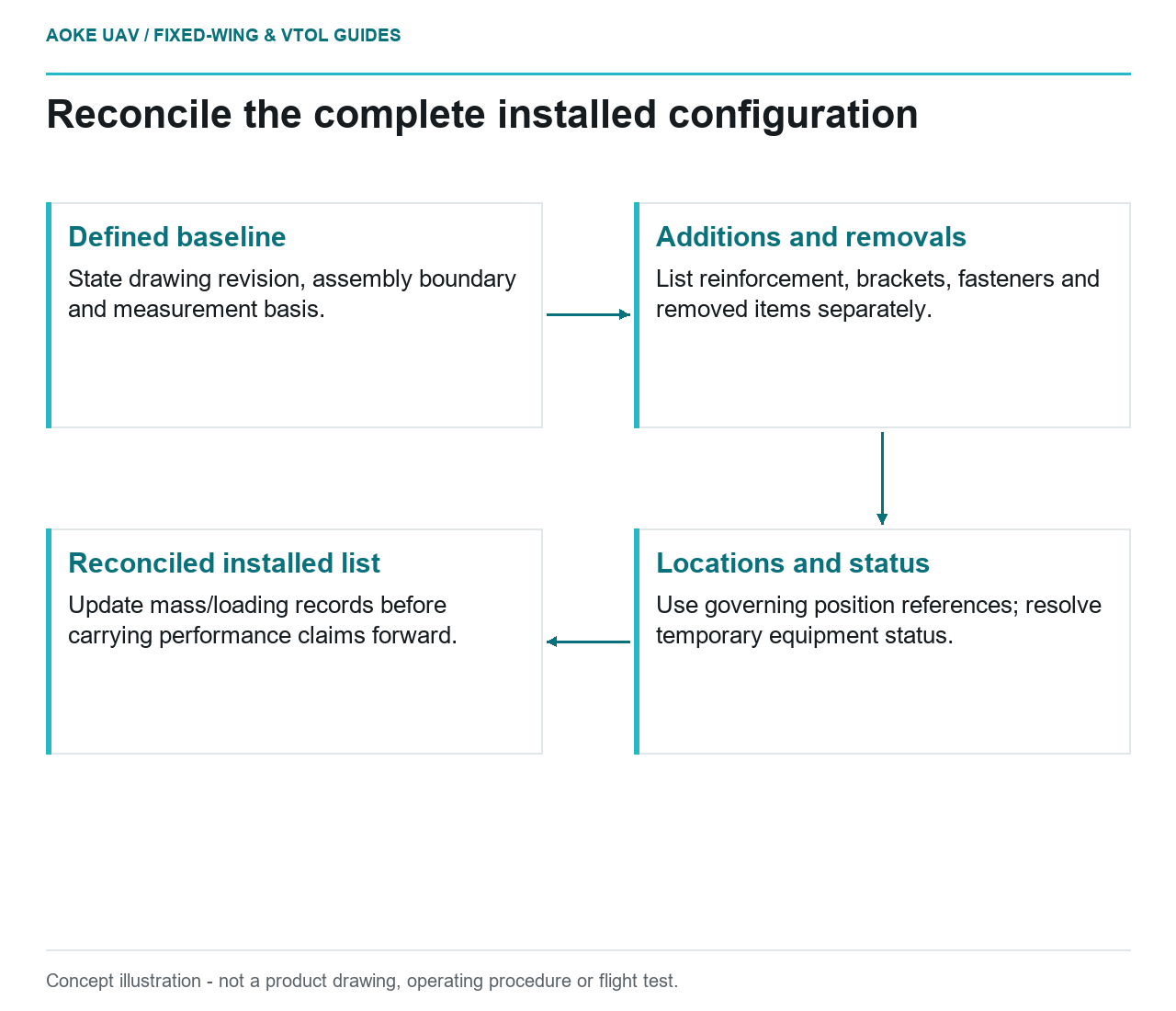
- Defined baseline: State drawing revision, assembly boundary and measurement basis.
- Additions and removals: List reinforcement, brackets, fasteners and removed items separately.
- Locations and status: Use governing position references; resolve temporary equipment status.
- Reconciled installed list: Update mass/loading records before carrying performance claims forward.
A hypothetical large fixed-wing mapping aircraft receives a revised sensor tray. The payload itself is recorded, but the integration list omits its backing pieces, attachment hardware and revised cover. The structural mass review should reconcile the installed configuration rather than repeat the original aircraft mass figure. This article proposes a change-accounting method for discussion with the design authority. It does not calculate a new loading limit, certify a center-of-gravity range or preserve an endurance claim after the aircraft has changed.
Baseline assembly mass and configuration
Define the baseline with a drawing revision and an explicit assembly boundary. Does the recorded mass include the hatch, wiring supports and installed hardware, or only the empty shell? Ask how the measurement was made and which removable items were present. Without that definition, two accurate measurements may still describe different configurations.
FAA guidance requires manufacturing documentation and records for substantiated design and process changes. [1] In its US certificated-aircraft context, this supports the importance of identifying what changed. It does not supply a loading procedure for the hypothetical fixed-wing UAV. Use a configuration list to establish a consistent comparison before asking whether any increase is acceptable. Do not silently use a brochure value as the measured baseline of a modified individual aircraft.
Reinforcement and hardware additions
For the proposed review, give each structural addition an entry: reinforcement, brackets, inserts, fasteners, protective pieces and changes to existing panels. Record removed items as removals rather than concealing them in a net estimate. Link every entry to the change drawing or disposition that explains why it is present. These are accounting categories, not recommendations for adding reinforcement.
Ask whether any temporary integration equipment remains installed in the intended flight configuration. If its status is uncertain, preserve that uncertainty in the mass record. The useful fixed-wing handoff should let another reviewer reconstruct the installed assembly from the entries. A single total may be convenient, but it does not explain whether unrecorded hardware or a different payload support arrangement has entered the configuration.
Mass location versus total mass
Ask the aircraft authority which position references and loading documents govern the review. Record the location of changed items using those definitions, not an improvised coordinate system. Total added mass alone does not answer all configuration questions; for this hypothetical case, the responsible designer must establish how location and installation affect the assessed aircraft.
FAA guidance discusses mass, stiffness and damping changes in its aeroelastic considerations, including the effects of repairs and finishes. [1] That provides a reason to keep the structural change package broader than a single balance calculation. It does not predict flutter behaviour for this aircraft. Ask which existing analyses remain applicable, and avoid declaring a change harmless merely because a static loading check appears unchanged or the new structure weighs less overall.
Update records before performance discussion
Reconcile the final installed list with the current mass and loading documentation before using performance numbers in a mission proposal. Ask who accepts the revised configuration and what additional evidence is required. If the original endurance statement refers to a different assembly, retain that limitation instead of carrying the figure forward unchanged. No revised endurance estimate is established here.
FAA guidance ties structural evidence to configuration and calls for documentation of changes and repairs. [1] For the large industrial fixed-wing team, a practical review output is a baseline-to-installed comparison with measurement references, unresolved entries and a design-authority disposition. It should distinguish verified installation facts from predicted performance. Completion of a mass spreadsheet is not itself aircraft approval, and an apparently small collection of additions still needs the same explicit relationship to the configuration being assessed.
Related reading
- Removable Payload Trays Without Hidden Structural Assumptions
- A Mission-First Power Architecture for Large Fixed-Wing UAVs