Concept illustration
Read diagram notes
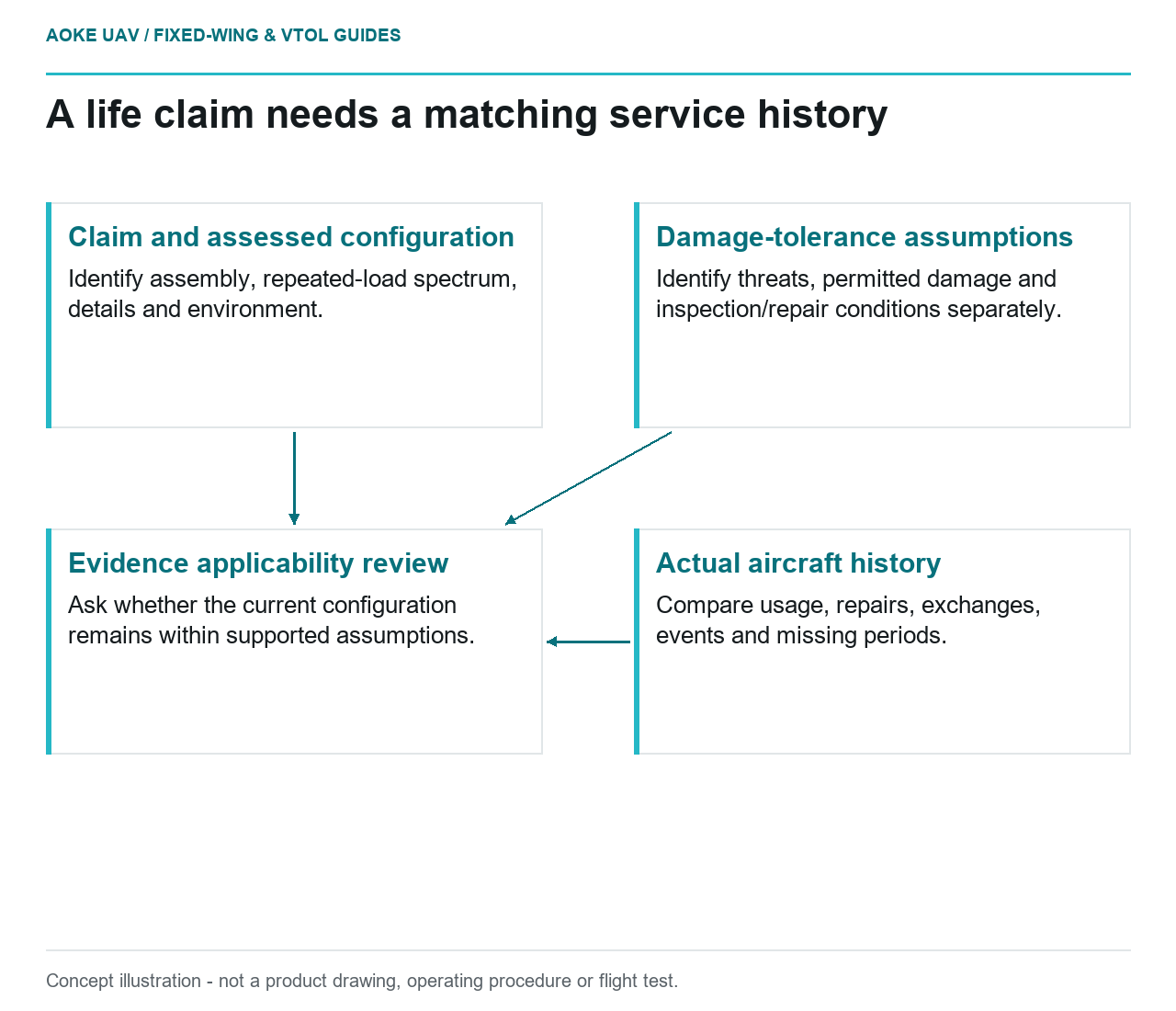
- Claim and assessed configuration: Identify assembly, repeated-load spectrum, details and environment.
- Damage-tolerance assumptions: Identify threats, permitted damage and inspection/repair conditions separately.
- Actual aircraft history: Compare usage, repairs, exchanges, events and missing periods.
- Evidence applicability review: Ask whether the current configuration remains within supported assumptions.
A hypothetical supplier describes a large fixed-wing survey airframe as having unlimited composite life. Before repeating that phrase, the customer needs to identify the structure, loading and maintenance assumptions behind it. A material family name cannot explain how an assembled aircraft’s history relates to the evidence. This article separates fatigue, damage tolerance and service records for a civil integration review. It establishes no permissible cycle count, inspection interval or life extension, and it does not determine whether an individual aircraft remains fit for service.
Load spectrum and structural detail
Ask which assembly configuration the life statement covers and how the anticipated service usage was represented. A test duration alone does not identify the loading imposed, the environmental conditions or the structural detail assessed. Request the relevant report scope and the relationship between that evidence and the aircraft being offered.
FAA composite guidance says the repeated-load spectrum used for fatigue tests and analysis should represent anticipated service usage. It also emphasizes the influence of structural details on fatigue and damage-tolerance performance. [1] This is US certificated-aircraft guidance, not a service-life approval for the hypothetical fixed-wing UAV. Its relevance is the need to ask what was evaluated, rather than treat a broad material claim as an unlimited-life conclusion for every configuration and mission.
Damage tolerance versus fatigue concepts
Keep fatigue substantiation distinct from evidence addressing damage that may be present in manufacture or service. Ask which damage threats and structural details the assessment included, what inspection assumptions were made and how residual capability was established. Do not use the existence of one fatigue test to answer every accidental-damage question.
The FAA discusses fatigue and damage tolerance together while requiring attention to geometry, inspectability, design details and damage or degradation. Its structural evaluation includes environmental effects, manufacturing defects and accidental damage as well as repeated loading. [1] For this large industrial fixed-wing review, ask the supplier to explain each evidence role. A statement that a specimen endured repeated loads does not, without an applicability argument, establish the behaviour of a repaired joint, an uninspected impact site or a different assembly detail.
Environmental and maintenance assumptions
Request the environmental and maintenance assumptions attached to the claimed life. Ask which exposures were represented, which protective systems were maintained and what inspection or repair conditions must remain satisfied. Keep those assumptions beside the conclusion rather than relegating them to a report that the operator never receives.
FAA guidance identifies environmental effects on structural properties and calls for documented inspection intervals and life limits appropriate to the detail. It also expects inspection methods capable of detecting the relevant damage. [1] No intervals or limits for this hypothetical fixed-wing aircraft are available here. The review should therefore ask for applicable instructions rather than borrow values from another platform. A lack of supplied limits does not establish that no limits exist or that maintenance can be omitted.
Records needed for service-life statements
Build a service-history comparison using the aircraft’s actual configuration and the records its applicable instructions require. Identify repairs, component exchanges, unusual events and any change in intended usage that may affect evidence applicability. If records are incomplete, state the missing period or event rather than estimating a benign history.
FAA maintenance discussion links repairs to specific part records and feedback on service damage; its aeroelastic discussion also recognizes changes in mass and stiffness after repairs or degradation. [1] For the hypothetical large fixed-wing operator, the closing question is whether the current aircraft remains within the assumptions reviewed by its responsible authority. Do not announce a new life from the accumulated log entries or describe an absence of visible damage as proof of unlimited endurance. A defensible statement names the evidence and its limits instead of removing them.
Related reading
- Visible Marks and Hidden Damage in Composite Airframes
- Propulsion Vibration Across Structure and Survey Payloads