Concept illustration
Read diagram notes
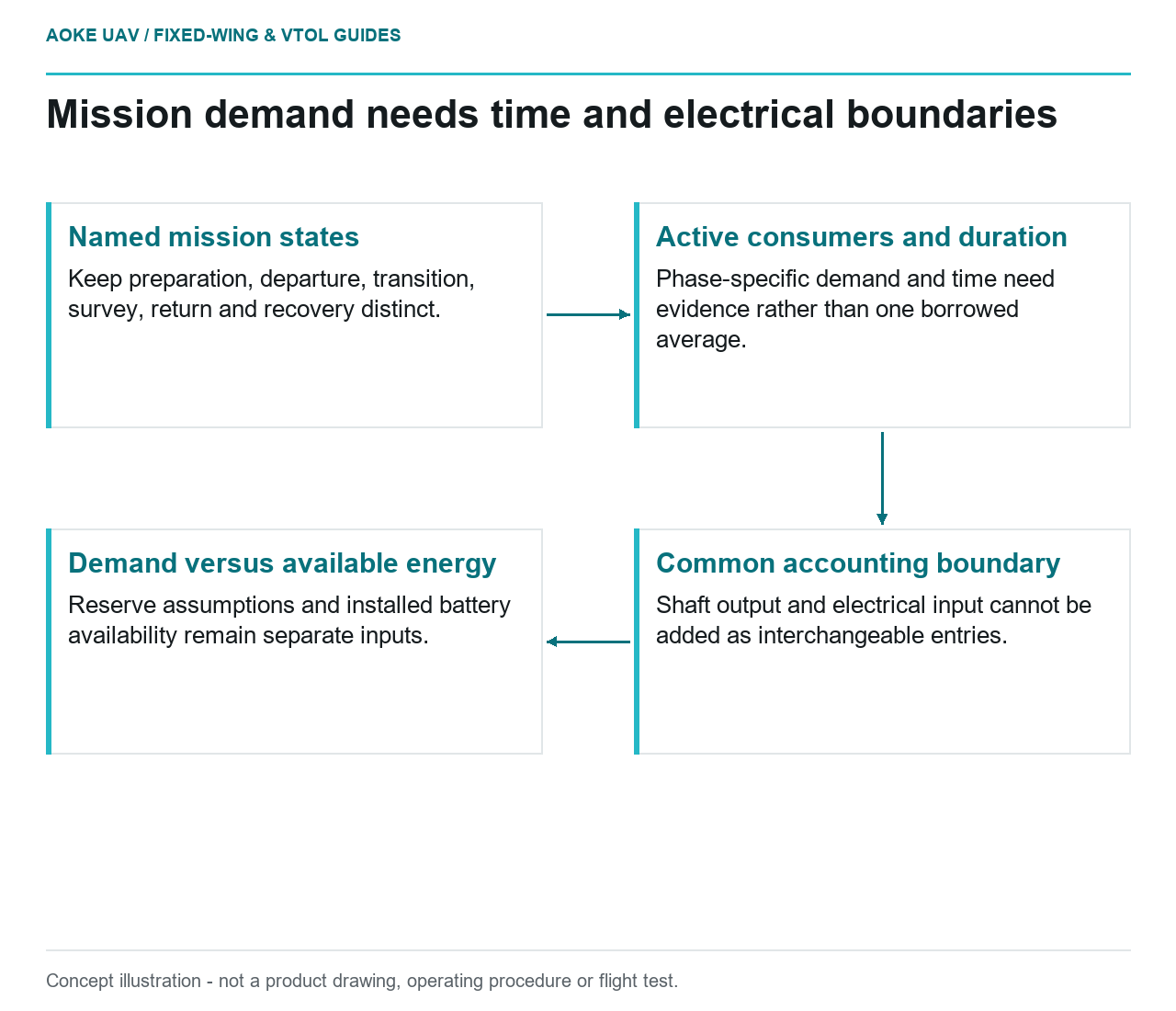
- Named mission states: Keep preparation, departure, transition, survey, return and recovery distinct.
- Active consumers and duration: Phase-specific demand and time need evidence rather than one borrowed average.
- Common accounting boundary: Shaft output and electrical input cannot be added as interchangeable entries.
- Demand versus available energy: Reserve assumptions and installed battery availability remain separate inputs.
An energy budget should make a mission’s assumptions inspectable. It should not turn the nominal energy printed on a battery into an advertised flight duration. For a large industrial fixed-wing UAV, the demand-side question is what electrical work the complete mission asks the installed system to supply. Available battery energy is a separate question that must eventually be reconciled with that demand.
Segment the mission by operating state
Take a hypothetical civil survey route with vertical departure, transition, climb, repeated mapping lines, return and recovery. This is original editorial reasoning, not a record of an GAUTEN operation. Create a row for each state and give it an assumed duration, an electrical demand estimate and an evidence reference. Keep route transit distinct from data collection even if the same cruise motor operates during both.
At this stage, the useful output is a ledger, not a single total with hidden inputs. Mark a supplier estimate differently from a measurement and an unresolved planning assumption. If a phase has varying demand, retain the variation or describe how the chosen representation accounts for it. Do not present an average from one operating state as though it characterized the entire mission.
Include payload and conversion boundaries
For the hypothetical survey aircraft, list the sensor, navigation equipment, telemetry, actuators and other identified consumers beside propulsion. Assign each to the branch where its consumption enters the ledger. The Common Power Module documentation illustrates why monitoring and supply functions need interpretation: it covers battery voltage/current measurement and a limited autopilot supply, not universal power provision for every aircraft device.[3]
As a proposed accounting discipline, define whether each estimate is measured at a battery branch, controller input, motor shaft or payload connector. maxon’s guide distinguishes electrical motor input from mechanical output.[1] Consequently, the worksheet should not add shaft output and electrical input as interchangeable entries. Ask for the actual conversion evidence at the boundary being used and check that a loss has not been omitted or counted twice.
Keep ground preparation in scope whenever the mission definition includes it. For example, the team might ask whether sensor initialization occurs on the flight energy source. That is a configuration question requiring an answer, not an assertion that all survey aircraft use the same sequence. The point is to expose consumers that disappear when budgeting begins only at takeoff.
Leave reserves and unknowns visible
Separate the planned route, any defined contingency cases and the reserve assumption in the worksheet. This article supplies no reserve percentage, battery cutoff or permission to fly a marginal mission. Record who owns each assumption and what applicable aircraft documentation would justify it. If a return condition or recovery delay has not been characterized, retain it as an unresolved case rather than burying it in an unexplained allowance.
FAA AC 20-184A addresses aircraft rechargeable lithium battery systems, including installation, operation and maintenance considerations.[6] Its presence in the reference set does not establish usable energy for the hypothetical pack or approve this mission. Demand accounting cannot replace the battery-specific evidence needed to determine what the installed source can supply under the stated conditions.
Compare predictions with configuration evidence
Propose reconciling the ledger with time-aligned measurements from appropriately authorized validation work. Identify the aircraft, payload, source configuration and measurement coverage. Compare phase boundaries before comparing totals: apparently similar totals can conceal different assumptions about transition duration, payload operation or recovery. Record unexplained differences as findings for review rather than adjusting the inputs solely to obtain agreement.
For the large fixed-wing survey scenario, the resulting document should show the predicted demand, the provenance of each estimate and the cases still lacking evidence. Revisit it when route geometry, payload duty cycle or aircraft configuration changes. This makes the budget useful as a change-control instrument as well as a planning tool.
A credible next step is a bounded demand statement with explicit uncertainty. An endurance guarantee is not the default output. Until the demand ledger and installed usable-energy evidence share compatible conditions, the responsible conclusion remains that mission capability has not yet been established.