Concept illustration
Read diagram notes
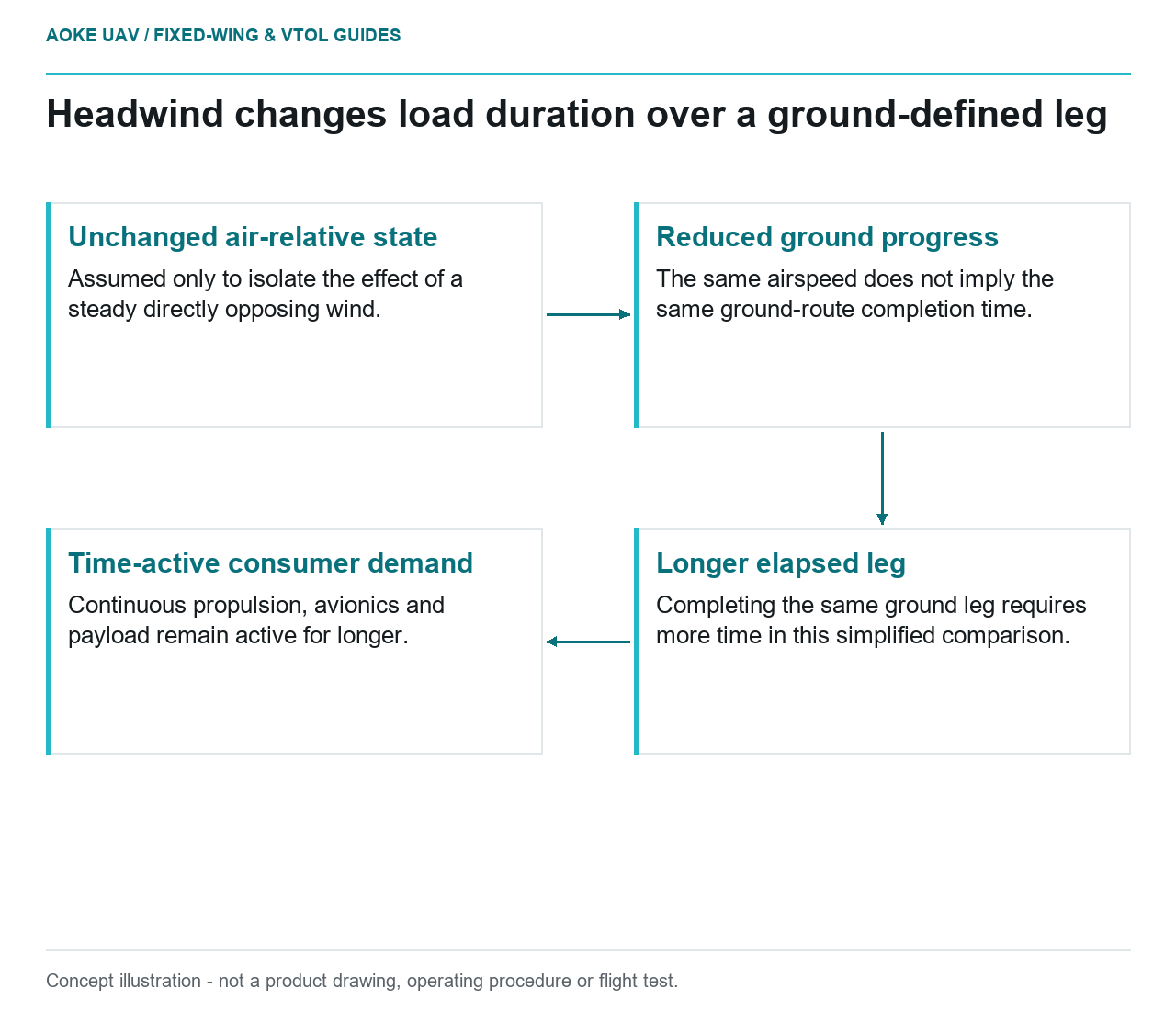
- Unchanged air-relative state: Assumed only to isolate the effect of a steady directly opposing wind.
- Reduced ground progress: The same airspeed does not imply the same ground-route completion time.
- Longer elapsed leg: Completing the same ground leg requires more time in this simplified comparison.
- Time-active consumer demand: Continuous propulsion, avionics and payload remain active for longer.
A fixed-wing survey route is drawn on the ground, but the aircraft moves through air that can itself be moving. Confusing those reference frames can make a still-air energy comparison misleading. This article examines one sensitivity in a mission budget: elapsed load duration when a headwind reduces progress along a ground route. It does not prescribe a wind limit or a flight decision.
Separate airspeed from ground speed
NASA’s relative-velocity explanation distinguishes ground-relative motion, wind and motion relative to the air, and describes their vector relationship.[12] For this article, use a deliberately simplified hypothetical case: a large industrial fixed-wing aircraft following a straight survey leg with a steady wind directly opposing its travel. Assume an unchanged air-relative operating condition solely to isolate the time effect. This is original analysis, not an observed UAV performance result.
In that simplified case, less progress is made over the ground during the same interval even though the assumed airspeed is unchanged. Completing the same ground leg therefore requires more elapsed time. The conclusion depends on the stated assumptions; it is not a claim that an actual aircraft will hold identical power in every windy condition. Crosswind, vertical motion and control responses are outside this deliberately narrow comparison.
Keep the propulsion point air-relative
A proposed review sheet should name the speed reference beside every propulsion input. If one proposal uses ground speed and another uses airspeed, they have not yet defined a comparable operating point. Ask for the relevant air-relative propeller condition, aircraft configuration and environmental assumptions. Do not interpret a navigation display’s route progress as a direct measurement of aerodynamic performance.
ArduPilot’s airspeed documentation discusses installation, calibration and failure considerations for the sensor used by Plane.[7] That is a reminder that a logged airspeed has a measurement and configuration history, not proof that any particular reading is valid. For the hypothetical survey aircraft, request the applicable sensor documentation and validation record rather than copying a calibration parameter from an example page.
Similarly, APC identifies its propeller performance figures as analytical calculations with a stated standard-atmosphere basis.[4] A calculated propeller point is not a demonstrated ground-route completion time. Keep the prediction’s provenance and conditions visible when connecting propulsion evidence to a route budget for a large fixed-wing installation.
Track consumers over the longer interval
Under the hypothetical constant-demand assumption, a longer leg means that each continuously powered consumer operates for longer. The route sensitivity should therefore include the identified avionics and payload, not just cruise propulsion. Record which devices remain active and whether their duty cycles follow clock time, distance, image events or another documented rule. Do not assume all payload consumers scale in exactly the same way.
Use separate outward and return rows with their own wind and duration assumptions. Do not assume a helpful return wind cancels an adverse outward wind merely because the route distances match. The worksheet should preserve each leg’s elapsed time and demand basis before forming any combined assessment. This is an accounting proposal, not a numerical endurance prediction.
Make wind uncertainty an explicit input
For the civil mapping scenario, propose comparing a baseline route with alternative documented wind assumptions. Label forecast information, observations and simplifying assumptions distinctly. Identify which cases remain within the aircraft evidence available to the review team; this article cannot establish an operating envelope. A route calculation made under one wind assumption should not be presented as a guarantee for another.
Retain the provenance of the speed and timing inputs when comparing a prediction with recorded work. If a discrepancy appears, investigate whether the route, wind, sensor validity, aircraft state or payload schedule differed before attributing it to motor efficiency. A timing mismatch is not automatically a propulsion fault.
The useful outcome is a clear explanation of why a ground-defined mission may consume a different amount of energy under different wind assumptions even before changing the assumed air-relative propulsion point. For large fixed-wing planning, keep that sensitivity separate from the full mission ledger and from any claim that the aircraft can complete the route.
Related reading
- Ground Speed and Airspeed in Inspection Image Planning
- Turn Space and Edge Coverage in Fixed-Wing Surveys