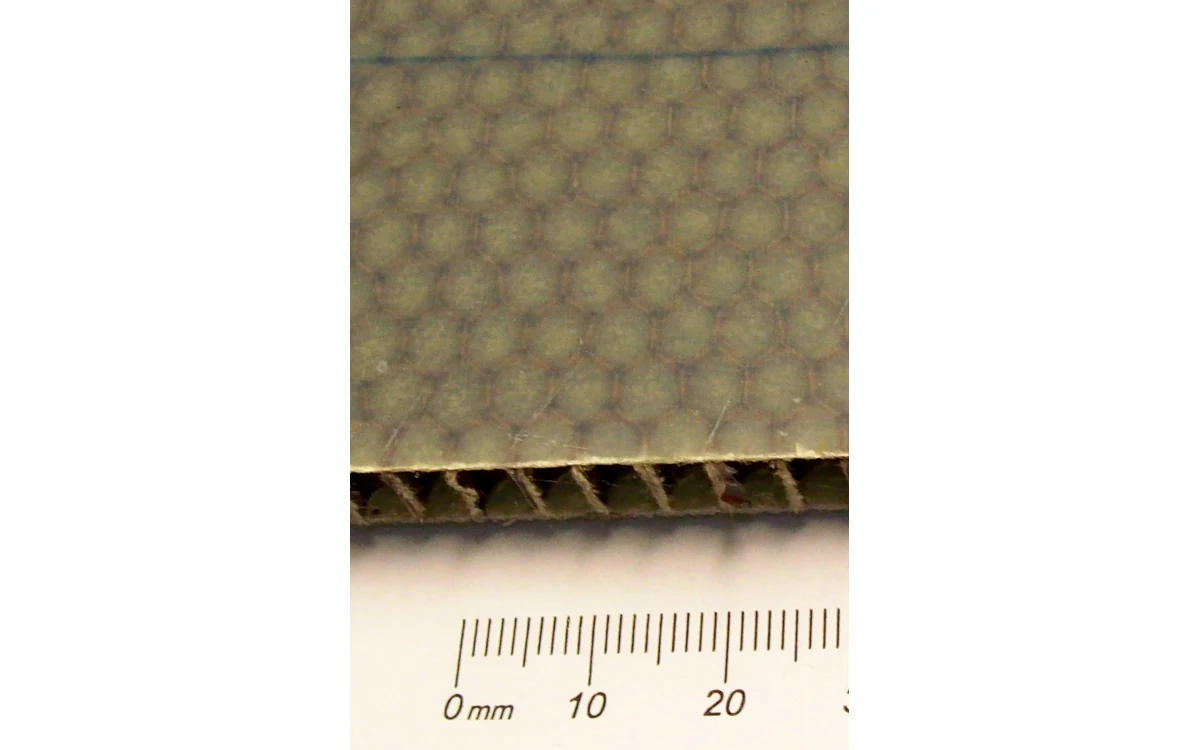
Select the panel concept before the core label
Consider a hypothetical broad, thin wing skin on a large fixed-wing civil mapping aircraft. The proposed skin is a sandwich assembly with fittings and inspection openings nearby. Choosing its core should begin with the assembly’s intended structural role and manufacturing evidence, not a contest between catalog density values. This is original review reasoning, not an GAUTEN laminate or an endorsed material selection.
NASA JSC’s sandwich assembly specification explicitly connects process definition to the applicable drawing or CAD model and distinguishes assembly types. FAA composite guidance likewise ties material behavior and design values to representative processing and structural details. Neither document supplies a universal core choice for this UAV. [2] [1]
Give the faces and core explicit responsibilities
For the proposed fixed-wing review, ask the designer to describe the facesheets, core and interfaces separately, then explain their combined behavior. Identify the shear and compression demands to be checked rather than assuming that a lightweight core designation answers both. This question set requires the actual geometry, material system and loads before it can produce a selection.
Request the evidence showing that the assembled panel, not merely its constituents, represents the proposed wing region. FAA discusses building-block testing from simpler specimens toward details, subcomponents and components, with attention to competing failure modes and combined loading. [1] A core coupon and a facesheet certificate may be inputs, but ask what connects them to the specific assembly.
Review hardware regions as distinct details
Mark fittings, fasteners and openings on the panel drawing. Ask which regions retain the general sandwich construction and which use locally different details. For the hypothetical aircraft, the evidence request should identify how local attachment reactions are introduced, what core condition the analysis assumes and what inspection remains possible after assembly.
NASA’s specification discusses honeycomb densification by potting and requires designated locations and detailed procedures. It also addresses avoiding facesheet delamination when potting inserts that require holes. This is a process-control example within NASA JSC’s specification, not an instruction to add potting to an unspecified UAV panel. [2]
Do not compare a proposed reinforced attachment area with an unmodified catalog panel as if their results were interchangeable. Ask for the manufacturing route and the relevant detail-level evidence for whichever concept is actually proposed.
Include edges, orientation and handling
Request a drawing of the trimmed edges and opening boundaries before settling the core decision. Ask where the core is exposed during manufacture or maintenance and what final closeout is specified. Keep the question of sealing separate from a claim that the panel tolerates every expected environment.
For honeycomb specifically, NASA’s retrieved process specification controls cell geometry and ribbon direction and addresses trimming, splicing and fit-checking against contoured facesheets. Its storage and handling provisions also depend on material documentation. [2] Those requirements illustrate why core form and process route matter; they do not make honeycomb the required choice for a large fixed-wing wing.
FAA calls for environmental criteria appropriate to the material system and construction detail, including temperature and moisture effects where relevant. [1] In this review, request the assessed exposures and protective details rather than assuming an exterior finish proves that a core remains unaffected throughout service.
Ask for process-specific verification
Record the selected core identity, orientation where relevant, facesheet construction, adhesive system and manufacturing route in one configuration note. Ask which inspection and acceptance documents refer to that combination. NASA Level 1 process verification addresses records, layup and core orientation, cure execution and dimensions; it treats NDE as a separately specified matter. [2]
The practical tradeoff is not weight alone. In our hypothetical survey program, compare the evidence and maintainability of each complete panel concept, including local hardware and repair access. If one proposal lacks a demonstrated manufacturing route or a usable inspection plan, leave that as a gap rather than hiding it behind a favorable core property.
State the boundary of the selection
No GAUTEN panel geometry, shear requirement, compression allowable or process qualification was supplied. The outcome is therefore a structured request for assembly evidence, not a material recommendation or structural release. Choose only after the responsible assessment connects the proposed panel to its actual fixed-wing configuration and intended service conditions.
Related reading
Sources
- [2] Process Specification for the Assembly of Composite Sandwich Structures
- [1] Composite Aircraft Structure, AC 20-107B including Change 1
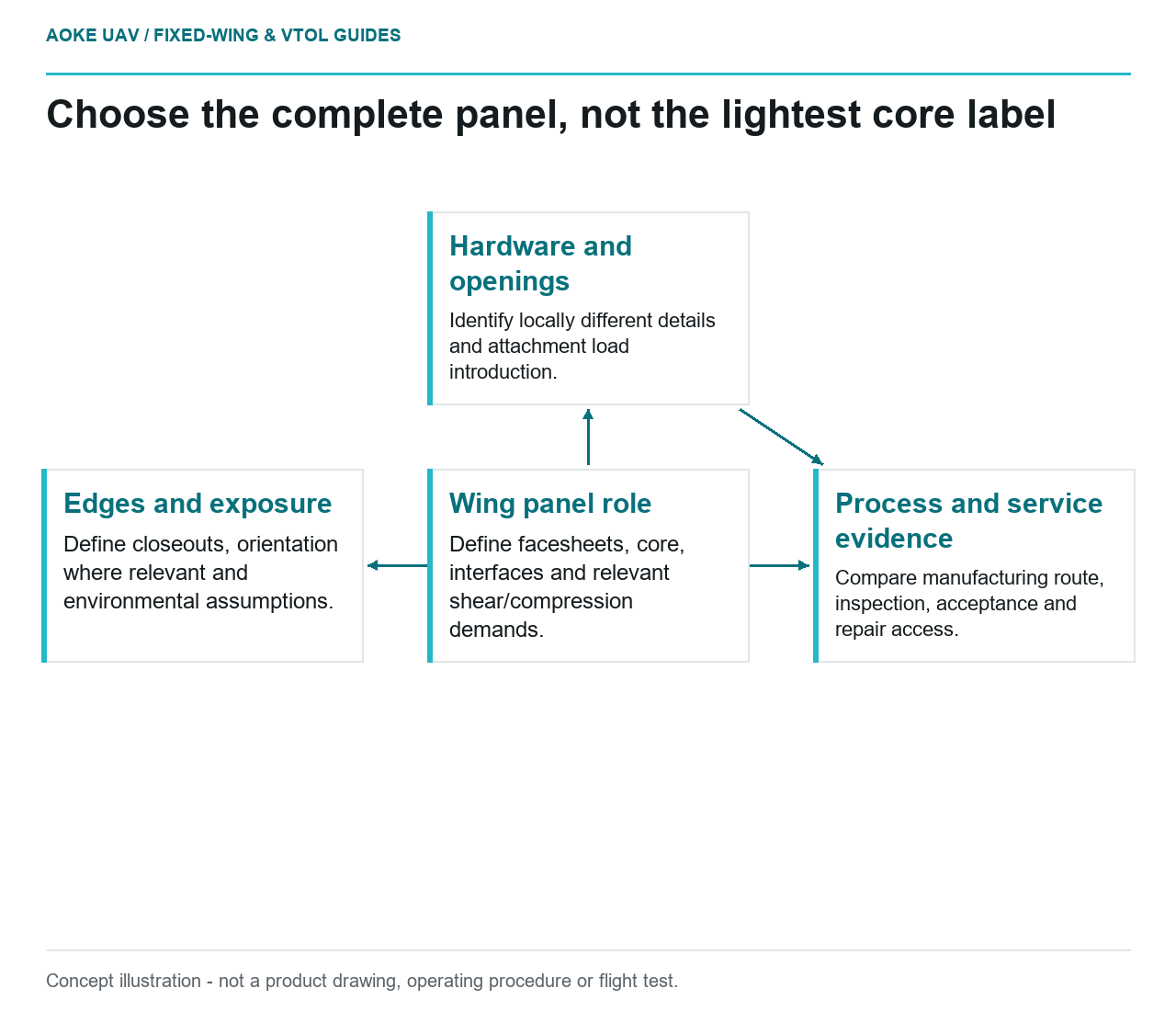
Visual summary
Concept illustration
Read diagram notes
- Wing panel role: Define facesheets, core, interfaces and relevant shear/compression demands.
- Hardware and openings: Identify locally different details and attachment load introduction.
- Edges and exposure: Define closeouts, orientation where relevant and environmental assumptions.
- Process and service evidence: Compare manufacturing route, inspection, acceptance and repair access.