Concept illustration
Read diagram notes
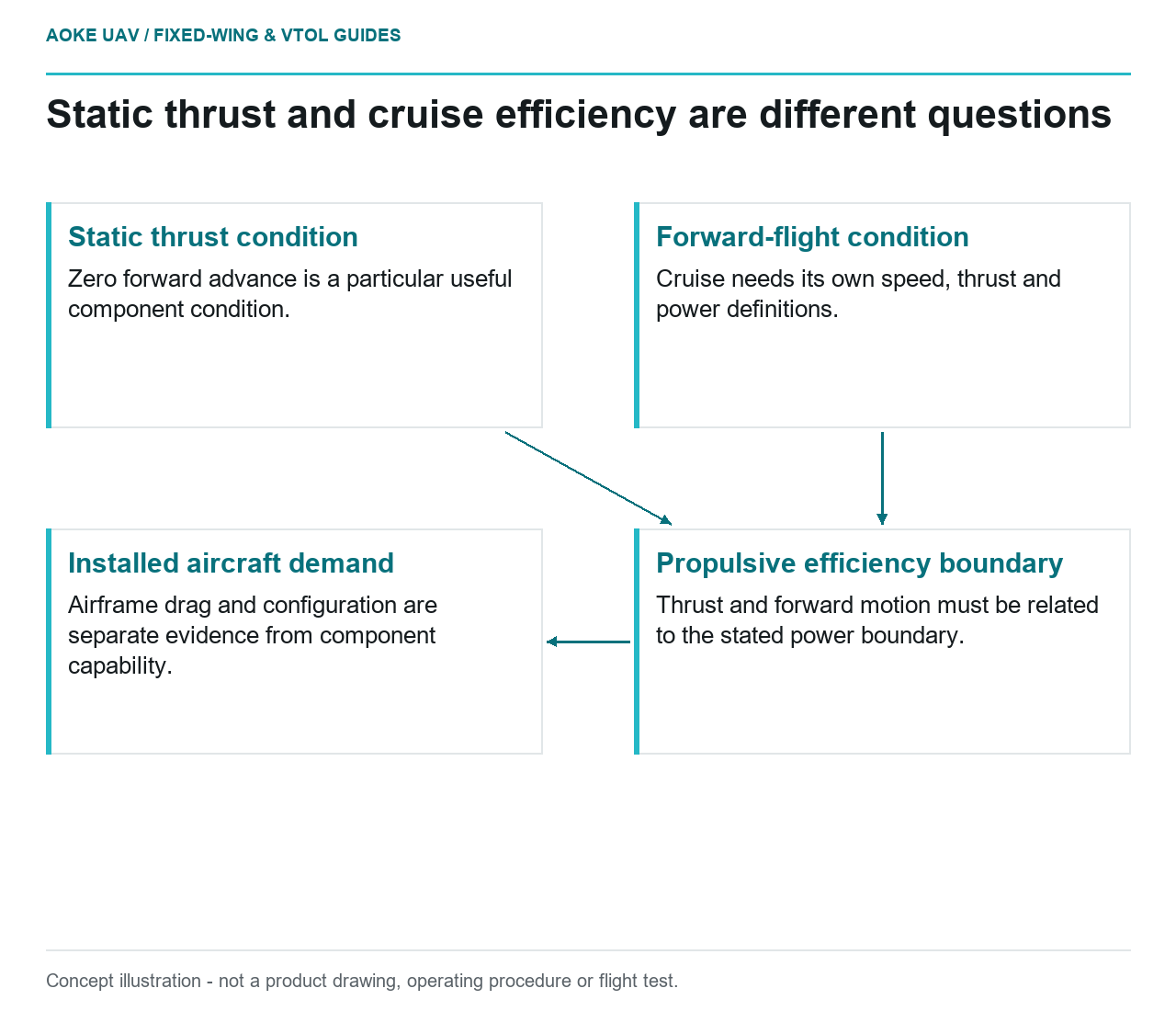
- Static thrust condition: Zero forward advance is a particular useful component condition.
- Forward-flight condition: Cruise needs its own speed, thrust and power definitions.
- Propulsive efficiency boundary: Thrust and forward motion must be related to the stated power boundary.
- Installed aircraft demand: Airframe drag and configuration are separate evidence from component capability.
A static-thrust result can be real, repeatable and still answer the wrong procurement question. If a large fixed-wing survey aircraft is being compared on cruise energy demand, a zero-advance thrust number does not establish the result the mission needs. The issue is not that static testing has no value. It is that its operating condition must remain attached to its conclusions.
Separate zero advance from forward flight
Imagine a hypothetical propulsion proposal containing a photographed bench setup and a prominent static-thrust value, but no forward-flight data. The recipient is integrating a large industrial fixed-wing aircraft for civil mapping. This is an original editorial scenario, not an GAUTEN procurement or test result. The next question should be what evidence connects the bench condition to the aircraft’s intended cruise point.
The UIUC site’s basic-relations figure defines propeller advance ratio using forward speed, rotational speed and diameter, and expresses propulsive efficiency using thrust, forward speed and input power.[8] At zero forward speed, a static result therefore cannot identify the nonzero-speed efficiency relevant to cruise. This is a distinction between operating conditions, not a claim that a motor consumes no energy while producing static thrust.
The same UIUC portal explicitly describes small UAV and model-aircraft wind-tunnel measurements.[8] It is useful here for definitions and test-condition literacy, not for scaling a measured small propeller into a large-aircraft recommendation. Neither its measurements nor a similar-looking graph establishes performance of the proposed installed system.
Ask for the relevant propeller operating points
Request a dataset showing the exact propeller and the operating conditions needed to evaluate the intended air-relative cruise state. Record rotational speed, forward-flow condition, thrust and power definitions. Keep measured results distinct from predictions. A supplier may have useful analytical evidence, but it should not be silently described as a wind-tunnel or flight measurement.
APC states that its performance data are determined analytically and that the calculated power, torque and thrust use a standard-atmosphere basis.[4] That is an example of declared provenance. For the hypothetical proposal, request equivalent clarity about calculation method, geometry and conditions. A single static row from a map should not stand in for the map’s forward-flight information.
Keep motor and controller boundaries visible
Propeller performance is not automatically battery-to-aircraft efficiency. maxon’s guide distinguishes motor electrical input from mechanical output and describes losses and operating characteristics.[1] It is generic motor background, not a rating for the proposed drive. In the comparison worksheet, identify whether power is measured at the supply, controller input or shaft, and which additional conversions have evidence.
Ask the supplier to document the controller and motor combination rather than combining attractive figures from unrelated devices. If the proposal reports only thrust per electrical input at a static point, preserve that description exactly. Do not rename it cruise efficiency. Nor should a controller’s advertised peak efficiency fill an unmeasured loss term in the installed aircraft’s budget.
Connect the evidence to aircraft demand
For the mapping scenario, request the aircraft drag and operating-point basis for the actual payload and configuration. The propeller evidence describes what the propulsion device may deliver under specified conditions; the aircraft evidence must establish the demand being compared. This article provides neither an airframe drag model nor a validated cruise capability.
Propose a review table with separate entries for static characterization, forward-flight-relevant component evidence and installed aircraft substantiation. A proposal can be strong in one column and incomplete in another. This avoids both dismissing useful bench work and treating it as proof of a result it never measured.
The practical decision is whether the evidence answers the intended mission question. Static thrust may remain part of the record, but it should not determine a cruise ranking on its own. For large fixed-wing integration, ask for traceable operating-point and installation evidence before converting an impressive bench number into a performance claim.