Follow the boundary, not just the paint
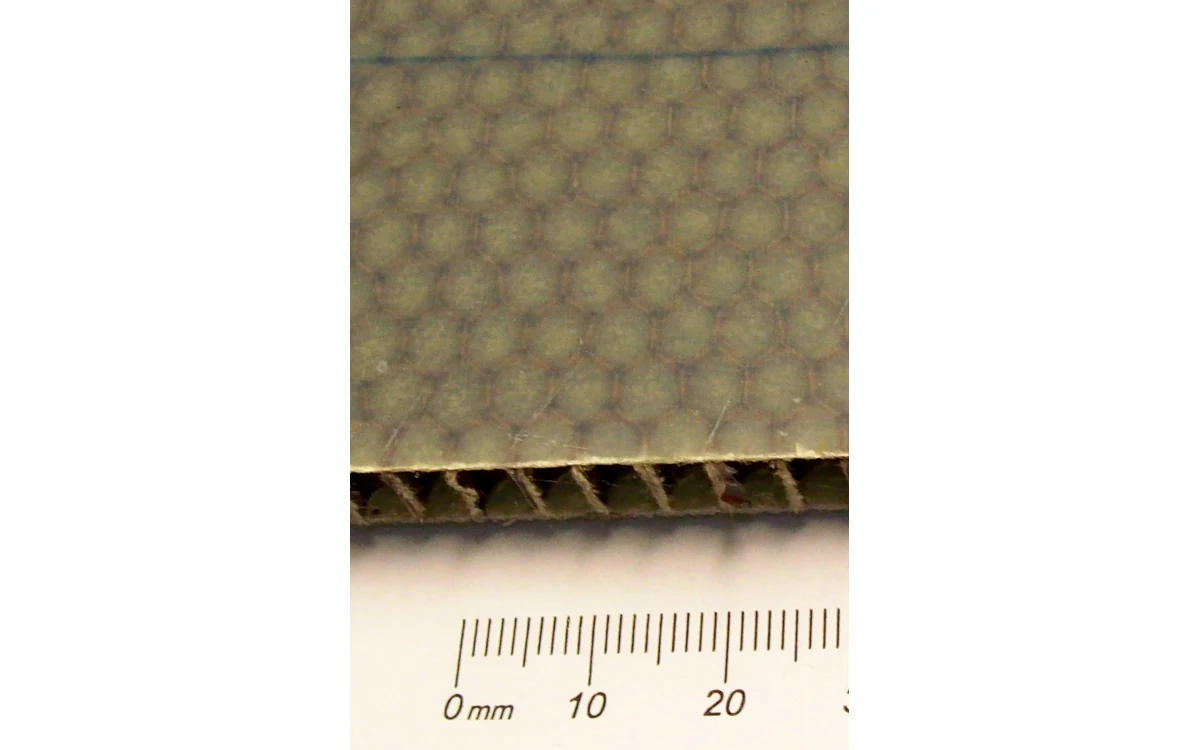
Imagine a hypothetical large fixed-wing mapping aircraft whose wings are detached for road transport. Its sandwich skins have trimmed edges, hatch openings and penetrations. The review asks where the final construction protects the core and how that protection is checked after handling. It does not claim that a particular GAUTEN wing leaks or that every painted panel is inadequately sealed.
FAA composite guidance identifies moisture and temperature as environmental considerations to be assessed for the relevant material system and structural details. It also discusses protective provisions, including ventilation and drainage where necessary. These are contextual principles from certificated-aircraft guidance, not a moisture qualification or sealing instruction for this UAV. [1]
Map every interruption of the sandwich boundary
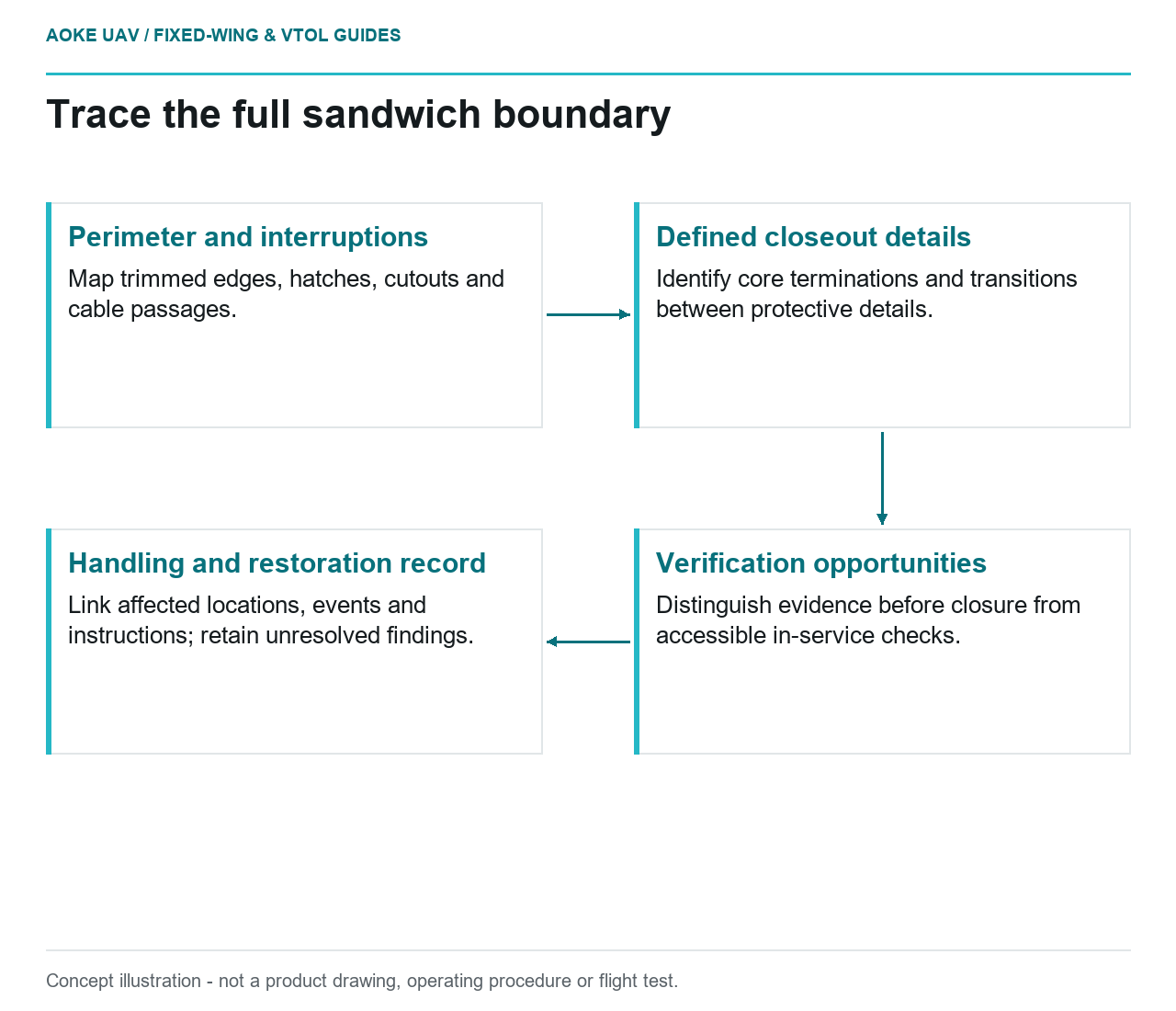
For this editorial review exercise, trace the panel perimeter and add each hatch, cutout and cable passage to the drawing. Ask the designer where the core terminates, which closeout detail applies and how adjacent details join. Do not assume the visible external contour reveals the internal edge construction.
Separate the intended finished condition from intermediate manufacturing conditions and later maintenance access. A panel trimmed to shape is not necessarily a finished panel ready for service. NASA JSC’s sandwich specification controls core forming and trimming to preserve drawing-defined geometry and addresses core placement and fit-checking. It is a manufacturing-process reference, not a standalone UAV edge-sealing standard. [2]
Ask about hatches and penetrations
On the hypothetical fixed-wing aircraft, select one inspection hatch and ask for a section through its boundary. What closes the surrounding core? Which document identifies the material and process? What changes when the hatch is removed? These questions should be answered for the actual construction rather than by choosing an unspecified sealant from general practice.
Next examine penetrations and nearby hardware as interfaces. Ask whether maintenance can disturb the protective detail and which instruction restores the documented configuration. The objective is to find discontinuities in the drawing and service process, not to assert an unseen flow path from an exterior photograph.
Check continuity at corners and transitions
A useful review annotation marks each transition between closeout details and each area that cannot be examined after assembly. Ask how continuity is established during manufacture and how the specified acceptance checks are recorded. Where a detail is hidden, identify the evidence that exists before closure instead of expecting a later surface inspection to answer every question.
NASA’s process specification provides a bounded example of documented dimensional checks, material records and traceable mandatory inspection points for Level 1 processing. It separately addresses NDE specification rather than prescribing a general field method. [2] For this wing, ask which actual inspection documents cover the edge detail and whether they address the intended service condition.
Link handling events to inspection records
For the transport scenario, propose a record that identifies the panel, exact affected location, observed condition, handling event and instruction used for disposition. Record a damaged corner as a specific finding even when the surrounding surface looks clean. This is a planning suggestion, not a statement that any stated damage size is acceptable.
FAA guidance says visual indications provide limited information about hidden damage and calls for procedures that characterize the full extent where required. It also asks that repair records identify the relevant part and that service damage inform manufacturer feedback. [1] Do not use a cosmetic touch-up or a photograph of fresh paint as a structural disposition.
Environmental questions also extend beyond an obvious opening. FAA’s aeroelastic discussion identifies water ingression and sandwich disbond as examples of changes that may affect control-surface behavior through mass or stiffness. [1] That example is a reason to request applicable assessment, not evidence that every wet wing panel has the same consequence.
Finish with an accountable closeout map
The useful deliverable for this large industrial fixed-wing review is a drawing-linked list of boundary details, verification records and maintenance responsibilities. No GAUTEN sealing qualification, drying procedure or allowable moisture condition was supplied. Leave those limits to applicable aircraft documentation. The explainer helps locate unanswered questions; it cannot certify a panel as sealed or authorize a field repair.
Related reading
Sources
- [1] Composite Aircraft Structure, AC 20-107B including Change 1
- [2] Process Specification for the Assembly of Composite Sandwich Structures
Visual summary
Concept illustration
Read diagram notes
- Perimeter and interruptions: Map trimmed edges, hatches, cutouts and cable passages.
- Defined closeout details: Identify core terminations and transitions between protective details.
- Verification opportunities: Distinguish evidence before closure from accessible in-service checks.
- Handling and restoration record: Link affected locations, events and instructions; retain unresolved findings.