Overview imagery and site context
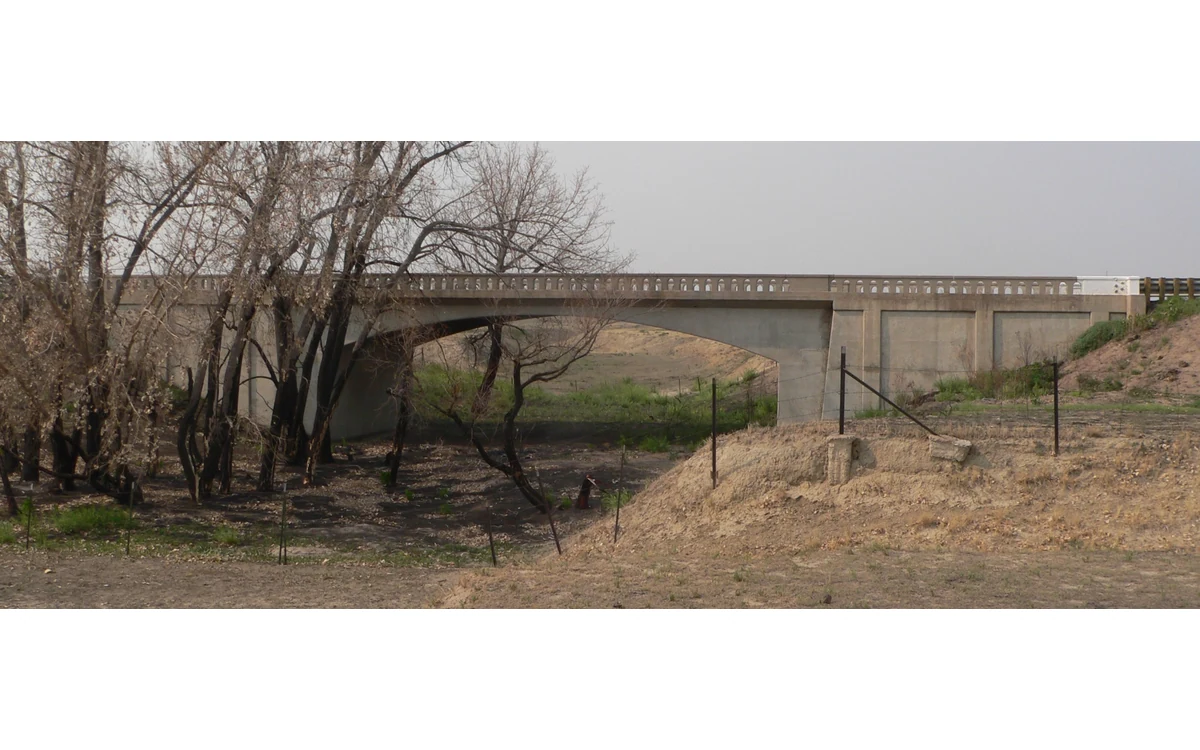
A bridge can appear prominently in an aerial image while many inspection questions remain unanswered. Consider a hypothetical civil assignment in which a large fixed-wing aircraft documents roadway approaches, the river setting and visible surroundings of a bridge. That overview may organise a later inspection visit. It should be commissioned as context evidence with explicit view requirements, not described as a complete bridge inspection merely because the structure is included in the scene.
FHWA’s research report on UAS data collection discusses mapping approaches and upstream and downstream channels with rotary or fixed-wing systems. Its platform discussion identifies fixed-wing usefulness for mapping and longer-coverage tasks while distinguishing inspections requiring static positioning. [1] This is the relevant research context for the proposed large fixed-wing role. It is not a demonstration that an unspecified aircraft can detect every bridge deficiency or perform a required inspection from an overview route.
Underdeck and confined-view limitations
In the proposed scope review, ask the bridge specialist to list the required views before selecting the acquisition method. An overhead record does not establish an underdeck view. Nor should an image of an outer member be treated as evidence about a hidden interface. Mark those questions unresolved unless there is a separately demonstrated view. This is an observability discipline, not a claim about which particular components may be omitted from an inspection.
The FHWA report describes specialised small or collision-tolerant UAS for confined or near-surface access. It also explains that fixed-wing platforms cannot hover and are poorly suited to tasks requiring static positioning. [1] A large fixed-wing aircraft should not inherit the capabilities of those close-access systems by analogy. The hypothetical project therefore assigns broad context to the wingborne acquisition and leaves close, hidden or contact-dependent evidence to a method selected by the qualified inspection team.
Vertical takeoff does not erase the distinction. The report discusses hybrid VTOL platforms separately and notes limitations for bridge inspection, including wing-related wind effects while hovering. [1] That research observation is not an operating limit for a particular aircraft. It is a reason not to promise that a large fixed-wing VTOL can work beneath a bridge, hold a confined view or safely approach a structure based only on its architecture label.
Research on small UAS has different geometry
Read the report’s results with their platform, sensor and acquisition setting attached. FHWA presents research, case studies and testing aimed at understanding UAS support for inspection, not a universal approval of all airborne imaging methods. The report explicitly characterises its practices as recommendations rather than requirements. [1] Do not turn a successful close-camera example into an equivalent capability claim for distant, moving fixed-wing imagery.
For this proposed evidence review, trace each requested observation to the image that demonstrates it. Keep original files, acquisition notes and the bridge specialist’s interpretation together. A stitched site presentation may help locate the evidence, but the owner should still be able to distinguish a view that exists from one merely implied by a model. These are original handoff recommendations. They do not establish defect thresholds, measurement accuracy or inspection equivalence for the hypothetical system.
Asset-owner inspection requirements remain separate
FHWA states that UAS do not replace a person where tactile or other contact-inspection methods are needed or required, and that UAS use does not change underlying inspection requirements. [1] Treat that as a clear boundary when describing the research. This article is not a current legal compliance assessment, and neither an overview image nor a citation to the report establishes that an owner’s statutory or contractual obligations have been met.
Close the hypothetical large fixed-wing assignment with a view register: context documented, features directly observed, views unavailable and questions referred for follow-up. Let the responsible bridge team determine the applicable inspection scope and methods. The useful outcome is an honest contribution to the evidence chain, not a claim of a complete diagnosis. Keep operational permission, aircraft clearance, structural condition rating and public-release decisions outside the reconnaissance deliverable unless separately established through the appropriate process.
Related reading
- Vertical Faces and the Blind Spots of Nadir Mapping
- A Propulsion Supplier Evidence Checklist for Industrial UAVs
Sources
Visual summary
Concept illustration
Read diagram notes
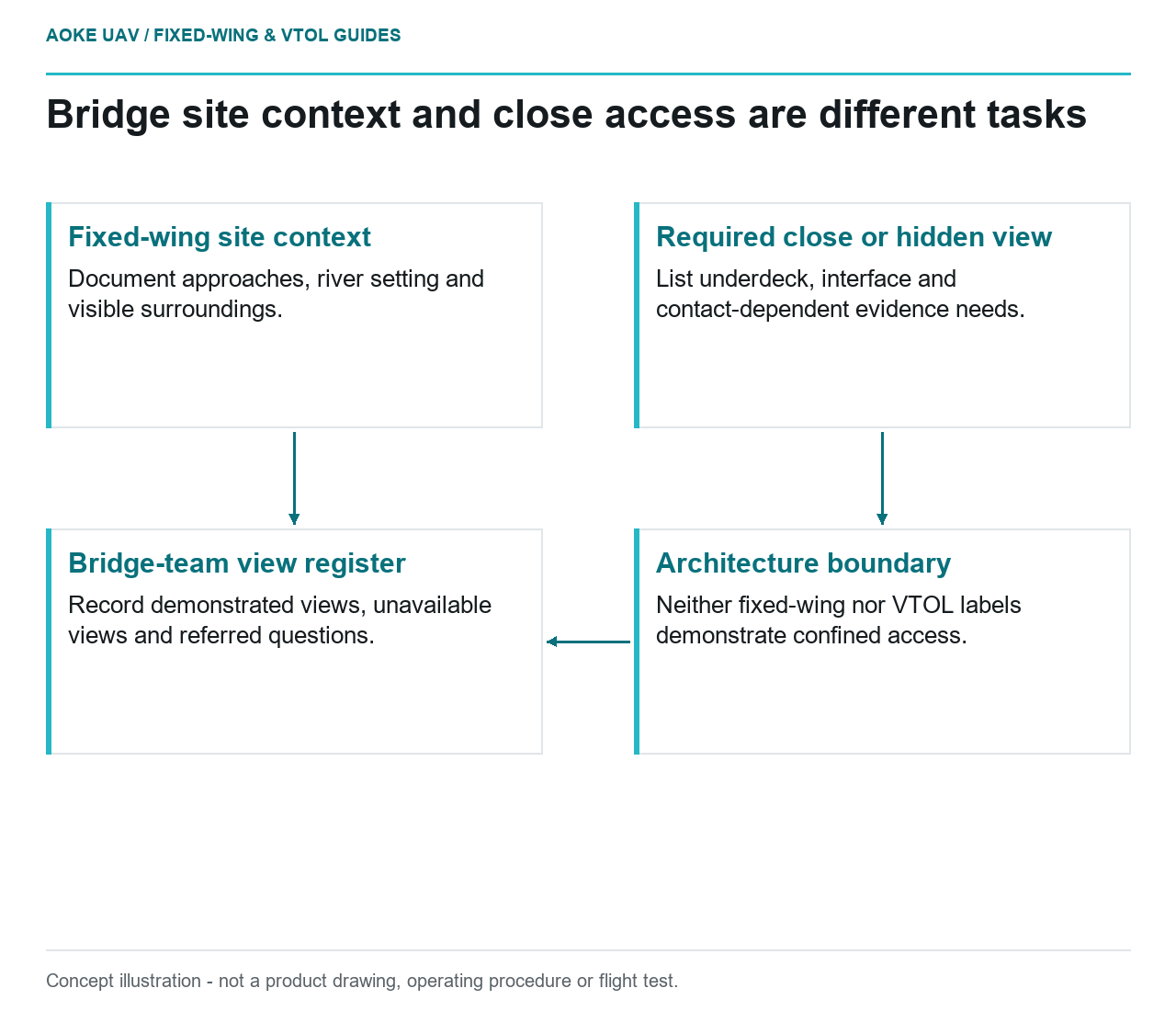
- Fixed-wing site context: Document approaches, river setting and visible surroundings.
- Required close or hidden view: List underdeck, interface and contact-dependent evidence needs.
- Architecture boundary: Neither fixed-wing nor VTOL labels demonstrate confined access.
- Bridge-team view register: Record demonstrated views, unavailable views and referred questions.