Concept illustration
Read diagram notes
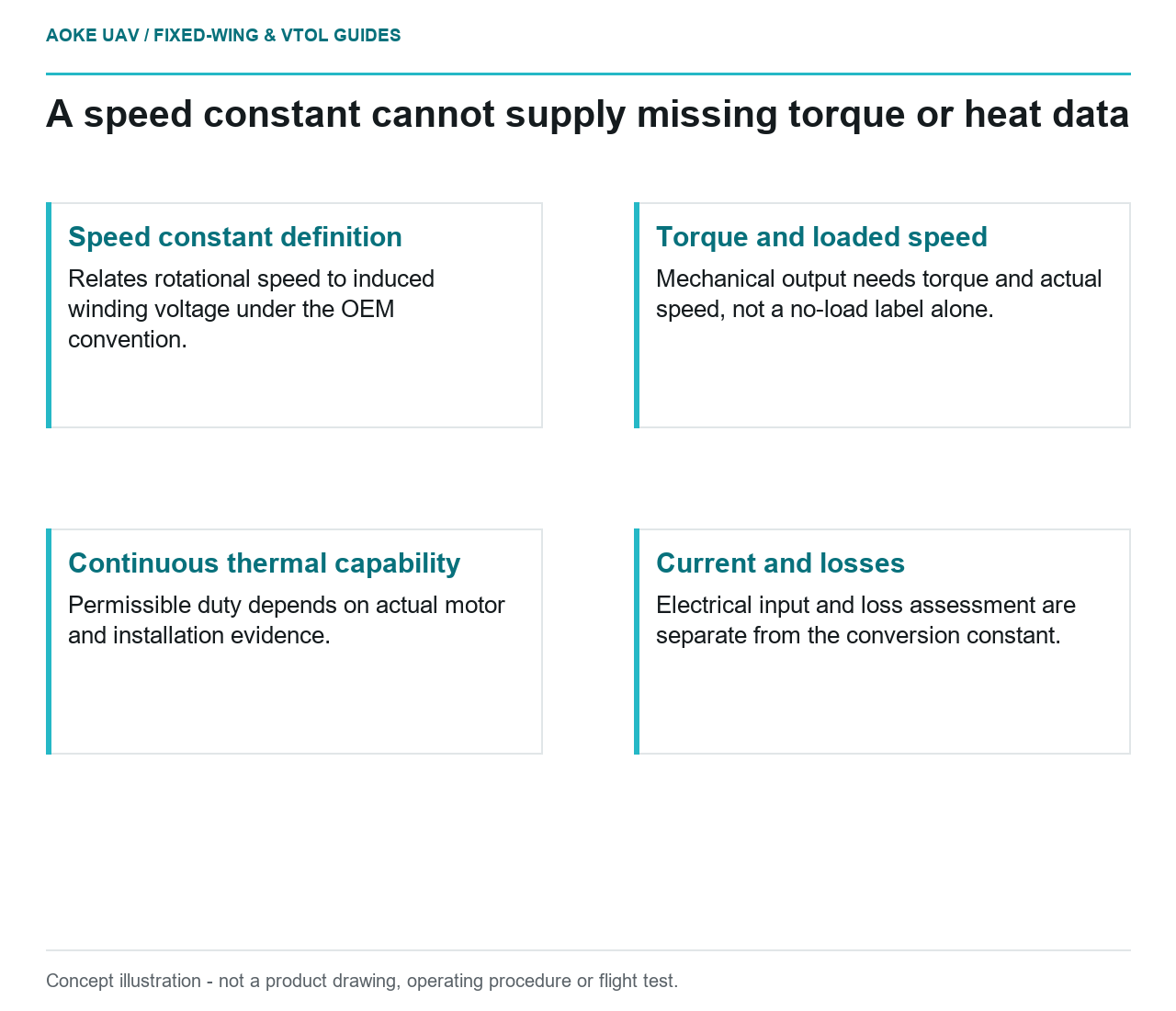
- Speed constant definition: Relates rotational speed to induced winding voltage under the OEM convention.
- Torque and loaded speed: Mechanical output needs torque and actual speed, not a no-load label alone.
- Current and losses: Electrical input and loss assessment are separate from the conversion constant.
- Continuous thermal capability: Permissible duty depends on actual motor and installation evidence.
Read the constant before interpreting the label
Consider a hypothetical large civil survey aircraft whose proposed motor specification lists a speed constant but no relevant torque or thermal data. The immediate task is to interpret that constant, not to select the propeller or promise climb performance. This example is an original integration scenario; it is not a motor recommendation or an observed aircraft result.
The maxon technical reference defines a speed constant through the relationship between rotational speed and voltage induced in the winding. It separately defines a torque constant linking torque with motor current. These are conversion relationships, not declarations that every operating condition is permissible. The document also warns that its formulas require the catalog’s stated units. [1]
When a supplier writes Kv, ask for its definition and units rather than relying on typography. The distinction between induced winding voltage and the battery-bus voltage belongs in that clarification. Keep the manufacturer’s convention attached to the value, especially when comparing documents from different motor and controller suppliers.
Why a speed relationship cannot specify output power
Maxon describes mechanical output in terms of rotational speed and torque, with electrical input associated with voltage and current. Its energy-conversion discussion separates output from losses. A speed constant supplies neither the complete loaded torque nor the complete loss assessment needed to identify a usable mechanical output. [1]
For the hypothetical fixed-wing project, a proposal containing only speed constant and battery description should therefore remain incomplete. Ask what torque the intended shaft must deliver, at which speed, and with what corresponding current. These questions describe missing evidence; they do not authorize multiplying unrelated catalog values to create a power rating.
The same reference treats no-load speed as an approximate relationship to applied voltage in its motor model. It then shows speed changing with torque at constant voltage. A no-load estimate is thus not an installed propeller speed prediction. The distinctions remain important even before a particular aircraft installation has been designed. [1]
Put thermal capability in a different evidence column
The reference associates nominal current with the motor’s thermally permissible continuous current. Its operating-range discussion also distinguishes continuous operation from temporary overload and ties overload duration to current and starting temperature. Those definitions make clear why a conversion constant cannot substitute for the thermal conditions attached to a rating. [1]
In this proposed large fixed-wing installation, request the actual motor revision, winding identity, continuous operating region and stated cooling assumptions. If the motor will sit within a fuselage, ask how the intended enclosure and heat paths are represented by the available evidence. Do not infer that a catalog constant confirms suitability for sustained survey cruise.
For a fixed-wing VTOL variant, describe lift, transition and forward-flight demands separately in the request. This is a suggested review structure, not a claim that the cited generic motor document validates those aircraft phases. No temperature limit, overload interval or safe control setting can be transferred from an unrelated motor example.
Use Kv to organize questions, not close them
A useful specification review would retain the speed constant exactly as supplied, beside its definition, source revision and units. It would then list the distinct evidence still missing: relevant torque-speed-current data, controller assumptions, losses and installation-specific thermal support. That format prevents a concise catalog line from appearing more complete than it is.
The boundary of this article is deliberately narrow. Understanding a speed constant is different from finding the actual motor-propeller operating point, and different again from validating a mission power system. The cited maxon material supplies generic definitions and diagrams, not large-aircraft propulsion selection data.
For the civil fixed-wing scenario, the decision is whether the specification has become interpretable enough to continue analysis. A supplier who defines the constant clearly has answered one useful question. Until the separate load and thermal evidence exists, the team still cannot call that number a continuous power capability, an endurance guarantee or an aircraft installation approval.