Concept illustration
Read diagram notes
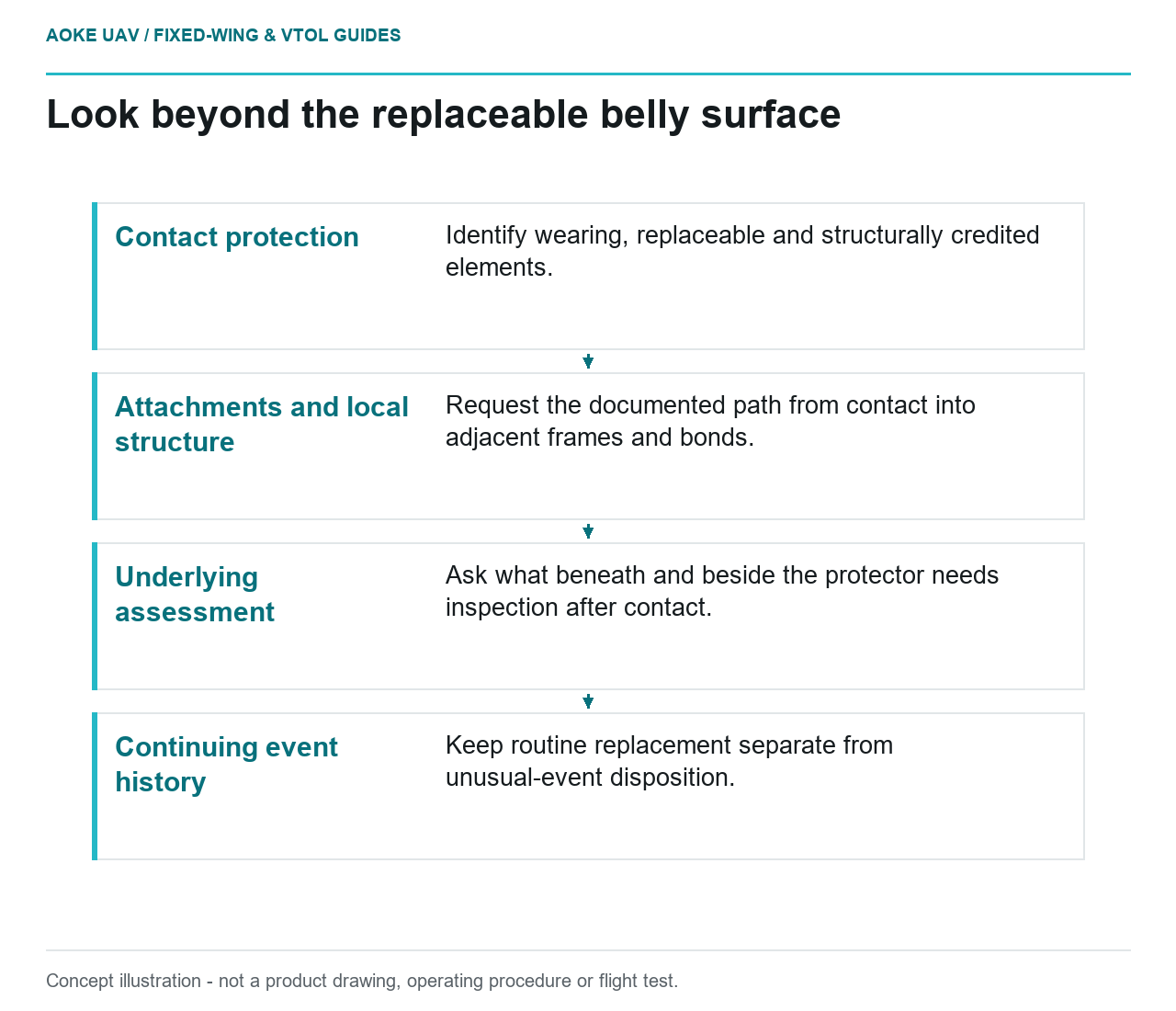
- Contact protection: Identify wearing, replaceable and structurally credited elements.
- Attachments and local structure: Request the documented path from contact into adjacent frames and bonds.
- Underlying assessment: Ask what beneath and beside the protector needs inspection after contact.
- Continuing event history: Keep routine replacement separate from unusual-event disposition.
A protective belly panel can be easy to replace while the structure behind it remains difficult to assess. Consider a hypothetical large fixed-wing civil survey aircraft with a protected belly contact region. The editorial task is to distinguish the wearing surface from the structure intended to receive ground-contact loads. This example is not a landing-capacity claim, an GAUTEN design description, or permission to use an undocumented surface as landing gear.
Sacrificial surface versus primary structure
In the proposed review, start with the drawing that defines the protection system. Ask which elements are intended to wear, which may be replaced, and which form part of the primary load path. Establish whether a panel is merely a cover, a sacrificial layer, or an element credited in the structural assessment. Do not infer those roles from thickness, appearance, or the name “skid.”
FAA composite guidance calls for structural substantiation that considers critical loads, failure modes, permitted damage, and environmental effects. It also requires supported treatment of damage allowed in maintenance documents. That provides an evidence framework, not a landing specification for the hypothetical fixed-wing aircraft. [1] Ask where the actual documentation defines the protection system’s function and the conditions under which its structural assumptions apply.
Local load introduction into frames
Draw a proposed path from the contact region through attachments and local structure into the wider fuselage. Request the engineering assessment that explains that path for the actual construction. For the scenario, useful questions include whether a replaceable panel distributes contact as assumed, how its attachments are represented, and whether the adjacent frames and bonds are included. These are questions to resolve, not statements about a tested installation.
FAA guidance discusses joints and other discontinuities as detail-level substantiation issues and includes combined loading in the consideration of structural damage and residual strength. [1] A report for the panel material alone would therefore leave the interface question open. The review should identify the configuration represented by the supporting analysis or test rather than treating a material label as assembly evidence.
Hidden impact damage beneath protection
An intact-looking outer surface is not a complete description of the underlying structure. FAA guidance distinguishes initial visual damage detection from the additional investigation needed to characterize hidden damage. It notes that visual indications provide limited information about the concealed extent of damage. Its guidance applies to certificated aircraft, not as a generic UAV inspection acceptance rule. [1]
For the hypothetical large fixed-wing survey airframe, prepare an event record before assuming that changing the belly cover resolves the event. Identify the location and known circumstances of contact, the installed protection configuration, and any visible changes. Ask the responsible engineering or maintenance organization what areas need assessment beneath and beside the protector. Avoid inventing a harmless-impact category based on a clean replacement panel.
Inspection access after contact
Inspection access belongs in the protection-system discussion before field deployment. FAA guidance says composite structure should be designed for inspection and repair access and that inspection methods need demonstrated capability for the relevant damage question. [1] Request the applicable access and removal instructions, including how the protector can be removed without introducing new damage or obscuring the original evidence.
For this civil fixed-wing example, ask the review team to distinguish routine protector replacement from disposition after an unusual ground-contact event. The record should identify what was removed, which underlying areas were assessed, what procedure was used, and who made the disposition. If an area cannot be examined through the documented method, identify the coverage gap rather than reporting that the whole region was checked. A replacement surface should not reset the structural event history.
Decision boundary
The useful outcome is a clear distinction between replaceable protection and the supported landing-load path. No maximum landing mass, sink rate, acceptable dent size, or continued-flight decision follows from this article. A large fixed-wing operator needs the actual aircraft’s loading, damage, and inspection documentation; otherwise, the honest result is an unresolved assessment, not a tougher-looking skid.
Related reading
- Visible Marks and Hidden Damage in Composite Airframes
- Airframe Readiness and Inspection Data After Hard Contact