Concept illustration
Read diagram notes
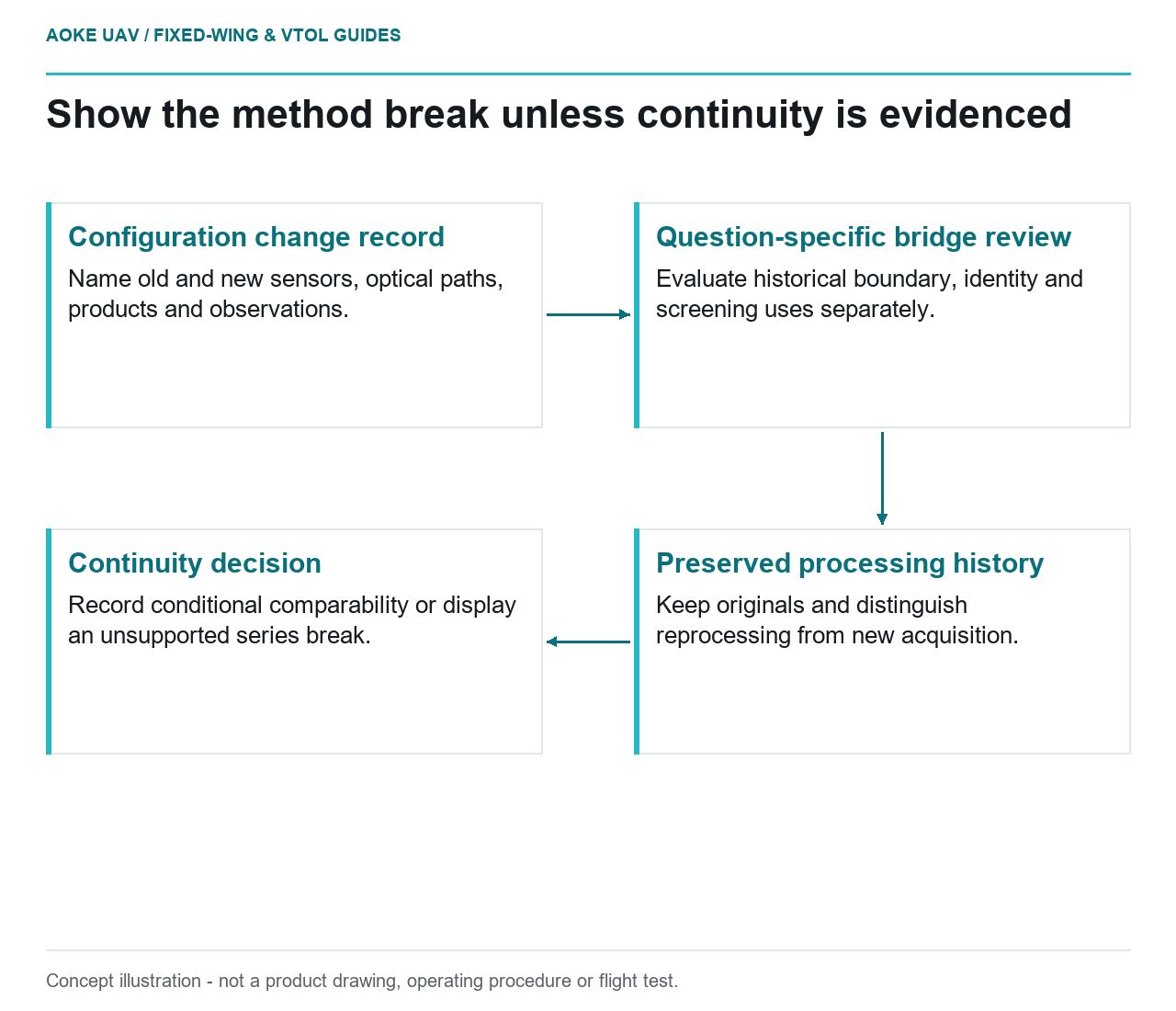
- Configuration change record: Name old and new sensors, optical paths, products and observations.
- Question-specific bridge review: Evaluate historical boundary, identity and screening uses separately.
- Preserved processing history: Keep originals and distinguish reprocessing from new acquisition.
- Continuity decision: Record conditional comparability or display an unsupported series break.
Treat the new payload as a changed measurement
A hypothetical civil district has several campaigns of large industrial fixed-wing RGB monitoring. A contractor proposes replacing the camera and adding thermal imagery, then presenting the new outputs as a seamless continuation of the historical condition record. The district first needs to identify what changed and which comparisons remain justified. This is an illustrative program review, not an GAUTEN upgrade, a validated sensor comparison or a measured asset trend.
Open a configuration-change record before merging results. Name the earlier and later sensors, optical paths, processing products and intended observations. A file format or familiar report layout should not make different measurements appear interchangeable. Keep the original time series intact while the owner decides which new outputs can legitimately be related to it.
Identify changes in geometry and signal meaning
USGS imagery guidance discusses the challenges of inconsistent sensors and processing, the need for geometric and radiometric calibration, and the value of common measurement units. It also describes calibration metadata as information for judging dataset usability. These principles support investigating comparability, not assuming that calibration automatically makes every sensor product equivalent. [1]
For the hypothetical camera replacement, request evidence linking the new optical configuration and processing method to the intended spatial product. Ask whether observation definitions, image selection and reference geometry changed. If an earlier record described a manually delineated visible patch and the new system supplies an automated category, identify that change in method as well as the change in hardware.
Adding thermal imagery introduces a separate measurement context. FLIR explains that measured radiation involves emissivity, reflected surroundings and atmospheric effects, with relevant compensation inputs. That document concerns thermographic measurement techniques, not an asset diagnosis or a rule that a thermal observation is equivalent to an earlier RGB label. [2]
Design a transition comparison around the actual question
In this fixed-wing program, ask which historical questions need continuity. The owner may want to compare a visible boundary, recover the same asset association or evaluate a new screening output. Define a separate transition comparison for each rather than looking for one general equivalence score. Retain the exact configurations and conditions represented by any test.
Where feasible and appropriate to the real project, the owner could commission overlapping observations of agreed reference features using both methods. This is a proposed evaluation, not a claim that overlap establishes equivalence by itself. Ask what independent evidence would distinguish a method difference from actual asset change, and who is qualified to decide whether the comparison is adequate.
Do not retrofit new labels into historical records without preserving their derivation. If older imagery is reprocessed, retain the old result, the revised result and the new processing version. Make clear whether a plotted difference comes from new acquisition, a corrected reference, changed interpretation or a changed measurement method. A trend graphic should not erase these separate events.
Revise acceptance and display the series break
For this scenario, propose a decision record for every historical use: comparable under stated conditions, comparable only after documented adjustment, or not yet supported. Leave an unsupported relationship unresolved instead of filling it with an assumed conversion. USGS’s emphasis on calibration uncertainty and documented processing provides a basis for making those limits visible, without supplying project-specific acceptance criteria. [1]
The civil client should approve the revised observation scope and review process before the new fixed-wing product inherits an older acceptance status. A previously accepted map does not establish the quality of a new sensor, and a richer payload does not automatically answer the same question better. Acceptance needs to address the actual delivered measurement and intended use.
If continuity cannot be demonstrated, show a method break in the time series and explain what evidence is missing. Preserve the earlier campaigns as useful historical context rather than discarding them or pretending they are identical to the new product. The program gains a documented transition instead of an unsupported appearance of uninterrupted measurement consistency.
Related reading
- When a New Payload Requires a Structural Reassessment
- Seasonal Comparability in Multispectral UAV Surveys