Concept illustration
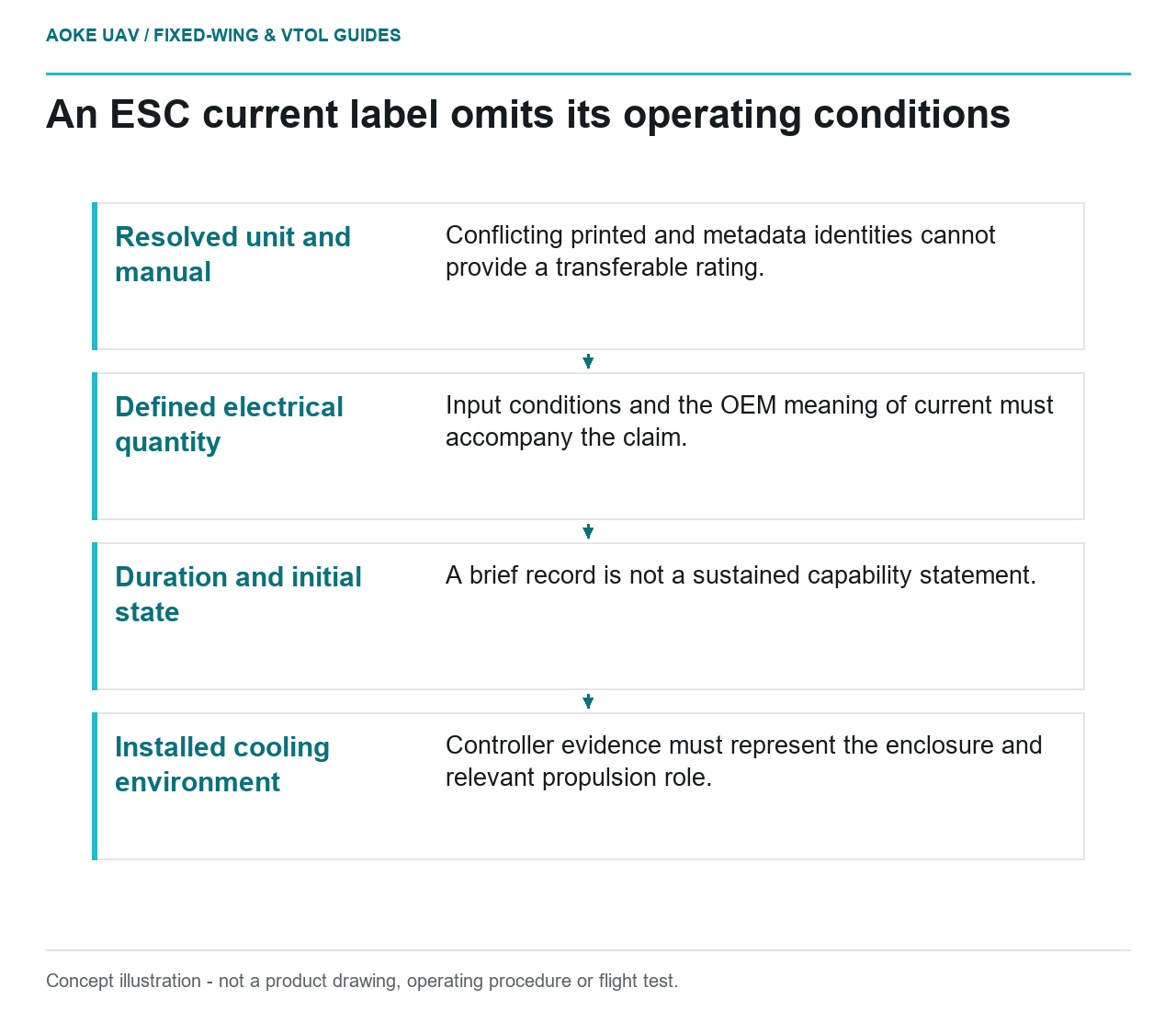
Read diagram notes
- Resolved unit and manual: Conflicting printed and metadata identities cannot provide a transferable rating.
- Defined electrical quantity: Input conditions and the OEM meaning of current must accompany the claim.
- Duration and initial state: A brief record is not a sustained capability statement.
- Installed cooling environment: Controller evidence must represent the enclosure and relevant propulsion role.
Resolve the controller identity first
A hypothetical large fixed-wing civil survey aircraft needs a propulsion controller, and a proposal offers only an ESC current label. No exact manual, firmware identity or installed cooling record accompanies it. The useful review is not a search for an assumed percentage margin. It is a request for the conditions that make the proposed component claim interpretable.
The retrieved HOBBYWING example illustrates why document identity belongs at the beginning. Its printed body names PLATINUM 80A V5, while its PDF metadata names 180A. That conflict prevents using this document as a rating source for the proposed installation. The mismatch is a provenance warning, not evidence that either numerical label applies to the aircraft. [2]
Request the precise controller part number, hardware revision, firmware revision and corresponding manufacturer documentation. Keep those identifiers together. Until the physical unit and applicable document are reconciled, a catalog current number is not an adequate basis for an integration conclusion.
Ask for the complete electrical compatibility statement
For the illustrative fixed-wing project, ask the OEM to specify the controller’s permitted input conditions and its compatibility with the intended motor. Retain how the manufacturer defines the relevant current quantity. A battery-side number, a motor-related field and a marketing label should not be treated as equivalent without their actual definitions.
The maxon reference is useful only as motor background here: it separates voltage-current electrical input from speed-torque mechanical output and describes winding losses. It does not provide voltage capability, switching capability or a current rating for an unrelated ESC. Those controller-specific questions remain with the applicable OEM evidence. [1]
Keep the proposed battery, motor and controller identities in the same review record, but do not infer compatibility from their appearance on one equipment list. Where a supplier statement leaves startup, load or environmental assumptions unspecified, record the omission and ask for clarification rather than inventing a requirement.
Distinguish sustained loading from a short demonstration
Maxon explains that continuous motor operation and temporary overload have different thermal conditions; overload duration depends on current and starting temperature. This supports the need for careful duration language in the motor portion of the review. It does not establish that an ESC follows the same thermal model or has the same allowable interval. [1]
Ask the controller supplier separately what sustained and short-term labels mean for the exact unit. Request the cooling arrangement, initial thermal state and relevant duration associated with each claim. For a large fixed-wing installation within a fuselage, ask whether the supporting evidence represents that enclosure and airflow path. Do not apply a generic derating factor to fill the gap.
A fixed-wing VTOL derivative should describe each relevant propulsion role and phase in its evidence request. A brief record associated with one state should not silently qualify another. This is an original review method: it establishes questions for the project, not an aircraft-specific safe loading schedule.
Keep protection and installation evidence distinct
The example HOBBYWING document contains protection and configuration sections, but its unresolved identity means those sections are not an instruction set for this hypothetical aircraft. Do not extract threshold values, adopt a cutoff mode or cite either conflicting current label as capability evidence. Retrieve the manual that actually applies to the intended controller. [2]
For that exact controller, ask what happens when a relevant limit is approached or a fault is detected. Keep the response definition separate from the claim that the unit can sustain a load. A proposed integration review should ask both questions; one answer cannot substitute for the other.
The deliverable should be a controller evidence packet with clear unresolved items: identity, input compatibility, current definition, duration, cooling and response behavior. Its purpose is to determine what further assessment is needed for the large civil fixed-wing system. It is not a controller recommendation, an operating limit or proof of installed aircraft performance. A current label can start that packet, but cannot finish it.