Concept illustration
Read diagram notes
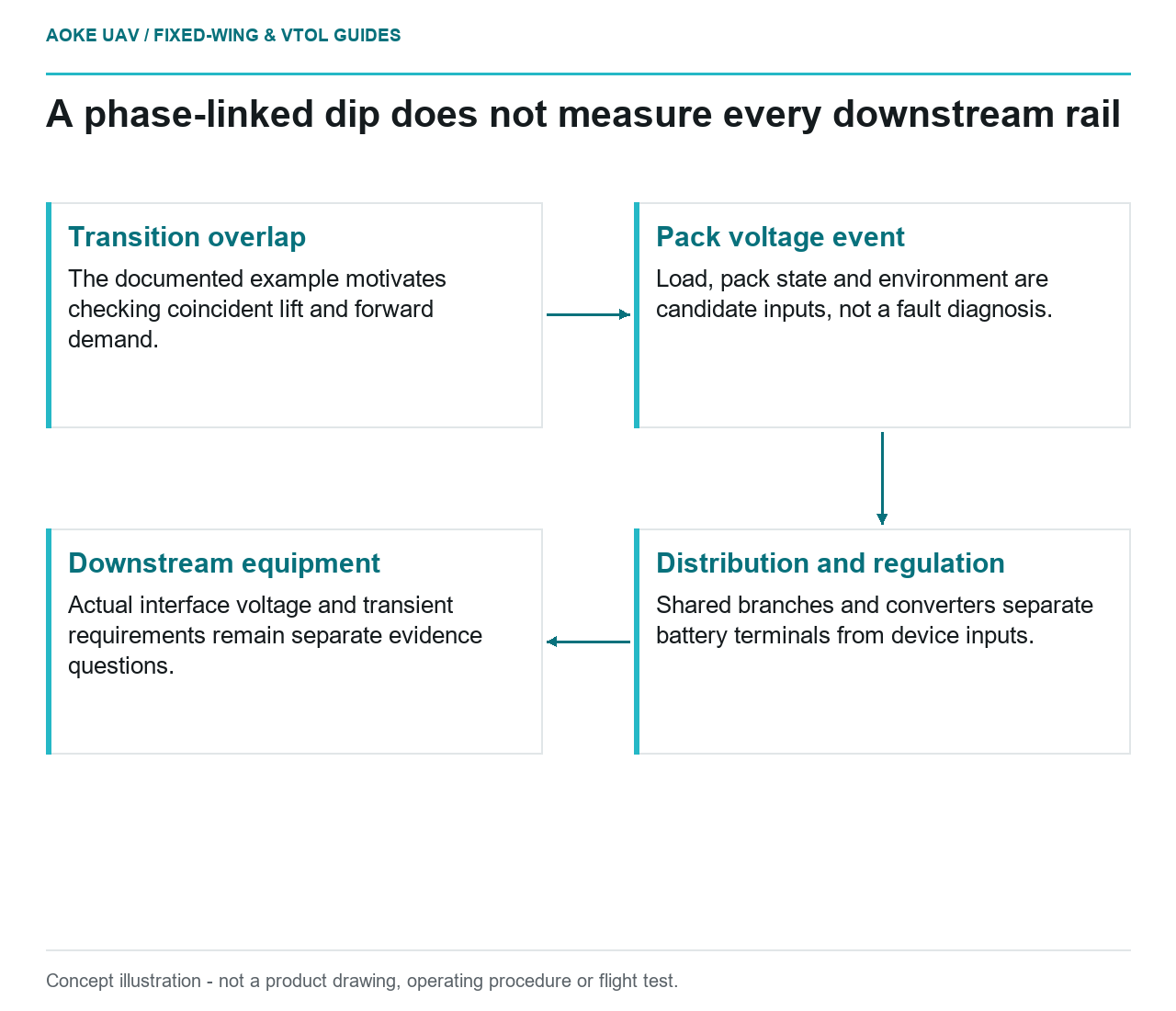
- Transition overlap: The documented example motivates checking coincident lift and forward demand.
- Pack voltage event: Load, pack state and environment are candidate inputs, not a fault diagnosis.
- Distribution and regulation: Shared branches and converters separate battery terminals from device inputs.
- Downstream equipment: Actual interface voltage and transient requirements remain separate evidence questions.
Locate the event within the mission state
A hypothetical large fixed-wing VTOL aircraft is being reviewed for a civil corridor survey. Its battery trace looks unremarkable in cruise but contains a voltage depression near a phase change. The team’s first task is to describe the event and its measurement context, not to declare the pack defective or invent a protective threshold. This is an original evidence-review scenario.
ArduPilot’s QuadPlane transition documentation explicitly warns that all motors can operate at high levels during the VTOL-to-fixed-wing transition and discusses battery sag in that context. This gives a documented reason to examine concurrent demands in that implementation. It is not an operating-envelope demonstration for the hypothetical large aircraft, and its example parameters are not recommendations here. [1]
Identify the relevant phase, propulsion roles and timestamp before comparing the event with a cruise interval. Retain whether the records describe commands, measured currents or another field. A phase name can organize the inquiry, but cannot substitute for evidence of what the installed electrical system actually experienced.
Ask for pack-specific load and state evidence
For the illustrative project, request applicable pack data describing terminal-voltage behavior under relevant loads, temperatures and battery states. Identify pack configuration and service history with the record. Do not fit an assumed internal-resistance value to a single log point and present it as a validated battery model.
FAA AC 20-184A discusses the differing electrical impedance characteristics of rechargeable lithium batteries and calls for evaluation with other aircraft electrical-system components. It also addresses monitoring across expected environmental extremes. This supports a system-level evidence request, not a numerical sag prediction for an unspecified UAV battery. [2]
The same guidance warns that some capacity loss may not be detected through simple voltage measurements. A voltage depression therefore should not be promoted into a complete battery-health diagnosis. Keep load response, available capacity and long-term condition as distinct questions requiring the appropriate evidence. [2]
Trace simultaneous demand and downstream supplies
Use an electrical diagram to ask which motors, avionics and payload supplies share the observed source during the event. For a fixed-wing VTOL design, identify the intended overlap of lift and forward propulsion rather than considering their logs in isolation. This proposed review method does not assert that a particular architecture or separate-battery solution is required.
The ArduPilot transition page’s high-demand warning is specific to its documented behavior. Do not copy its battery thresholds, power-limiting parameters or suggested remedies into the hypothetical installation. Ask the responsible project team to assess the exact controller, battery and aircraft evidence before deciding whether any configuration change is appropriate. [1]
Also request the applicable supply requirements and transient behavior of downstream equipment. Ask whether the available records show battery terminals, a distribution point or a regulated avionics rail. The battery trace alone does not establish what voltage every connected device received, nor does it demonstrate that the aircraft could continue safely through the event.
Check the instrument before interpreting the dip
ArduPilot’s common analog-module documentation defines voltage and current conversion parameters and a current offset. It also describes comparison of reported measurements with independent meter readings in a supported setup context. These details support checking the log’s measurement chain before assigning a physical explanation to its shape. They do not specify the hypothetical aircraft’s monitor accuracy or bandwidth. [3]
For this large fixed-wing review, preserve sensor placement, calibration record, configuration and the reporting time basis. Ask whether channels can be compared over the event interval without unsupported alignment or filtering assumptions. Keep any processed plots distinguishable from the original data, and state which questions their resolution cannot answer.
A useful outcome is a phase-based evidence packet: event timing, concurrent-demand records, pack conditions, sensing boundaries and downstream questions. It may establish the next assessment needed without establishing a fault cause. A satisfactory cruise observation is not a transition qualification, and one sag sample is not a health certificate. No operational threshold or mission assurance follows from these generic documents alone.
Related reading
- Concurrent Power Demand During Fixed-Wing VTOL Transition
- Reviewing Structural Load Cases Across VTOL Transition