Concept illustration
Read diagram notes
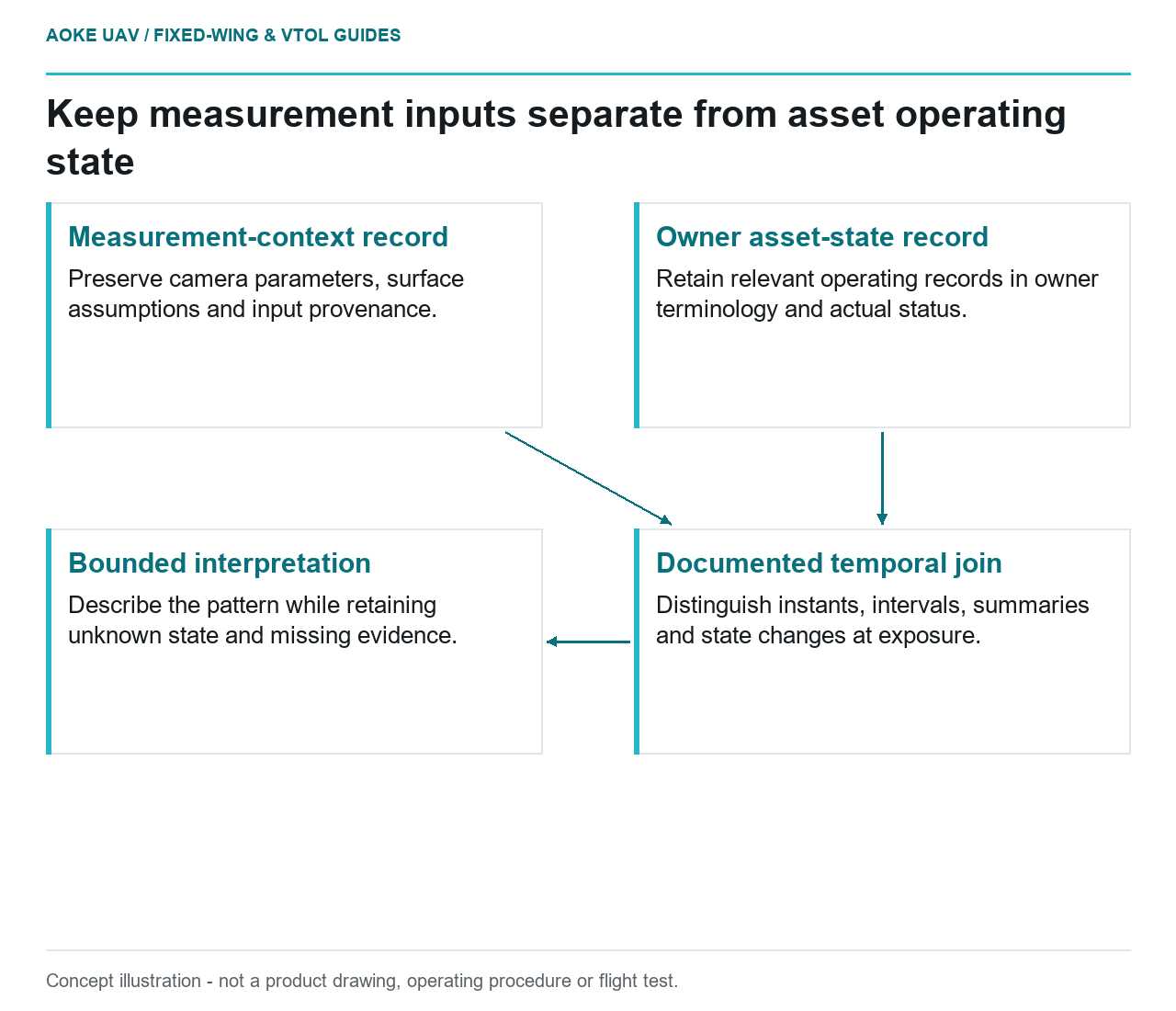
- Measurement-context record: Preserve camera parameters, surface assumptions and input provenance.
- Owner asset-state record: Retain relevant operating records in owner terminology and actual status.
- Documented temporal join: Distinguish instants, intervals, summaries and state changes at exposure.
- Bounded interpretation: Describe the pattern while retaining unknown state and missing evidence.
Ask which asset state the owner needs recorded
Consider a hypothetical industrial utility campus observed with a thermal payload on a large fixed-wing aircraft. The image analyst sees a temperature pattern on exterior equipment, but the delivery contains no owner operating record for the acquisition period. The immediate task is to identify missing context, not diagnose a fault. This is an editorial evidence scenario, not an GAUTEN thermal result or an operating assessment of a real facility.
Ask the responsible asset team which state variables matter to its intended interpretation and which primary records exist. Depending on the actual task, the team might request an operating mode, a load record or an event history, but this article does not supply an asset-specific list of diagnostic requirements. Preserve the owner’s terminology and distinguish reported state from state inferred by an analyst.
Keep radiometric inputs separate from operating context
FLIR’s measurement guidance explains that detected infrared radiation depends on emissivity, reflected surroundings and atmospheric effects as well as object temperature. It identifies inputs such as reflected apparent temperature, camera-to-object distance, humidity and atmospheric temperature. These are measurement considerations; the document is not a diagnostic standard for industrial equipment. [1]
For this fixed-wing example, maintain a measurement-context record beside an asset-state record. A camera setting is not evidence of the equipment’s operating mode, and an owner load log does not resolve an unknown emissivity assumption. Each input should have its own source and status so a reviewer can see which parts of the interpretation are documented and which remain uncertain.
Do not copy default camera values into the report as though they were field measurements. Record whether an input was measured, supplied by the owner, taken from applicable documentation or left assumed. The measurement reviewer should determine whether those inputs are appropriate to the actual payload and view; this article provides no compensating values or temperature limits.
Join external records by a documented time basis
In the hypothetical campus, request the source and timestamp convention for each relevant operating record. Identify whether it describes an instant, an interval or an aggregated summary. Preserve the image acquisition time and explain how it is associated with that external record. A matching calendar date alone should not be presented as a verified match to a short-lived operating condition.
If the owner supplies a record spanning a state change, keep the change visible. Ask whether the image can be associated with one side of the event and what evidence supports that association. Where timing is insufficient, state that the operating state at exposure is unknown. Do not interpolate a plausible state and then treat it as an observed fact.
For repeated fixed-wing campaigns, preserve the state evidence separately for every observation rather than inheriting the previous mission’s entry. A later comparison should be able to identify documented differences in context without retroactively overwriting the earlier record. This is a proposed provenance practice, not a claim that any particular state causes a particular thermal signature.
Limit the conclusion to the available evidence
Suppose the illustrative observation has usable thermal data but no relevant owner log. The report can describe the recorded pattern and list the missing state evidence, while withholding the asset diagnosis. It should not label the equipment normal, overloaded or defective merely to close the finding. The responsible specialist must choose the applicable method and interpretation criteria.
FLIR also discusses compensation for external optics in supported cameras and analysis programs. If a payload installation includes such an optical path, request the actual documentation and relevant configuration evidence rather than assuming a generic guide resolves it. This remains a measurement question independent of the equipment’s operating state. [1]
A useful handover links the thermal frame, asset identity, measurement assumptions, owner records and timing limitations. That package lets the civil owner decide whether further evidence is needed. Large fixed-wing monitoring can contribute a traceable observation without claiming that an image establishes operating conditions it never measured.