Concept illustration
Read diagram notes
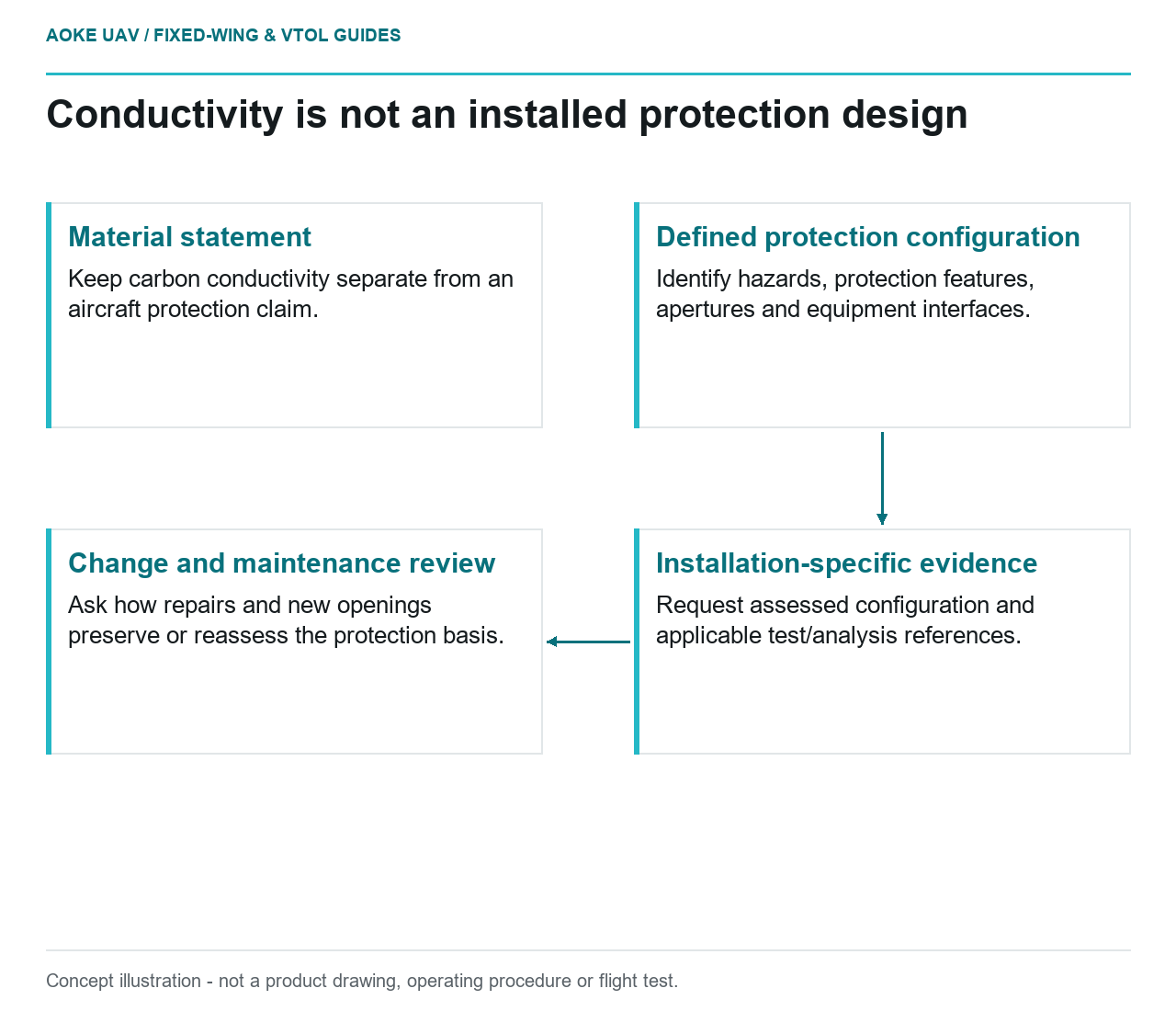
- Material statement: Keep carbon conductivity separate from an aircraft protection claim.
- Defined protection configuration: Identify hazards, protection features, apertures and equipment interfaces.
- Installation-specific evidence: Request assessed configuration and applicable test/analysis references.
- Change and maintenance review: Ask how repairs and new openings preserve or reassess the protection basis.
An airframe proposal for a hypothetical large fixed-wing environmental-survey aircraft says its carbon structure provides natural lightning protection. The integration team should not convert that material description into a protected-aircraft claim. The relevant evidence concerns the complete installation, its protection features and the configuration assessed. This article helps read the claim and identify missing substantiation. It provides no lightning-zone assignment, conductor sizing, test prescription or operational permission. Nothing here supports deliberate thunderstorm exposure or a return-to-service decision after a suspected strike.
Material conductivity versus system protection
Separate the material statement from the system claim. Ask what the supplier means by protected: which hazards, structural regions and installed systems were considered? Request the evidence behind that definition rather than accepting conductivity as the answer. A claim about a reinforcement material is not yet a description of an aircraft protection design.
FAA composite guidance explicitly discusses the need for lightning protection design features and the potential for structural damage and induced electrical effects. It distinguishes the conductivity of carbon composites from that of resins and other reinforcement systems. [1] The document concerns US certificated aircraft, not this fixed-wing UAV. It provides a reason to demand applicable evidence, not a basis for declaring the hypothetical aircraft protected because one ingredient can conduct electricity.
Bonding paths and sensitive interfaces
Ask the supplier to identify the protection features represented in its configuration documentation. Request the interfaces included in the assessment, particularly added apertures, removable panels, attachments and equipment installations. Do not invent a preferred current path or assume that every apparently conductive connection is an intentional protection feature. Those questions require the actual design and supporting evidence.
For the large industrial fixed-wing review, keep structural and equipment responses linked but distinct. A statement about the external surface may leave the internal installation unspecified. FAA guidance discusses both structural effects and induced current or voltage on internal metallic and electrical systems. [1] Use that scope to ask what was evaluated. It does not justify predicting damage severity for an untested arrangement or claiming that a continuity measurement proves installed lightning performance.
Evidence for the installed configuration
Request the assessed configuration, test or analysis references and the authority responsible for their applicability. Ask whether the evidence includes the offered aircraft’s geometry, protection details and equipment interfaces. If representative specimens were used, request the explanation connecting them to the installation instead of dismissing or overextending their results.
The FAA states that effectiveness should be demonstrated through tests or analysis supported by tests and discusses representative structural testing. It also calls for assessing observed structural damage appropriately. [1] No such installation-specific substantiation was supplied for this hypothetical fixed-wing aircraft. The correct editorial conclusion is that the protection claim remains unverified. A document title in a supplier bibliography is not proof that its methods were applied to the offered configuration or that the resulting evidence supports the advertised scope.
Limits of a technical explainer
Treat repairs, new openings and altered surface systems as applicability questions for the responsible design authority. Ask how the protection definition is preserved or reassessed when the configuration changes. FAA maintenance guidance notes the need to detect degradation of protection systems and to restore relevant surface and lightning-protection features during repair. [1] It does not authorize a generic field restoration technique.
For this hypothetical large fixed-wing program, the review record should distinguish a supplier claim, the evidence actually examined and the remaining questions. Operational weather decisions and post-event inspections must follow applicable aircraft and operating documentation, not this explainer. No protection statement should be paraphrased as permission to fly in thunderstorms. If the evidence does not define the installed configuration, preserve that limitation explicitly rather than filling it with a general assertion about carbon.
Related reading
- Carbon Composite and Metal Interfaces in Damp Service
- Signal Grounds and Power Returns in UAV Payload Integration