Concept illustration
Read diagram notes
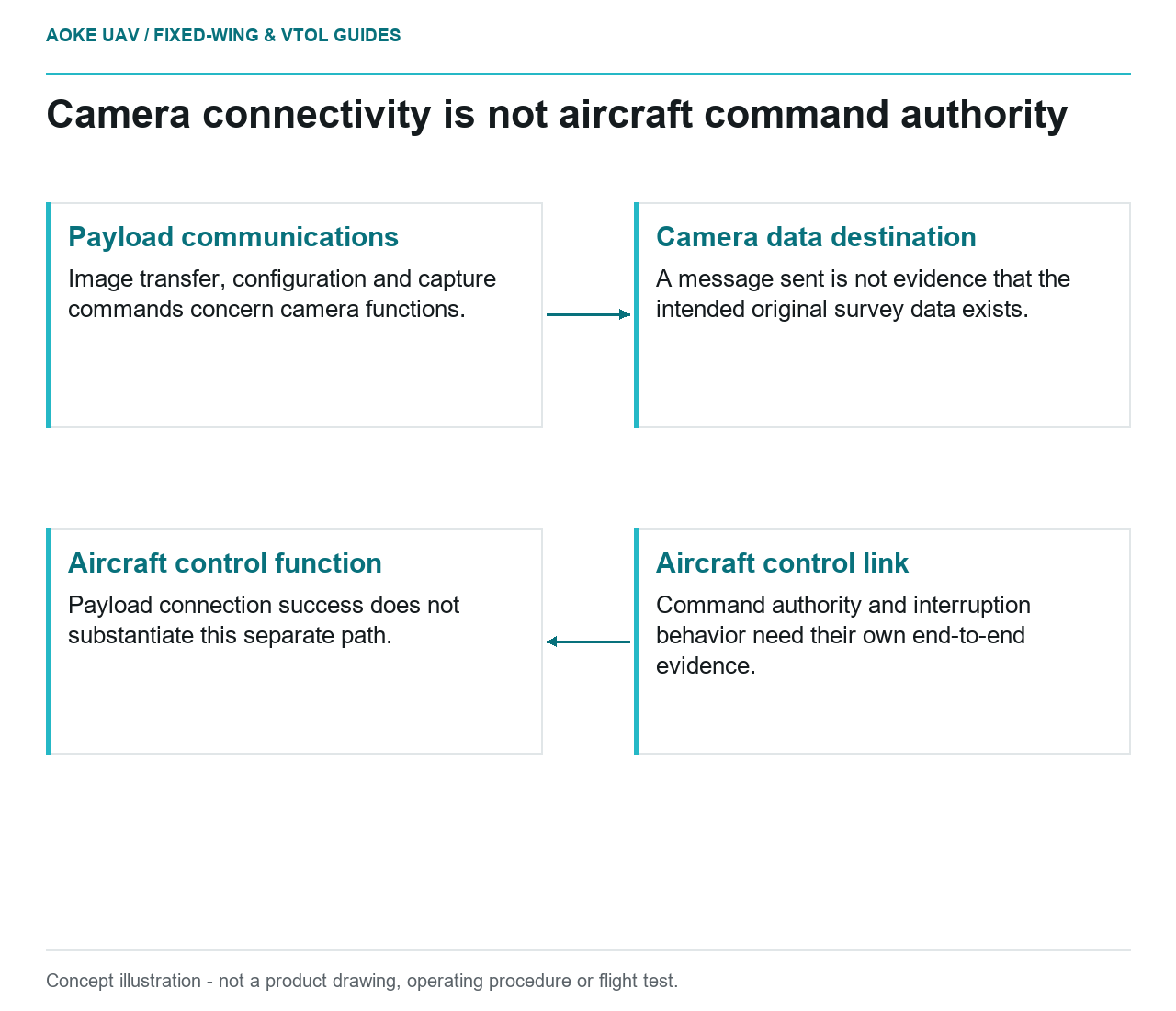
- Payload communications: Image transfer, configuration and capture commands concern camera functions.
- Camera data destination: A message sent is not evidence that the intended original survey data exists.
- Aircraft control link: Command authority and interruption behavior need their own end-to-end evidence.
- Aircraft control function: Payload connection success does not substantiate this separate path.
A hypothetical large fixed-wing environmental survey aircraft has a camera communications interface and a separate aircraft control system. A proposal groups them under the phrase data link and implies that adding payload connectivity resolves aircraft command requirements. That wording hides several different functions. The review should identify what each connection carries, which device can issue which commands and what evidence describes interruptions. This article makes those boundaries explicit without claiming radio range or operational authorization.
Separate data and control functions
Build a connection map that names both endpoints and the intended function of each link. Distinguish image transfer, payload configuration, navigation data, camera commands and aircraft command authority. Some functions may share hardware in a particular design, but that relationship must be documented rather than inferred from a shared connector or protocol name. The map should show the actual architecture, not assume it.
The RedEdge-P and DLS 2 integration guide describes camera interfaces using Ethernet, Wi-Fi and serial communications, including MAVLink and camera capture commands.[1] Those are model-specific payload capabilities. They do not establish the authority or performance of the aircraft control link. Sending a camera command through a documented API should not be described as controlling the fixed-wing aircraft itself.
Bandwidth and interruptions
For each hypothetical fixed-wing connection, request the applicable device and system evidence for its intended traffic and interruption behavior. Identify which traffic is required by the aircraft architecture and which is only part of the payload workflow. Do not substitute a nominal interface speed for the missing end-to-end evidence. This article supplies no bandwidth allocation, guaranteed latency or range figure.
Ask what the design claims when a payload connection becomes unavailable and which document supports that claim. The camera guide establishes interface options, not every aircraft-level consequence of a missing link.[1] A functioning ground display is an observation about one connection state; it should not be promoted into proof that a separate command path or interruption case has been substantiated.
Logging and local storage behavior
Keep the location of original data and the behavior of any transmitted copy explicit. The cited guide identifies the camera’s supplied storage hardware, but that fact alone does not guarantee retention under every power or communications event.[1] Request exact device documentation and configuration-specific evidence for the data workflow the project intends to rely on. Do not call a local storage device a complete backup architecture without that argument.
For the large fixed-wing survey example, the evidence inventory should distinguish aircraft logs, camera records and any ground-system copies. Ask which record demonstrates that the intended survey data exists and which record merely shows that a message was sent. This prevents communications success from becoming a substitute for deliverable completeness. It also keeps a payload-data gap from being mislabeled automatically as a loss of aircraft control.
Architecture and authorization remain separate
A useful handoff assigns ownership to each communications function, records its supporting OEM documents and marks unresolved interruption assumptions. If control-radio performance evidence is absent, leave that item open rather than borrowing range claims from the camera interface. Likewise, do not infer permission for a particular civil operation from an available radio feature. Equipment capability and operational authorization require separate applicable evidence.
The resulting fixed-wing architecture description should be precise enough that a reader can tell which link supports which function and what remains unsubstantiated. No radio configuration, flight procedure or legal assurance is given here. The article’s practical outcome is a function-by-function communications record, with camera connectivity kept within its documented payload scope instead of being used as a blanket claim about aircraft command, range or mission permission.
Related reading
- Storage and Transfer Planning for Survey Payloads
- GNSS Interfaces Between Autopilot and Survey Payload